
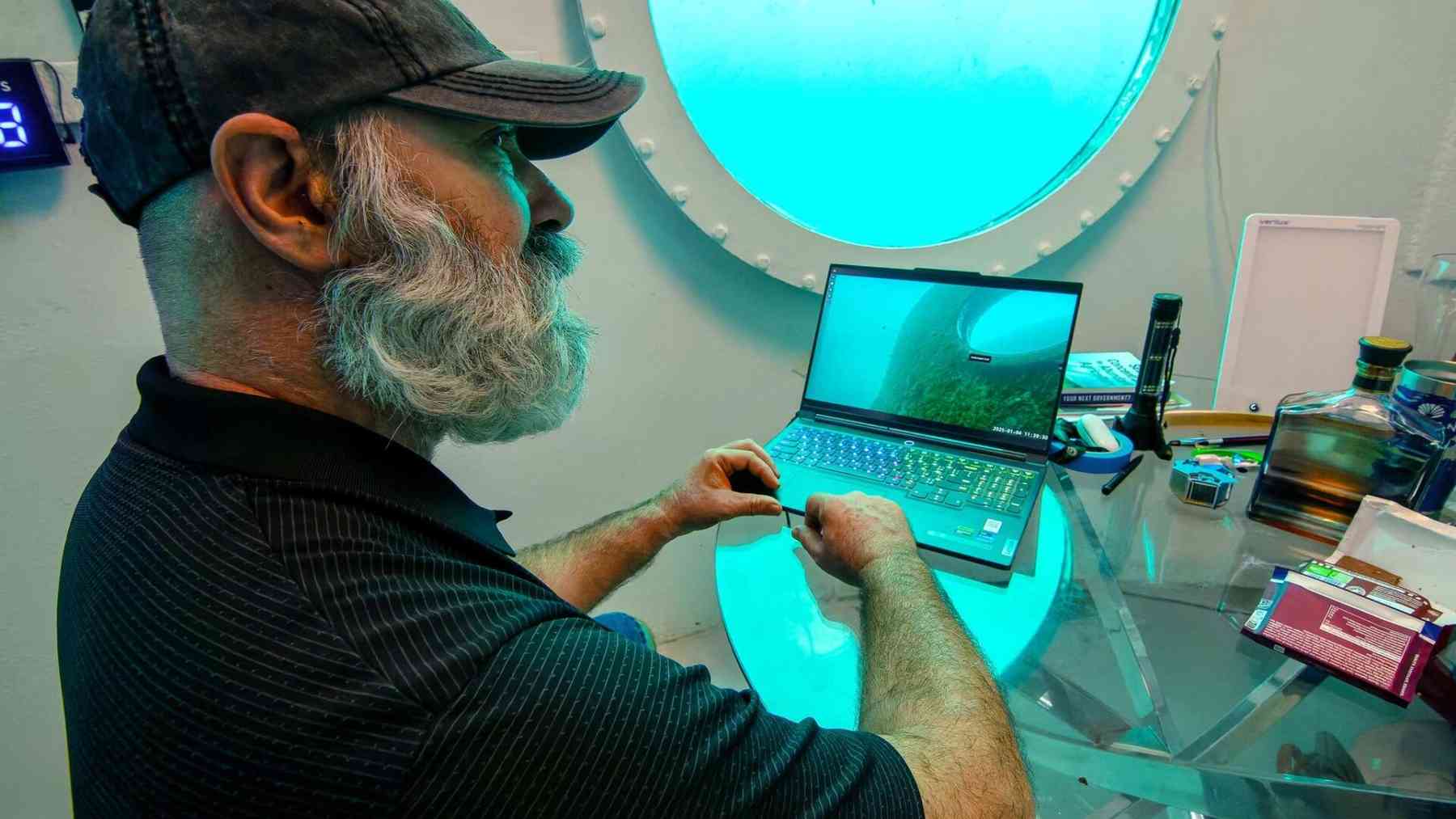
A porthole fogs on the inside while the Caribbean presses on the outside.
Thirty six feet above, waves roll past a man eating breakfast beneath them.
He has a bed, a toilet, an exercise bike and a view of passing fish.
He has not stood in open air for months.
No shower, either.
And the only road home is a staircase inside a tube.
A tube and a staircase kept the room alive
The underwater room did not float free. It hung beneath a structure on the surface, attached by a tube containing a narrow spiral staircase that provided a way down for food and visitors, including a doctor. Solar panels above supplied the electricity.
That slim connection is the ordinary reason a stay like this runs for months rather than days. Supplies, power and company all came down the same shaft. Four cameras filmed his movements, capturing daily life and mental health, and providing proof that he never came up to the surface.
When it ended he went back up the way everything else had come down. He drank a glass of champagne and smoked a cigar before jumping into the Caribbean for his first swim in 120 days, and a boat picked him up and took him ashore for a party.
A 320 square foot room with a 360 degree view
The home under the sea measured 320 square feet, about the size of a small studio apartment. It held a bed, a portable toilet, two televisions, a computer with satellite internet and an exercise bike. Circular windows gave a 360 degree view of the water, and large underwater windows were cleaned weekly to keep the view of marine life unobstructed.
The one facility he said he missed was the ability to take a shower.
He captured more than 1,000 hours of marine life footage through the porthole, and kept a copy of Jules Verne’s Twenty Thousand Leagues Under the Sea in his bedside table, a small nod to the story he was now living out.
So the capsule was less a laboratory than a small, closely watched apartment lowered into the sea.
120 days beat the previous mark by 20
Guinness World Records lists the stay plainly. The longest time spent living in an underwater fixed habitat is 120 days, achieved by Rüdiger Koch, who entered the Ocean Builders SeaPod at a depth of 36 feet off Puerto Lindo, Panama, on 26 September 2024 and left on 24 January 2025.
Verifying it was its own marathon. Adjudicator Susana Reyes said “we needed witnesses who were monitoring and verifying 24/7 for more than 120 days”, and she called the record undoubtedly one of the most extravagant.
Koch sounded reluctant to leave. He told reporters it had been a great adventure, that there was almost a regret now it was over, and that he enjoyed his time there very much.
The pressure version of the record is a Florida one
Here the labels get slippery. News coverage described the Panama stay as the longest time living underwater without depressurisation, one dive outlet reported the judge verifying a record for underwater human habitation at ambient pressure, and the official listing mentions no pressure at all.
The mark it passed is unambiguous. Joseph Dituri spent 100 days in Jules’ Undersea Lodge, 30 feet beneath a Key Largo lagoon. Unlike a submarine, which uses technology to hold its interior near surface pressure, that lodge’s interior is set to match the higher pressure found underwater, about 1.67 atmospheres absolute.
That difference is not cosmetic. Dituri’s prolonged exposure to increased pressure raised the potential for decompression concerns on returning to the surface. It meant a carefully managed decompression protocol and close medical monitoring during the ascent, the kind of staged surfacing a deep diver would recognize from a flooded sinkhole far from any ocean floor.
What four months down there actually showed
Koch is a co founder of Ocean Builders, the company that designed and built the underwater room, and his stated aim was larger than a certificate. He told a visiting reporter the point was to prove the seas are a viable environment for human expansion.
What the stay did not settle is the physiology. The confinement and the prolonged time in an unusual environment were tracked by cameras and by a doctor coming down the stairs, not presented as a medical trial. The questions about what constant pressure does to a body belong to the Florida work rather than the Panamanian one, much as a Texas research unit once tracked a volunteer’s blood volume rather than his mood.
On this evidence, the limiting factor in long term ocean living looks less like human endurance than like patience and plumbing. Air, power, food, a clean window and a reliable way back up the stairs.
Read the whole thing?
Get the week's signal, not the noise
Our sharpest reporting on energy, climate and nature — free, once a week.


