
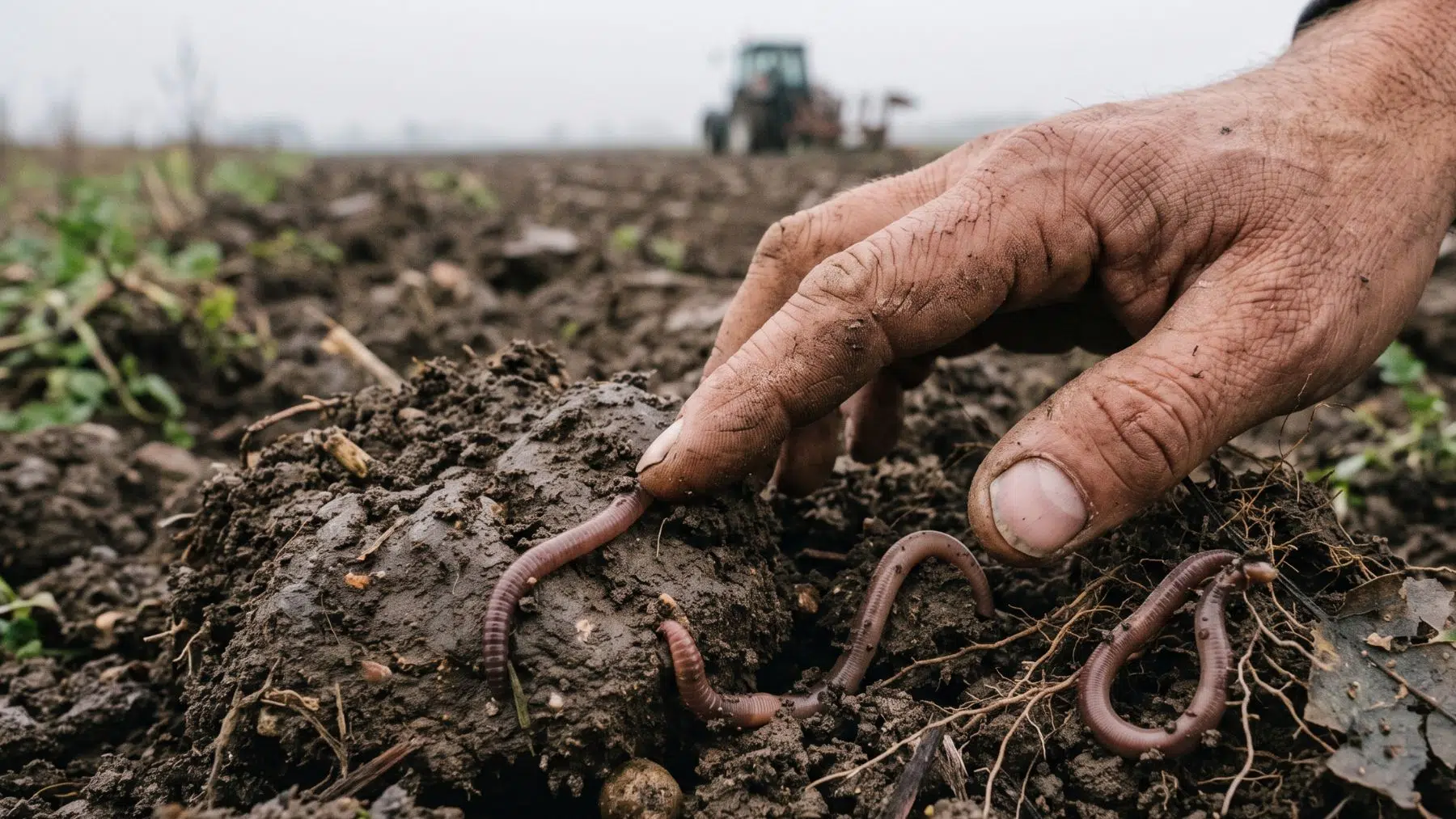
On a farm field on a warm growing day, a sprayer drifts over a patch of weeds.
Nothing dramatic happens at first.
The weeds stay green for days, then slowly yellow and collapse from the roots up.
This is the world’s most used weedkiller, working its way through the whole plant.
Most of it lands on leaves, yet a share still reaches the soil below.
So what does it do to the creatures living down in that dirt?
The test where the young worms vanished
The clearest warning comes from a careful greenhouse study. Austrian researchers filled large pots with real soil and living earthworms, sprayed one dose of a glyphosate weedkiller at label strength, and then watched closely. A second set of pots, left unsprayed, teemed with worms as usual.
The deep burrowing worms nearly shut down. Within three weeks they had almost stopped surfacing to feed, the very job that keeps soil open and mixed. Something in the treated dirt had changed their behavior.
For the soil dwelling species, the blow landed on their offspring. The share of eggs that hatched fell from about 71 percent to 32, a drop of more than half across three months. Fewer eggs hatching means fewer worms in every season that follows.
How a weedkiller reaches a worm
You might expect a plant killer to leave animals alone. But glyphosate does not simply vanish once a weed dies. A good share of it washes off the dying leaves and roots and settles into the top few inches of soil.
That top layer is exactly where earthworms live and feed. They swallow soil and dead plant matter all day long, the habit that keeps the ground rich and loose. So they meet the residues again and again.
So the exposure never really stops.
For a small, soft bodied animal, that contact adds up. Its skin sits right against the treated dirt, hour after hour.
What glyphosate really is, and is not
It helps to be clear about the chemical itself. Glyphosate is the active ingredient in Roundup and dozens of other brands, and it is the most sprayed farm chemical in the country, used across hundreds of millions of pounds a year.
It is also widely misunderstood. Glyphosate kills nearly any green plant it touches, grass included, so it is not a lawn product. Growers use it to strip bare ground before planting, clear stubble, and keep paths and rows open, never to green a lawn, which it would simply brown and kill.
And it is slow, not instant. The plant has to be in active growth, pulling the chemical down into its roots over one to two weeks, so a dose on a dormant early spring field does very little at all. That single mix up, treating it like a selective lawn feed, is where a lot of scare stories go wrong.
Why the finding is not the whole story
The greenhouse result matters, but it needs honest limits. This was a controlled pot experiment, not an open field, and real farmland is messier, with rain, roots and weather that all change how residues behave. Field numbers often vary quite a bit.
So a pot is not a paddock.
Even so, the concern is real and it fits a wider unease about the life underground. Like the hidden base of an offshore wind farm, the damage here works out of sight. The greenhouse study is a first careful look, not the final word.
What is not in doubt is that soil is slow to build and quick to wear out. A field that loses its worms drains worse and gives up the crumbly structure that roots depend on.
Living with a chemical that is hard to replace
None of this makes glyphosate simple to give up. For many growers it is the one tool that clears weeds without endless hand hoeing, and skilled manual labor has grown both scarce and expensive. On a big spread, going back to weeding by hand can mean whole crews with hoes, week after week. Pulling it out overnight is easier said than done.
So the honest path is using less, and only where it truly earns its place. Spraying spot by spot, leaving buffer strips, and rotating in cover crops all ease the pressure below ground, the same way a fox settles back in around some solar panels once the land is left in peace.
It also helps to back research that does not lean on the firms selling a chemical this widely sprayed. The clearer the independent picture, the better anyone can weigh the trade offs, from the worm to the harvest.
Underneath the tidy rows, the worms are still keeping score.
Read the whole thing?
Get the week's signal, not the noise
Our sharpest reporting on energy, climate and nature — free, once a week.


