A crow watches a screen. Dots flicker across it, moving left or right. Within 235 milliseconds — roughly the time it takes to blink — the bird has read the scene, made its choice, and acted on it. Most humans need twice as long to do the same.
That gap is striking enough on its own. What researchers at the University of Tübingen found inside the crow’s brain while it was deciding makes the result harder to explain — and harder to ignore.
A touchscreen test that put crow brains on the clock
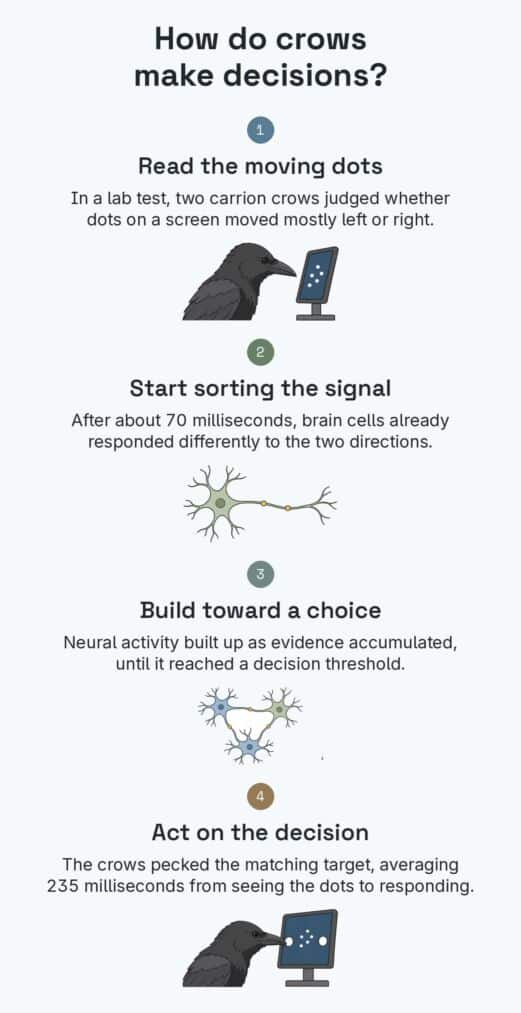
The experiment sounds deceptively simple. Two carrion crows sat before a touchscreen showing a cloud of moving dots. Their job: decide whether most dots were drifting left or right, then peck the matching side. Researchers Philipp Schmidbauer and Professor Andreas Nieder at the University of Tübingen’s Institute of Neurobiology designed the task to mirror classic decision-making tests used with primates — so the results could be compared directly.
The crows averaged 235 milliseconds from stimulus to response. Humans and monkeys typically need around twice that. More impressive still, speed didn’t come at the cost of accuracy. Even when the motion signal was weak or ambiguous, the birds performed better than chance, and when the signal was clear, accuracy climbed to nearly 100 percent. Fast and reliable — not a common combination.
Neurons firing before the bird even moves
To understand what was driving that speed, the researchers recorded activity from individual neurons while the crows worked through the task. The target region was the nidopallium caudolaterale — a structure in the bird brain that functions as a rough equivalent of the mammalian prefrontal cortex, handling complex information processing and decision-making.
What they found was striking. Just 70 milliseconds after the dots appeared — well before any physical peck — neurons linked to each possible direction were already showing distinct activity patterns. The brain hadn’t waited for the body to catch up. It was already sorting the problem, carving the decision space before any movement had begun.
From that early signal, neural activity built gradually rather than spiking all at once, accumulating toward a threshold. The rate of buildup reflected both how clearly the dots indicated a direction and which choice the crow ultimately made. The decision was legible in the neurons before the bird had acted on it.
Same decision logic, completely different brain
Here’s where the finding gets genuinely puzzling. Birds don’t have a cerebral cortex. Unlike mammals, their brains aren’t organized into the layered structure that neuroscientists have long associated with higher cognition — and yet the pattern of neural activity the researchers recorded in the crows looked remarkably familiar.
“These findings show that neuronal dynamics in the avian brain are consistent with established models of decision-making in humans and non-human primates,” said Andreas Nieder. The same gradual accumulation of evidence, the same threshold-crossing moment — just running faster, in a differently wired brain.
This is one of the clearest demonstrations yet that radically different brain architectures can converge on the same fundamental computational strategy. The hardware differs. The logic doesn’t.
Why evolution may have pushed crows to think so fast
The researchers have a hypothesis about where that speed comes from: flight. Birds navigating three-dimensional space at speed need to interpret visual information almost instantly. A crow diving toward a target or threading through branches has no margin for a slow decision loop, and its beak — its primary tool for interacting with the world — demands precise, rapid guidance.
“Birds rely on their vision to carry out precise, rapid maneuvers during flight and to guide their beaks towards objects when foraging,” Nieder explained. Ground-bound primates, by contrast, operate in a world that may simply reward deliberation more than raw speed. Whether the crows’ advantage comes down to synaptic efficiency, neural density, or something else entirely remains an open question.
What this means for our understanding of intelligence
The study, published in Science, adds a significant data point to a growing body of work challenging one of neuroscience’s quieter assumptions: that sophisticated cognition is essentially a cortex story. Crows keep complicating that narrative.
If a bird with a fundamentally different brain structure can not only match primate decision-making logic but execute it twice as fast, then the architecture we’ve long treated as the benchmark for intelligence may be just one solution among many. Evolution doesn’t need a single blueprint.
That’s worth sitting with. The next time you watch a crow — scanning a parking lot, working a latch, reading a situation — consider that its brain may be running through the same basic calculations yours does, just on a faster clock, built from completely different parts.
Read the whole thing?
Get the week's signal, not the noise
Our sharpest reporting on energy, climate and nature — free, once a week.