Rain lands on a green lawn and mostly disappears into it.
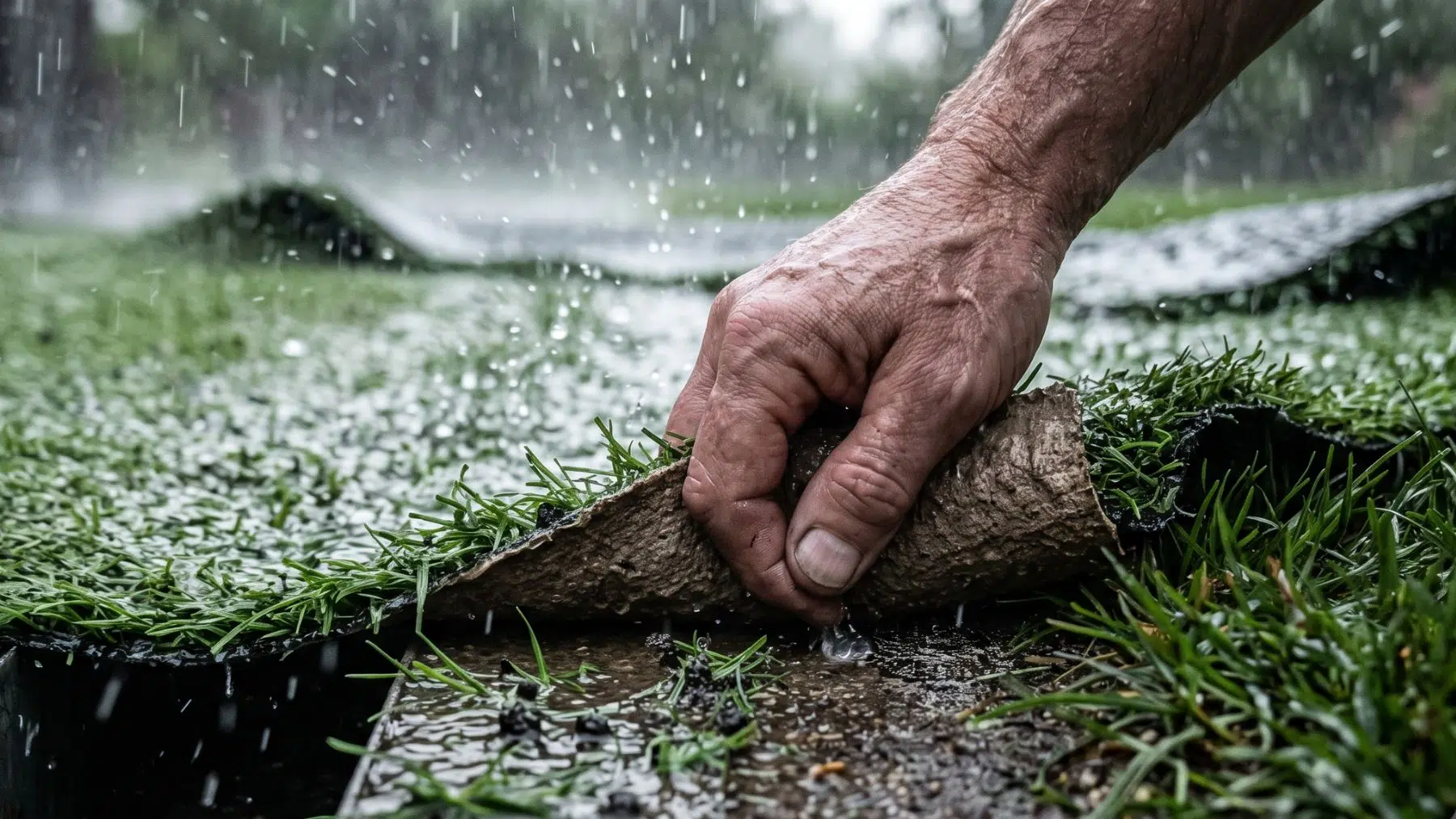
Rain lands on the plastic version and goes sideways.
You can watch it on any patio in a storm, a sheet of water crossing toward the drain instead of sinking.
Two researchers built that storm indoors and measured it properly.
They found what everyone expected about the water.
They also found something small and green moving in it that nobody went looking for.
The water leaves, and it does not leave alone
The experiment set living turf against two kinds of artificial grass, one with short pile and one with long, under repeated controlled downpours. Every treatment produced significantly different runoff, both plastic surfaces produced more than the living control, and living grass held more water and released it far more slowly.
That delay is the property that actually matters.
A lawn is not a surface, it is a slow release sponge. The gap it puts between rainfall and the drain is the entire reason a garden can absorb a cloudburst instead of forwarding it to the street, and it is the first thing you lose when plastic goes over the top.
Then came the part nobody had set out to test. Plastic thatch and loose fibers shed from the installations during the runs and were carried off in the runoff itself, so every simulated storm sent a small piece of the lawn downstream.
How you build a rainstorm on a bench
The setup was deliberately unglamorous. Sections of each surface were laid out, water was applied in three set volumes standing in for short daily rain events, and whatever came out was caught and measured. The largest was about two thirds bigger than the smallest.
Drainage was not treated as a single number.
The team split it into total drainage, the water that came through at once, and the water that turned up late. That last category is the one flood engineers care about, because a surface that passes the same volume but takes an hour longer behaves like a different material in a storm.
Living grass pulled ahead exactly there. It was significantly better at retaining and delaying than either plastic surface, and the two artificial varieties did not even match each other on retention.
The longer pile made it worse
Here is the result that goes against the showroom. The long pile artificial grass produced significantly more runoff than the short pile version, even though a deeper and softer mat looks like it ought to slow water down and hold more of it.
The rest of the picture is messier, and worth saying plainly. Short pile installations generally drained fastest overall, so the two products fail in different ways rather than one being simply worse than the other.
For a buyer that is an awkward trade.
The plusher and more convincing the product looks in the shop, the harder its surface pushed water away in these tests. The authors were careful about how far to take that. “The potential impacts on runoff in particular should be considered when replacing living lawns with their artificial counterparts,” they wrote, and they asked for more experimentation before bench results become a verdict on a street.
Scale it up to an actual garden
A test section is small. A back garden is not, and neither is a suburb where a good share of the front gardens have gone the same way inside a decade. Water that used to soak in has to go somewhere, and in most streets that somewhere is a storm drain sized for a neighborhood of open soil.
The runoff question also sits alongside two things already on the record about these surfaces.
They get startlingly hot, and a plastic lawn can beat the pavement next to it on a warm afternoon. They also change what happens below, where the soil beneath gradually stops behaving like soil at all.
Put all three together and the picture is coherent rather than alarming. The surface holds heat, the ground under it goes still, and the rain that used to feed that ground runs across the top of it and away.
What a gardener can do with this
None of it makes a plastic lawn a catastrophe, and the study never says so. This is one controlled comparison, run indoors on small sections, and the researchers state plainly that field work comes next. The full study record is public if you want the method instead of the headline.
What it does hand you is one design question worth asking before the mat goes down. Where does the water go, and is there anything waiting at the edge, a bed, a gravel strip, a shallow hollow, that is willing to take the overflow.
Governments have begun asking the same thing. A ban on artificial lawns was raised in a Welsh debate, with drainage on the table beside wildlife and plastic.
The finding worth carrying around is simpler than the paper. A lawn you never water is also a lawn that never drinks.
Read the whole thing?
Get the week's signal, not the noise
Our sharpest reporting on energy, climate and nature — free, once a week.