In January 2024, a team of marine scientists boarded the research vessel Falkor (too) and set course for one of the least-explored corners of the Pacific — a chain of volcanic seamounts stretching across 2,900 square kilometers off the coast of Chile. Science had barely touched these underwater mountains.
Leading the expedition was Dr. Javier Sellanes of the Universidad Católica del Norte. As remotely-operated vehicles prepared to descend into the dark, the team had one clear goal: to understand what, exactly, was living down there.
A mission into the deep unknown
The Schmidt Ocean Institute’s research vessel Falkor (too) carried the team into waters that science had largely ignored. Their target: a 2,900-square-kilometer stretch of volcanic seamounts — underwater mountains built up over millennia by geological activity on the ocean floor. No one had systematically studied them, and no one knew what lived there.
To find out, the team deployed remotely-operated vehicles capable of reaching depths of up to 4,500 meters, alongside multibeam sonar and underwater mapping sensors that built detailed pictures of the terrain. The technology gave scientists eyes in a place where sunlight never arrives.
The expedition focused on ten seamounts inside a marine protected area roughly the size of Italy. That legal status mattered. These ecosystems had been shielded from industrial activity, even if science had yet to document what was actually there.
More than 100 species that science had never seen
The results came faster than anyone expected. In under a month, the team from Ocean Conservancy documented more than 100 deep-sea animals previously unknown to science. Dr. Sellanes said the outcome “far exceeded” their expectations — a significant statement from a researcher who’d spent years studying remote marine environments.
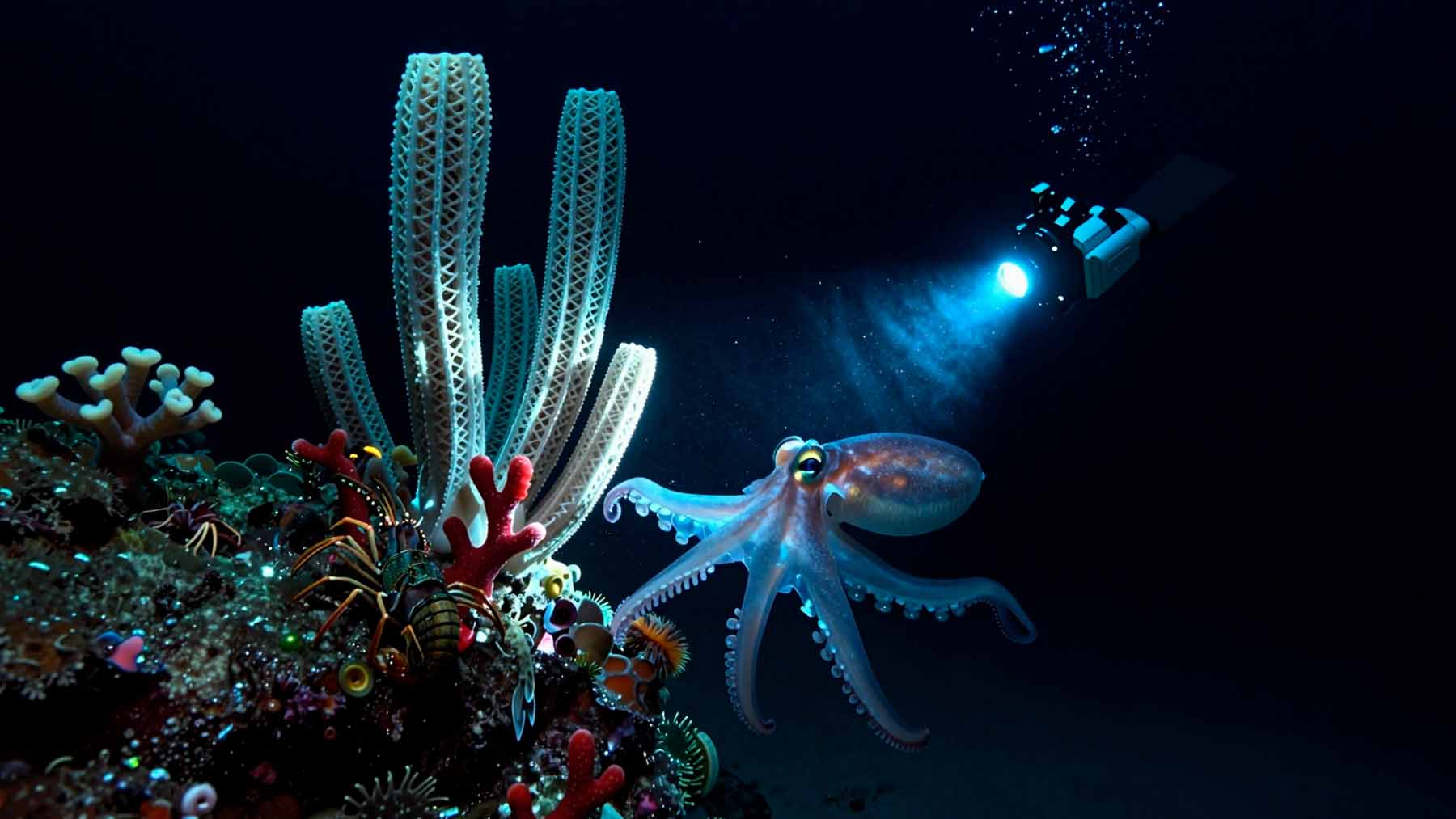
The list of discoveries reads like a catalog of the ocean’s strangest residents. Deep-sea corals, glass sponges, squat lobsters, dumbo octopuses, siphonophores, and jellies all appeared in footage and samples collected during the dives. Each find added a new entry to the scientific record.
Sponges stood out in particular. The variety of new sponge species alone was, in Sellanes’s own words, “mind-blowing” — a striking characterization for a group of animals that’s easy to overlook. They dominated the haul.
The team also made a discovery they hadn’t planned for. During the mapping process, four previously uncharted seamounts appeared in the data — underwater mountains that hadn’t shown up on any existing chart.
Why this corner of the ocean is so extraordinary
Not every stretch of deep ocean produces results like these. What makes this region unusual is a specific combination of environmental conditions that effectively cuts it off from surrounding waters. The area sits near a low-oxygen zone, and a particular mix of ocean currents reinforces that separation — creating a kind of natural barrier that limits the movement of species in and out of the region over long timescales.
The result is extreme endemism. Roughly half of all animal species found here exist nowhere else on Earth — an unusually high proportion suggesting that life in this pocket of the Pacific has evolved along its own path, shaped by conditions found nowhere else.
Volcanic terrain adds another layer to this picture. Ridges, slopes, and rocky outcroppings create varied habitat structures that support highly specialized communities, where different species colonize different niches and diversity compounds from there.
During the expedition, the team mapped more than 52,000 square kilometers of ocean floor. That’s a significant expansion of what’s known about this region, and it sets the stage for research that simply wasn’t possible before.
From samples to science: what comes next
Spotting a new species is only the beginning. Before any of the animals documented during this expedition can be formally added to the scientific record, they need to be identified and classified through rigorous analysis — a process that’s slow and careful, requiring evidence, not just observation.
That work is now underway. Scientists and their partners are using genetics and other analytical methods to work through the samples collected during the dives.
A follow-up expedition is already in progress to continue exploring the same region. That continuity matters, because a single voyage can only cover so much ground. The four newly discovered seamounts alone represent significant territory that still needs to be studied.
The broader implication of this expedition is hard to ignore. If a single month of work in one relatively small area can turn up more than 100 species unknown to science, the deep sea as a whole remains profoundly underexplored — most of it never seen by human eyes, let alone studied.
That gap between what exists and what we know creates real urgency. Climate change is already altering deep-sea temperatures and chemistry. Plastic pollution has been found at extreme depths. Species discovered in January 2024 could face pressure from threats set in motion long before anyone knew those species existed.
The seamounts off Chile offer a glimpse of what the deep ocean holds. Whether science can document and protect these ecosystems before conditions shift is the question that will define the next phase of deep-sea research.
Read the whole thing?
Get the week's signal, not the noise
Our sharpest reporting on energy, climate and nature — free, once a week.