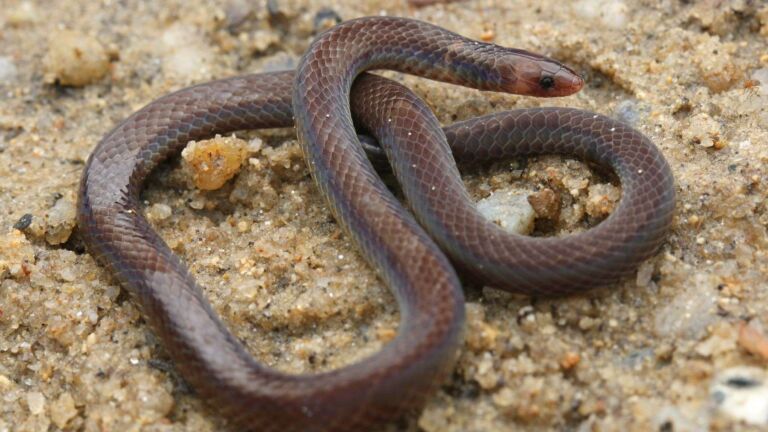
On a misty trail in a mountain village, a scientist stopped at a fence made from split cane. Two dark, bristled legs were poking out through a crack.
He coaxed their owner into the open: a small, fast-moving spider.
It would not sit still to be admired. Instead, it bolted in quick, jerky bursts, moving almost too fast to follow.
Back in the lab, researchers discovered this was a creature no one had ever formally named.
So what could make a spider found hiding in a fence earn a name associated with the devil himself?
Why the spider earns a name like Satan
This is not a slow, heavy ground tarantula that patiently sits for a photograph. It belongs to a family of fast, high-strung tree and crevice spiders, and when it feels cornered, it does not freeze. It explodes into motion. Speed is its main defense.
When cornered, it sprints in erratic bursts almost too quick for the eye and launches defensive strikes at anything that reaches for it. It is the escape reflex of an ambush hunter that would rather bolt than fight, but there is nothing calm about the encounter.
That behavior is what the name records. Attempts to handle the spider became small battles of quick, sporadic attacks and what the researchers described as a plainly bad temperament.
Those details, tucked into an otherwise formal scientific description, helped earn it the devil’s name.
Two legs poking from a bamboo fence
The discovery itself was surprisingly ordinary.
A researcher walking through a village in the western Andean foothills, about 3,000 feet up, noticed two hairy legs sticking out of a bamboo fence and stopped for a closer look.
The rest of the spider was wedged inside.
He carefully worked it free from the crack in the cane and took it back for study. It was a dark, modestly sized tarantula rather than one of the hand-spanning giants people often imagine.
The spider lives tucked into crevices, hollow canes and tree holes, which helps explain why a piece of split bamboo made such a perfect hiding place.
That habit may also explain why it remained unnoticed for so long. A spider that spends much of its life inside cracks and cavities and emerges mainly at night can easily be overlooked for decades, even when it is living in a fence in a populated valley.
How they proved it was new
Suspecting that an animal belongs to a new species and proving it are very different things.
Back at a university laboratory in Quito, the team spent months comparing the spider with museum collections and descriptions in the scientific literature, searching for anything that already matched it.
The proof was in the anatomy.
Careful examination and dissection confirmed that this was not simply an unusual individual from a known species, but a genuinely new one. The researchers formally described it in the journal ZooKeys under the name Psalmopoeus satanas.
The devilish nickname had become its scientific name.
The paper also has a softer twist. Despite the spider’s defensive attacks, the researchers wrote that they had grown very fond of the bad-tempered individual they cared for — the kind of personal admission that rarely makes its way into a formal species description.
Named and threatened in the same paper
The problem is how little habitat the spider appears to have.
It is known only from a small part of the western Andean slopes, where forests have already been broken up by farms, roads, mining claims, and expanding towns, much as a fox can find itself trying to survive around a field newly filled with solar panels.
The place where the spider was found is not protected.
Its type locality has no reserve status, meaning the only site where science currently knows the species to occur could potentially be cleared without anyone accounting for the animal. That concern was placed front and center by the researchers who described it.
Its striking new name may create another problem.
A newly described tarantula, especially one with a devilish reputation, is exactly the kind of animal that can attract attention from the illegal pet trade. In that sense, the publicity that comes with scientific recognition can work against it.
What still hides in the cracks
Perhaps the most remarkable part of the story is where the spider was found.
This was not an expedition into some untouched corner of the wilderness. It was discovered inside a fence in a settled valley — a reminder of how much biodiversity may still be hiding right under people’s feet, on the same unseen scale that can complicate an offshore wind survey.
Here, discovery and loss arrive almost together.
The harder truth is that an animal can be formally named and identified as being at risk in the very same scientific paper. Its habitat may already be shrinking on the day it enters the scientific record, leaving its future uncertain before most people even know it exists.
And it is almost certainly not the last.
More than a thousand tarantula species are already known, and new ones continue to be discovered in surprisingly ordinary places. The next may still be hiding in a crack somewhere, waiting for someone to stop and look a little closer, as one account of the discovery puts it.
Read the whole thing?
Get the week's signal, not the noise
Our sharpest reporting on energy, climate and nature — free, once a week.