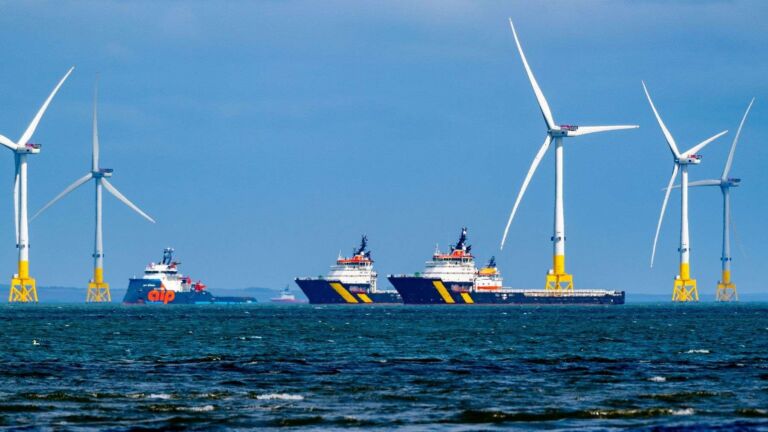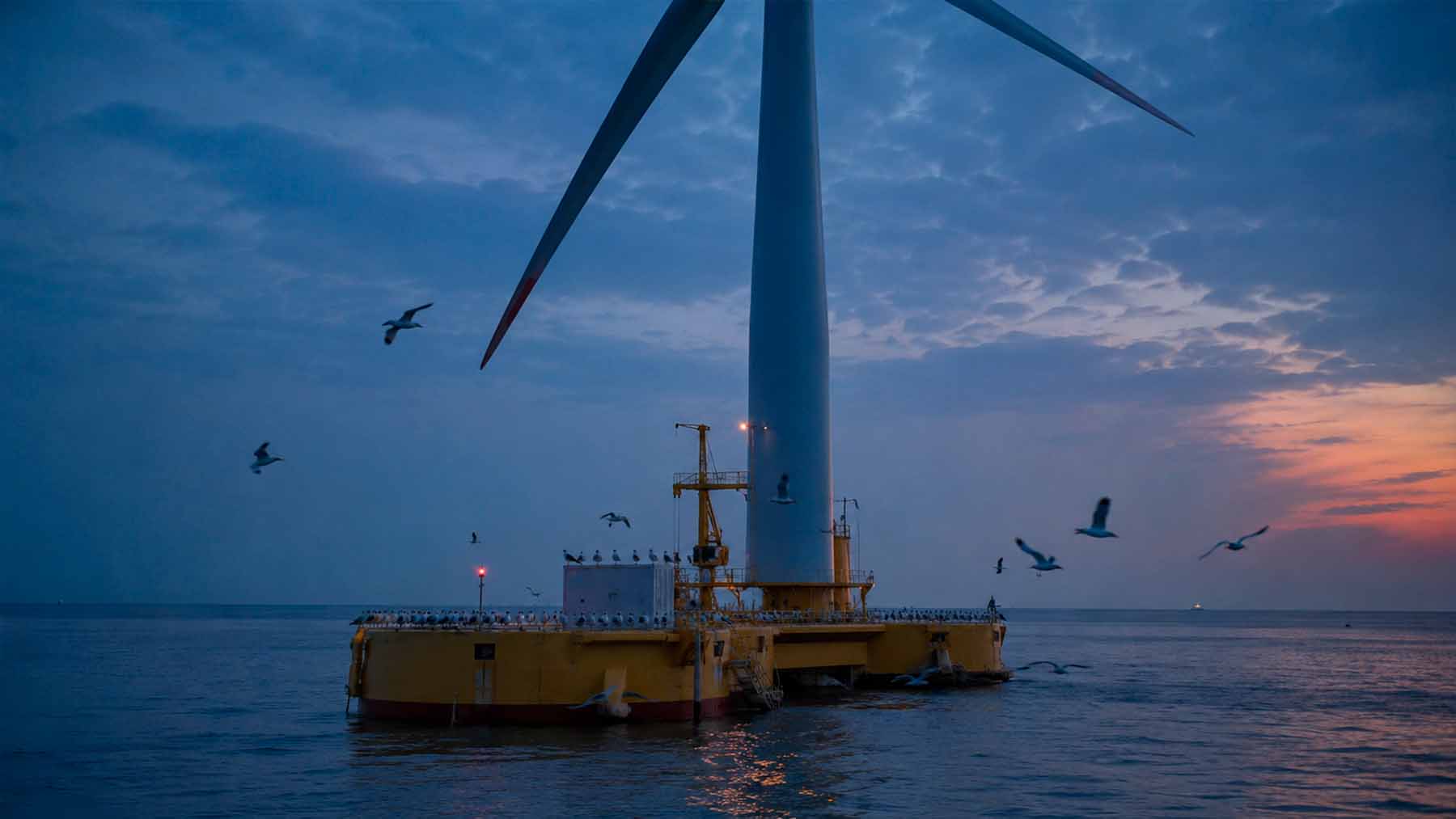
The two-megawatt Floatgen floating wind turbine 12 miles off the coast of France became the site of an insightful marine wildlife study.
Automated cameras were installed around the platform and ended up delivering 30,000 images of interactions with local wildlife. Researchers recorded gulls sitting on the platform like a park bench during the day. At night, the structure became a crowded roosting spot.
What makes the seabirds choose this spot to spend their days at?
How offshore monitoring was carried out at the SEM-REV test site
The monitoring was carried out by PIAFF&CO project at the SEM-REV offshore test site near Le Croisic, France. The multi-partner collaboration was led by Centrale Nantes, involving the Muséum National d’Histoire Naturelle, CNRS, Fondation Open-C, BW Ideol, and the Saint-Nazaire offshore wind farm. Funding was covered by ADEME, the French Ecological Transition Agency.
Rather than looking at the underwater conditions and wildlife, engineers mounted cameras and acoustic monitors directly onto Floatgen’s turbine. The monitoring systems had to be adapted to handle rough conditions on the ocean, the salt spray, and the constant motion of the platform.
It was not all down to the sensors, though. Monitors also checked for animal carcasses on the concrete platform. If any were found, they were handed over to veterinary specialists for investigative necropsies into their cause of death. Fatalities due to turbines and those from natural causes were separated in the records.
Operators need effective tracking tools if they want to correctly evaluate real-world risks to wildlife. This is especially important as the commercial floating wind energy sector expands across the world.
Insight into nighttime activity above the floating platform
It was a big job to analyze 30,000 photo frames, but the insight was valuable. Behavioral patterns became evident in the frequency of bird visitation on the platform. The most common species were gulls, and this was consistent across all the seasons. The concrete turbine base became their main resting station.
In the daytime, the birds would land and take off regularly. At night, the numbers increased as the birds’ activity slowed. Dozens of gulls were recorded roosting overnight, huddled in groups.
In addition to the visual data, acoustic sensors picked up migratory bats flying across the open water at night. The two species identified by their echolocation calls were Nathusius’ pipistrelles and Leisler’s bats miles offshore.
The combination of high-resolution photography and ultrasonic acoustic recording meant that researchers could track avian roosting and bat movements at the same time. It is a valuable baseline for the interaction of flying animals with floating wind energy infrastructure.
What gulls appreciate about the daytime conditions
The camera logs explain why gulls use the Floatgen platform as a daytime bench. Miles offshore, natural resting surfaces do not exist. Gulls use the concrete foundation as a convenient mid-ocean resting spot between active foraging trips, reported by L’Agence de la Transition Écologique.
Pausing on the structure allows birds to rest, digest food, preen feathers, and conserve energy without flying 12 miles back to mainland roosts or remaining continuously airborne over open water. The elevated foundation deck also provides a clear vantage point above rolling ocean swells.
Attraction to turbines means increased exposure
However, this perching behavior introduces potential ecological tradeoffs, according to Fondation Open-C. While the floating base offers a stable resting surface, attracting seabirds to operational turbine sites increases their exposure to moving blades and operational noise.
The PIAFF&CO camera records show that artificial floating platforms create new localized resting points, which could shift distribution patterns around offshore energy installations.
Researchers caution that camera and acoustic observations from a single demonstrator turbine cannot predict impacts across commercial multi-turbine arrays. Further long-term monitoring is required to measure direct collision frequencies and determine whether platform attraction ultimately aids or harms regional seabird populations. Evaluating these multi-sensor methods at the SEM-REV test site provides practical baseline monitoring protocols for future offshore wind environmental impact assessments.
Read the whole thing?
Get the week's signal, not the noise
Our sharpest reporting on energy, climate and nature — free, once a week.