The eleventh was a short par three with a green you could hold from the tee.
Then the golfers stopped coming, and the course shut in the fall and never opened again.
For most of a decade the old front nine sat visible from the road, leased for a while to an outfit running foot golf and fun runs across the abandoned holes.
Eventually the crews arrived.
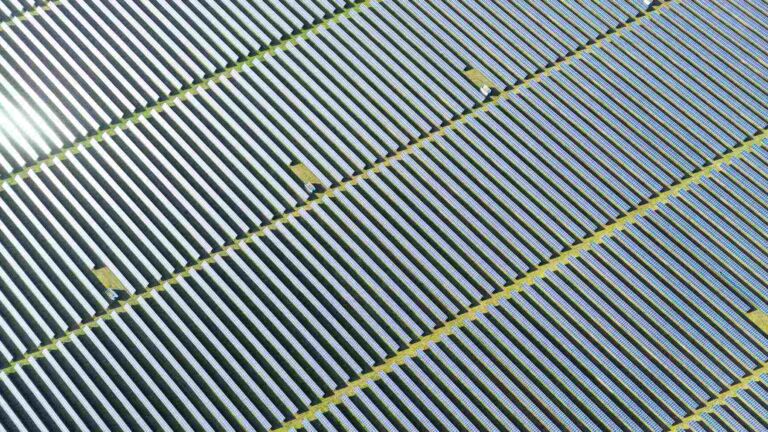
What went over the fairways was rows of panels, and what can live underneath them is the part still being counted.
Why a fairway is a bad place to be an insect
A fairway is engineered to be uniform, and uniformity is the whole problem.
Cut grass often enough and nothing gets to flower.
No flowers means no forage, and the herbicides and fungicides that keep a playing surface clean sit on the list of chemicals researchers point at when they describe intensively managed turf as thin ground for insects.
That is the obvious half.
The half nobody thinks about is where the animals actually live, because most native bees in the Northeast are not hive builders at all.
They dig.
They need bare, undisturbed, well drained soil to sink a nest tunnel into, which happens to be the exact condition a golf course superintendent spends a career eliminating.
A panel row changes the geometry of that land rather than its chemistry, and geometry is most of it.
What is standing on the old course
The array covers two industrially zoned parcels on the west side of the same road.
One is the golf course, 82.5 acres of it, most recently a sports park.
The other is 115.2 acres of largely farmland, which puts the combined footprint at 197.7 acres, and it is worth noticing that the farmland is the larger piece.
The finished plant is rated at 22.9 megawatts.
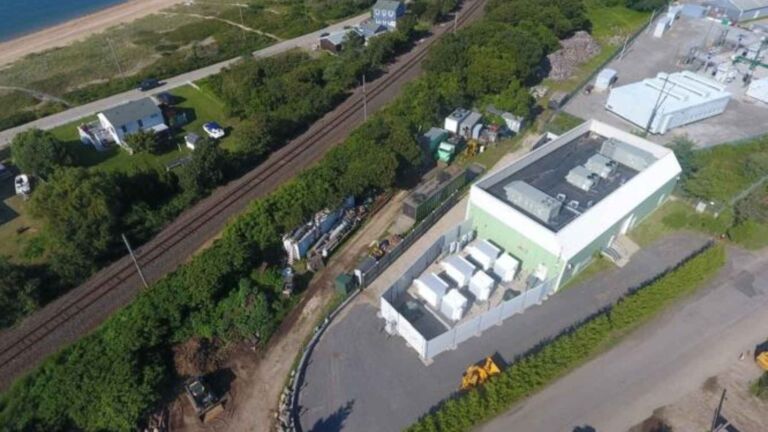
It feeds a substation on the same road and covers something over 4,200 households worth of demand, which for a shut golf course is a reasonable second career.
The strips between the rows are the interesting part.
Nobody mows them to a standard, nobody walks them, and nobody is judging them on how they look, which is three constraints removed at once.
Where the numbers actually come from
Not from this site.
The hard field data comes from two solar facilities in southern Minnesota, both built on retired cropland and both seeded deliberately with native grasses and wildflowers.
Researchers ran 358 observational surveys there, four times a summer, from August 2018 through August 2022.
Total insect abundance tripled across that period.
Native bee numbers rose roughly twentyfold, flowering plant diversity went up, and the team recorded pollinators from inside the fence out working soybean flowers in the field next door.
The work was published in a peer reviewed journal.
Which makes it the strongest evidence anyone has, and also not evidence about a golf course in New York.
The caveats that travel with it
Two of them, and they matter.
The Minnesota land was tired cropland rather than golf turf, and the habitat was planted on purpose at the start rather than left to arrive.
So the finding is a demonstration of what seeding achieves, not proof that native wildflowers turn up on their own once the mowers stop.
Several things can still go wrong after the crews leave.
Construction compaction ruins nesting soil, a single fast growing grass sown purely to hold the surface gives pollinators nothing, and mowing the strips on anything close to a turf rhythm walks the site straight back to where it started.
Timing matters as much as frequency.
Cutting has to dodge the nesting window of ground nesting species, which is a scheduling problem rather than a botanical one, and scheduling problems are the ones that quietly lose.
What has not been answered here
No pollinator survey for this site appears to have been published.
So whether the vegetation between the rows is habitat or erosion control stays an open question rather than a result, and the honest word for the headline claim is hypothesis.
The panels do change conditions underneath them.
Measurements at an agrivoltaic farm in Colorado found the shade taking up to 10 degrees off the temperature below, which moderates soil heat and slows moisture loss in a way seedlings notice.
Then there is the lease horizon.
These agreements run for decades, and whether anything established under the panels outlives the plant depends on who carries the restoration obligation at the end, a question rarely settled before the first post goes in the ground.
Which is the real point about this parcel.
Disturbed industrial land is exactly where critics of farmland conversion have always said solar belongs, and what grows between the rows will be decided by a seed mix and a mowing calendar rather than by the panels.
The federal study has the counts. The local reporting has the site.
Read the whole thing?
Get the week's signal, not the noise
Our sharpest reporting on energy, climate and nature — free, once a week.