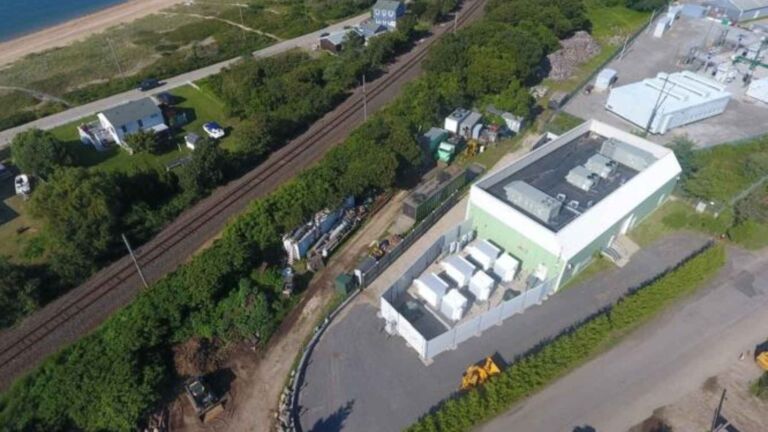
A small outbuilding stands about 164 feet from a house, and inside it the walls are cells.
Thousands of them, upright in plastic holders, combed together with nickel strip and thin colored wire.
Every single one was thrown out by somebody.
They came out of dead laptops, the kind replaced because the battery stopped holding a charge.
That is the part worth sitting with. The cells were declared finished years ago, and they have been running a house ever since.
Why the same cell dies in a laptop and lives in a shed
A laptop is a brutal place to be a battery. It charges fast because nobody waits, it discharges hard into a processor and a fan and a screen at once, and it does that inside a warm plastic case with a handful of cells sharing the work.
Heat and hard cycling are precisely what age lithium. Do both at once, in a confined space, and three years is a good run.
Now move that identical cell into a cool shed and change nothing but the job.
Solar fills it slowly across a whole day and the house draws it back down gently across a whole night.
Because thousands of cells sit in parallel, the current one laptop pushed through six of them is spread across a crowd, so nothing gets warm.
The cell was never worn out. It had been badly employed, which is a different problem with a different fix.
What is actually sitting in the racks
The cells are the 18650 format, the cylinder tucked inside most laptop packs of the past twenty years.
Each is seven tenths of an inch across and two and a half inches tall, which is why a house needs so many.
Getting them usable was the tedious part. Every pack was opened and every cell tested on its own, because a pack is only as honest as its worst member.
The weak ones went in the bin. The survivors were sorted by capacity and grouped into 100 amp hour blocks, which is what now lines the racks.
That step was learned the hard way. The early months were a mess of mixed age cells, some draining far faster than their neighbors and dragging blocks down with them.
The shed holds the batteries, the controller and the inverter, and the power walks the 164 feet to the house as direct current before becoming ordinary household supply.
What nine years of numbers look like
The build has been documented publicly since late 2016, which is what makes it unusual. Most amateur projects vanish after the first proud photo.
It started small. About 1.4 kilowatts of panels, a 24 volt forklift battery rated at 460 amp hours, a solar charge controller and a 3 kilovolt ampere inverter, for something near 2,700 dollars all in.
It did not stay small. The roof now carries 24 panels at 440 watts each, close to 10 kilowatts of generation, and the storage bank has grown from about 7 kilowatt hours to roughly 56.
The collection grew alongside it. Reports put the total gathered at more than a thousand laptop packs, against the roughly 650 he had in hand when he started.
Across all of it, no cell failure has been reported. No fire, no swollen cell, no replacement.
Where this stops being a good idea
The caveats are large, and the community around these builds says so itself.
Fusing hundreds of recycled lithium cells together is genuinely dangerous and will start a fire if done badly.
A damaged or overcharged cell can go into thermal runaway, which is why management electronics and distance from the house are safety features rather than conveniences.
Most of the people doing this, including the best known names, have no formal electrical training at all.
Supply is also tighter than it looks. New cells of this type run over five dollars each, and the hobby became popular enough that it bid up the price of the used ones.
Cells out of cheap machines, or packs left flat for years, can fail soon after passing a first capacity test.
And when they finally do die, they join everything else nobody has a clean answer for, like the retired panels that spend eighteen hours in weak acid to find out whether they count as hazardous waste.
What it proves and what it does not
The idea scales past salvaged laptop batteries.
An electric car pack that can no longer be trusted for range still holds a great deal of capacity, and a shed does not care what anything weighs, which is the argument behind reused car batteries running whole houses.
What a build like this contributes is real hours. Laboratory testing compresses a decade into weeks by cycling cells hard, which is exactly the treatment this system was designed to avoid.
So the open question is the interesting one. Nobody knows whether gentle handling genuinely stretches a lithium cell or merely postpones the collapse.
Year ten will say more than year nine did.
Read the whole thing?
Get the week's signal, not the noise
Our sharpest reporting on energy, climate and nature — free, once a week.