

The Northwestern University engineers have developed an innovative new wearable platform.
Eyeglasses are another common item that millions of people use every day. They can now also collect small amounts of energy (mechanical) from normal facial movements such as chewing or blinking.
This was engineered at Northwestern’s McCormick School of Engineering, where the team named this new system GlassTENG.
Data shows that people experience thousands of different micro-expressions every hour due to involuntary muscle contractions.
As a result of these natural forces, Northwestern engineers used three flexible sensors that were embedded around standard eyeglass frames to harness this biological movement.
Three paper-thin sensors capture static electricity from the face
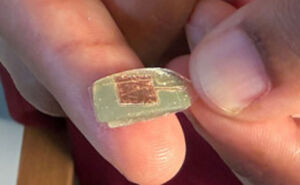
Each sensor is made using the triboelectric effect.
This produces static electricity whenever two different materials rub together and then pull apart.
Frictional contact that occurs at these sub-micron layers is responsible for continuous electron movement across the physical surface.
This creates a temporary electrical voltage.
A simple example of this would be rubbing your hair with a balloon. That’s exactly what Northwestern engineers created with their flexible sensors.
There is a sensor on the top part of the frame above the nasal ridge. There is another sensor next to the temple area. Lastly, there is a sensor close to the ear.
Each sensor detects mechanical pressure from the facial muscles moving differently depending upon the location of the sensor.
Turning micro-voltages into health data
When a person blinks, one sensor located above the nasal ridge receives some degree of pressure. At the same time, the second sensor located near the temple receives some degree of pressure from the jaw shifting slightly. The third sensor receives additional degrees of pressure from the ear.
Therefore, when a person moves their facial muscles enough to trigger one of these sensors, it generates its own operational voltage.
In essence, the physical action that is being monitored provides the mechanical force that is required to monitor itself. To achieve this, Northwestern engineers positioned the array across primary skeletal contact points.
This allowed them to measure multiple directions of force from different facial muscles simultaneously.
Mapping biomechanical forces into voltage signatures
The mechanical forces associated with the pulsing arteries produce lightweight electrical signals. These range from 50 to 100 millivolts.
Blinking and raising eyebrows produce medium-strength electrical signals. These range from 200 to 500 millivolts.
Stronger mechanical actions like chewing, talking, or clenching the teeth produce strong electrical signals. These reach up to 1.5 volts.
Since each type of activity has a distinct signature based on the electrical signal that it produces, the facial activity can be identified computationally based on those signatures.
While testing the system, twenty subjects were asked to perform six specific tasks.
The study assessed both low-force twitch contractions as well as high-force masticatory movements.
Northwestern University researchers used machine learning techniques to identify and classify the patterns in the electrical signals produced by each task.
Seamless continuous wellness monitoring without bulky batteries
Complex pattern recognition models demonstrated successful correlations between raw millivolt variation and specific physiological activity in real time.
The self-powered glasses had an impressive average accuracy rate of 93.8% for all tested activities.
The accuracy rates were even higher for certain tasks. Teeth tapping was recognized correctly 99% of the time, and jaw clenching 96% of the time.
Conventional health tracking devices require bulky batteries that compromise comfort and prevent true daily wearability.
The GlassTENG system uses approximately 4.1 microwatts across the three sensing front ends, demonstrating extremely low power requirements for signal detection.
That microscopic power footprint highlights the potential for lightweight wearable designs that could support extended use.
Unlocking natural biological forces could enable future battery-free wellness monitoring.
Read the whole thing?
Get the week's signal, not the noise
Our sharpest reporting on energy, climate and nature — free, once a week.


