

Hidden behind the dense curtain of the Milky Way, a colossal structure glows in radio waves — and it looks almost exactly like a musical treble clef. Astronomers had long known the formation was there, but explaining it proved stubbornly difficult: the galaxy’s own stars, gas, and dust kept blocking the view.
When researchers finally managed to peer through that veil, what they found wasn’t a simple, single event. The Treble Clef turned out to be the product of two of the most powerful phenomena the cosmos can generate — acting in sequence, hundreds of millions of years apart.
A shape hiding in plain sight — behind the Milky Way
The Treble Clef sits almost directly behind the plane of the Milky Way — one of the worst possible positions for Earth-based observation. Our galaxy’s own stars, gas, and dust act like a thick curtain, absorbing visible light and making traditional optical telescopes essentially useless for studying the structure.
The solution was to look in wavelengths that cut through that curtain. Researchers combined data from two X-ray observatories — NASA’s Chandra and the German eROSITA — with the LOw Frequency ARray (LOFAR), a large network of European radio telescopes. Together, these instruments finally brought the formation into focus.
The “treble clef” name is purely a matter of pareidolia — the deeply human habit of spotting familiar shapes in random data. No scientific connection to music exists. The label just stuck because the resemblance is genuinely striking.
Two colliding giants: what Chandra found inside the formation
When Chandra and eROSITA scanned the region, they detected diffuse, multimillion-degree hot gas surrounding the Treble Clef. That kind of superheated gas is a reliable fingerprint: it confirmed that a galaxy cluster — one of the universe’s largest structures — hosts the formation.
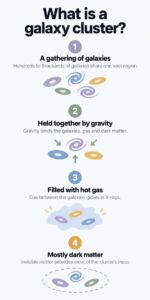
Galaxy clusters are staggering in scale, each containing hundreds of individual galaxies bound together by gravity and embedded in vast reservoirs of superheated gas. What researchers found here, though, was something more dramatic than a typical cluster. Further analysis revealed two separate galaxy clusters in the process of merging, and cluster mergers rank among the most energetic events the universe produces. The collision is estimated to have occurred a few hundred million years ago, with the clusters now gradually moving apart.
A two-stage cosmic crescendo: black hole outburst, then cluster crash
The Treble Clef didn’t form in a single event. Researchers concluded it was built in two distinct stages, separated by an enormous stretch of time.
Stage one began with a supermassive black hole at the cluster’s center, which drove enormous clouds of charged particles and magnetic fields outward at close to the speed of light. That outburst produced bright radio waves — a burst of cosmic energy that eventually began to fade as the particles lost energy over millions of years.
Then came stage two. When the two galaxy clusters collided, the impact compressed and reenergized that aging particle cloud. Radio emission brightened again, and the collision sculpted the cloud into its distinctive shape. Shock waves from the merger — comparable in principle to the sonic booms produced by supersonic jets — likely contributed to that reenergizing process.
The technique that cracked the case
Spotting the collision signature in Chandra’s data required more than a straightforward image. The research team modeled the hot gas’s natural shape, which approximates a symmetrical oval, then mathematically subtracted it from the original X-ray image.
What remained in the residual image was telling. X-ray emission appeared brightest toward the left and right of the cluster’s center, faintest in the middle. That asymmetry pointed directly to a collision running along the left-right axis — exactly the kind of signature a head-on merger leaves behind.
The final composite image layers multiple data sources: original and residual Chandra X-ray data appear in blue, LOFAR radio data in red, and infrared data from the UK Infrared Telescope in white. Scientifically precise and visually arresting at once.
The paper was led by Andrea Botteon of Italy’s National Institute for Astrophysics (INAF) and published in Astronomy & Astrophysics. It’s a reminder that some of the universe’s most complex histories are written in light we can’t see with our own eyes — and that reading them demands patience, the right instruments, and a willingness to look past the obvious. The Treble Clef spent hundreds of millions of years taking shape. Decoding it took us considerably less time, but only once we finally knew where — and how — to look.
Read the whole thing?
Get the week's signal, not the noise
Our sharpest reporting on energy, climate and nature — free, once a week.


