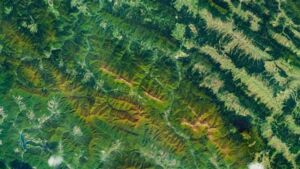
On October 8, 2026, as brown bears prowled the Carpathian Mountains fattening up before winter, a NASA satellite passed over southeast Poland and recorded something vivid: hillsides ablaze in reds and golds. The Landsat 9 spacecraft captured the moment in sharp detail, revealing the full sweep of seasonal change across Bieszczady National Park — one of Europe’s most ecologically significant mountain landscapes.
The image is striking on its own. But the colors it shows are the product of a story far older than any single autumn.
A satellite’s view of autumn in the Carpathians
Landsat 9’s OLI — Operational Land Imager — is the instrument that made this image possible. It detects reflected light across multiple wavelengths, giving scientists and observers a precise, repeatable record of how land surfaces change over time. That consistency is what makes satellite imagery so valuable for tracking seasonal shifts: the same instrument, the same orbit, year after year, building a visual archive of Earth in motion.
What the OLI captured on October 8 was a landscape mid-transformation. The forested hillsides of Bieszczady National Park, in the far southeast corner of Poland, glowed in deep reds and warm golds. Above them, the subalpine meadows along the ridge tops appeared in a muted tan — summer green already gone, grasses and shrubs faded into the palette of late autumn. The contrast between the two zones is sharp and immediate, even from orbit.
Why leaves turn: the science of autumn color
The colors aren’t random, and they aren’t a sign that something is wrong. They follow a predictable biological schedule triggered by two environmental cues: dropping temperatures and shorter days.
As both conditions set in, trees begin curtailing chlorophyll production — the molecule responsible for photosynthesis and for the green we associate with living leaves. As chlorophyll breaks down, it stops masking the other pigments already present in the leaf tissue. Yellows and reds emerge not because they’re newly made, but because the green that hid them is gone.
In Bieszczady, two species drive most of the visual drama. European beech (Fagus sylvatica) dominates the forests, producing warm copper and russet tones that define the hillsides in the image. Sycamore maple (Acer pseudoplatanus) contributes its own range of yellows and golds. Together, they create an effect that, from space, looks almost like combustion.
Ice-age survivors: the deep history of European beech forests
The beech trees now turning color in Bieszczady are descendants of a much older story. During the last ice age, beech populations survived in isolated refugia — pockets of suitable habitat in the Carpathians, the Alps, and other mountain ranges where glaciers didn’t reach. When the ice retreated, beech spread northward across the continent, reforesting land locked under ice for millennia.
That history gives these forests a particular ecological weight. They aren’t simply old — they’re connected to a lineage of survival and adaptation stretching back thousands of years. Portions of Bieszczady National Park are recognized within UNESCO’s network of Ancient and Primeval Beech Forests, a designation spanning 18 countries that identifies forests retaining their original character, largely undisturbed by human management.
Above the treeline: the polonina and what lives there
Beech forests in this part of the Carpathians climb only so far. At roughly 1,000 to 1,260 meters elevation, the trees give way to something different: the polonina. The word is Slavic, referring to the subalpine meadows that cap the ridges — open grasslands mixed with shrubby thickets of rowan, willows, and green alder.
In the satellite image, the polonina zones appear tan, their summer growth long faded. Research on these meadows — including a 2022 study published in Scientific Reports by Mitka and colleagues — has examined how subalpine woody vegetation changes after the release of agropastoral pressure, as traditional grazing declines and shrubs reclaim open ground. Forest below, meadow above: the distinct elevation zones create a layered ecological structure readable from space, each band reflecting different biology and different responses to the same autumn cues.
Brown bears, bison, and lynx: Bieszczady’s wildlife comeback
While the satellite recorded colors, the animals below were following their own seasonal rhythms. Brown bears were moving through the forest, eating heavily before winter. Eurasian lynx, quieter and less visible, were hunting in the same woodland cover that shelters them year-round.
The European bison adds another dimension to the park’s story. Once extinct in the wild, bison were reintroduced to Bieszczady in the 1960s. Recent surveys count them in the hundreds — a herd moving through the same hills captured in the image, their breath visible in the October air, hooves pressing into ground that beech roots have held for centuries.
On a ridge above the treeline, the polonina stretches pale and windswept under an autumn sky. Below it, the forest burns gold and red. Somewhere between the two, a bear moves through the understory, unhurried, following a schedule older than any map.
Read the whole thing?
Get the week's signal, not the noise
Our sharpest reporting on energy, climate and nature — free, once a week.