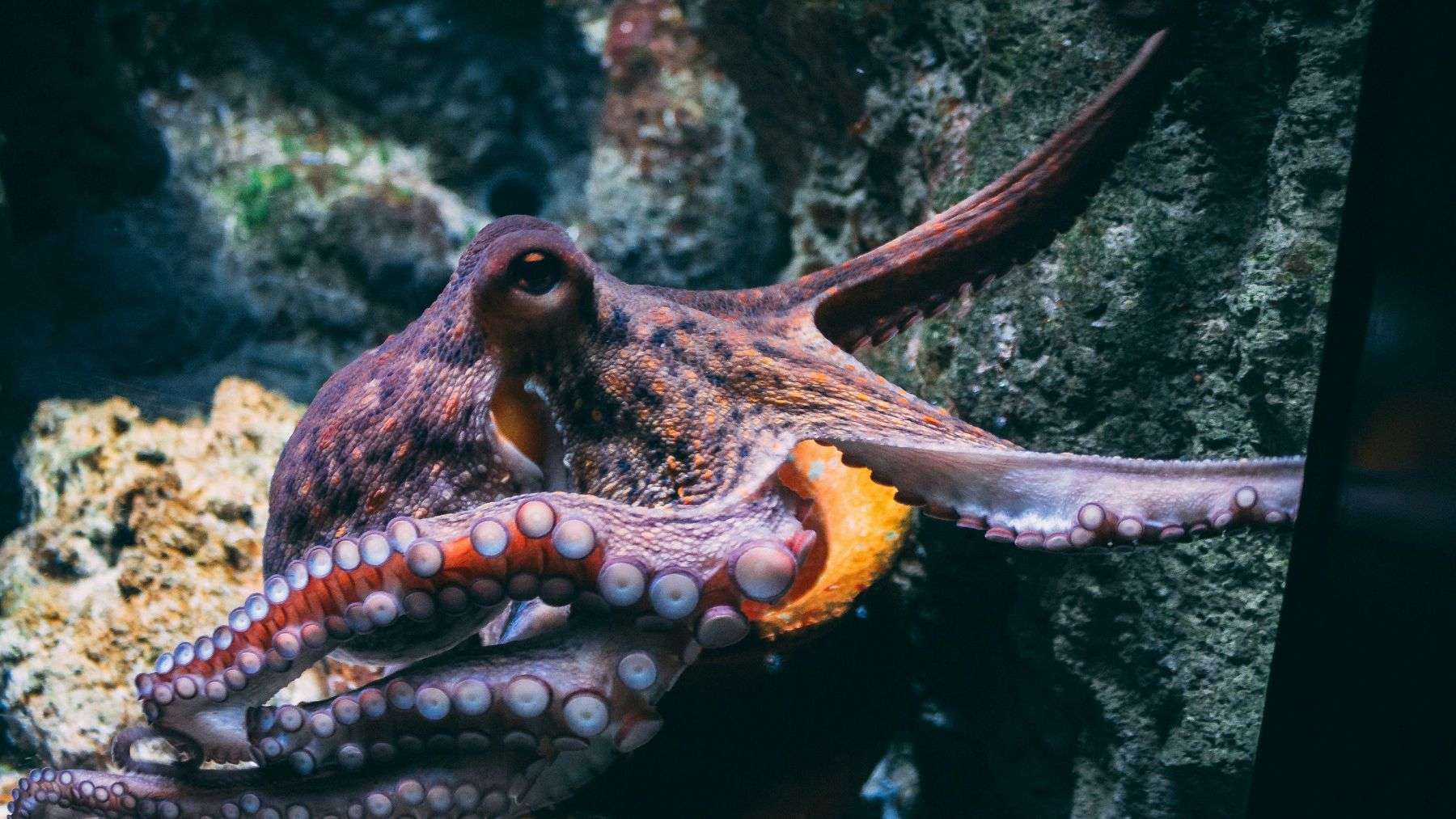
An octopus can unscrew a jar, navigate a maze, and camouflage itself in under a second. A cuttlefish can hypnotize prey with rippling waves of color and light. For decades, scientists have puzzled over how animals so distantly related to vertebrates — creatures closer to clams than to any backboned animal — could evolve such remarkable mental abilities.
A new study from the University of Vienna suggests the answer may not lie in which genes cephalopods carry, but in how their DNA is physically folded inside every cell.
A brain built differently — and a mystery that has puzzled scientists
Octopuses, squid, and cuttlefish — collectively called coleoid cephalopods — possess the most complex nervous systems of any invertebrate on Earth. They solve problems, use tools, and change their skin’s color and texture in milliseconds. These are feats we typically associate with vertebrates: birds, mammals, primates.
Cephalopods and vertebrates parted ways hundreds of millions of years ago. Their shared ancestor was likely a simple, slow-moving creature, which makes their convergent intelligence one of biology’s most stubborn puzzles.
Previous research tried to crack that puzzle by hunting for special genes. The new University of Vienna study, published in Nature Communications, takes a different approach entirely — looking not at the genetic code itself, but at the physical shape of the genome.
DNA isn’t just a sequence — it’s a folded, living structure
Most of us picture DNA as a long, twisted ladder. Inside a living cell, though, that ladder doesn’t stretch out in a straight line. It folds into a dense, intricate three-dimensional structure, coiling and looping so that sections far apart along the sequence can end up sitting right next to each other.
Those physical contacts matter enormously. When two distant regions of DNA are brought close together, they can influence each other — switching genes on or off, amplifying or silencing their activity — without changing a single letter of the genetic code. The shape of the genome, in other words, is itself a kind of information.
“The genome isn’t just a sequence of genes. It’s folded into a complex three-dimensional structure,” said lead author Dr. Thea Rogers. “Understanding how that structure evolves is becoming increasingly important for understanding how new forms of biological complexity arise.”
An ancient reshuffling that rewired genetic communication
To investigate, the research team reconstructed the 3D genome organization of octopuses, squid, and cuttlefish, then mapped those structures against patterns of gene activity. The evidence points to a massive genome reorganization that occurred hundreds of millions of years ago — an upheaval in which large chromosomal sections were rearranged, bringing previously separated regions into direct physical contact for the first time.
Those new contacts changed what the genome could do. Once neighboring regions could “talk” to each other, they began influencing each other’s activity, gradually building more elaborate regulatory networks. The researchers describe this process as “regulatory entanglement”: connections that, over time, become so interwoven they’re difficult to unravel. New connections form among existing genetic elements, enabling fresh patterns of activity while preserving the essential functions an organism needs to survive.
Stable scaffolds and flexible loops: two very different responses to evolution
Not all genomic structures behave the same way under evolutionary pressure — and that contrast turned out to be one of the study’s most revealing findings.
Large structural regions called chromatin domains stayed remarkably stable across evolutionary time. These broad organizational scaffolds appear to be strongly conserved, suggesting that some features of genome architecture are simply too fundamental to tinker with.
Chromatin loops told a different story. These smaller structures form when distant DNA sections are physically pulled together in 3D space, and unlike the stable domains, they varied considerably — between cephalopod species, between tissue types, across stages of development. Many of the most variable loops appeared near genes linked to nervous system development. That pattern suggests flexible genomic structures may be a key mechanism through which major genetic reshufflings generate new traits.
What this means for how we understand the evolution of intelligence
The findings don’t prove that these DNA changes directly caused cephalopod intelligence. The researchers are careful about that. But they do reveal a plausible, previously overlooked mechanism.
Genome architecture, this study suggests, isn’t just a passive reflection of evolution — it may actively shape which evolutionary paths are even possible. By rewiring which genes can communicate, a large-scale rearrangement could open up entirely new biological possibilities.
We tend to think of an organism’s potential as being written in its genes — in which instructions it carries. But the arrangement of those instructions may matter just as much. An octopus and a human may share more of the same genetic toolkit than you’d expect. What differs, at least in part, may be how that toolkit is folded, connected, and wired together inside each cell. Intelligence, it turns out, might be as much about architecture as about ingredients.
More information is available here: Thea F. Rogers, Jessica Stock, Natalie Grace Schulz, Gözde Yalçin, Simone Rencken, Anton Weissenbacher, Tereza Clarence, Darrin T. Schultz, Clifton W. Ragsdale, Caroline B. Albertin, Oleg Simakov. Genome reorganisation and expansion shape 3D genome architecture and define a distinct regulatory landscape in coleoid cephalopods. Nature Communications, 2026; 17 (1) DOI: 10.1038/s41467-026-77625-7
Read the whole thing?
Get the week's signal, not the noise
Our sharpest reporting on energy, climate and nature — free, once a week.