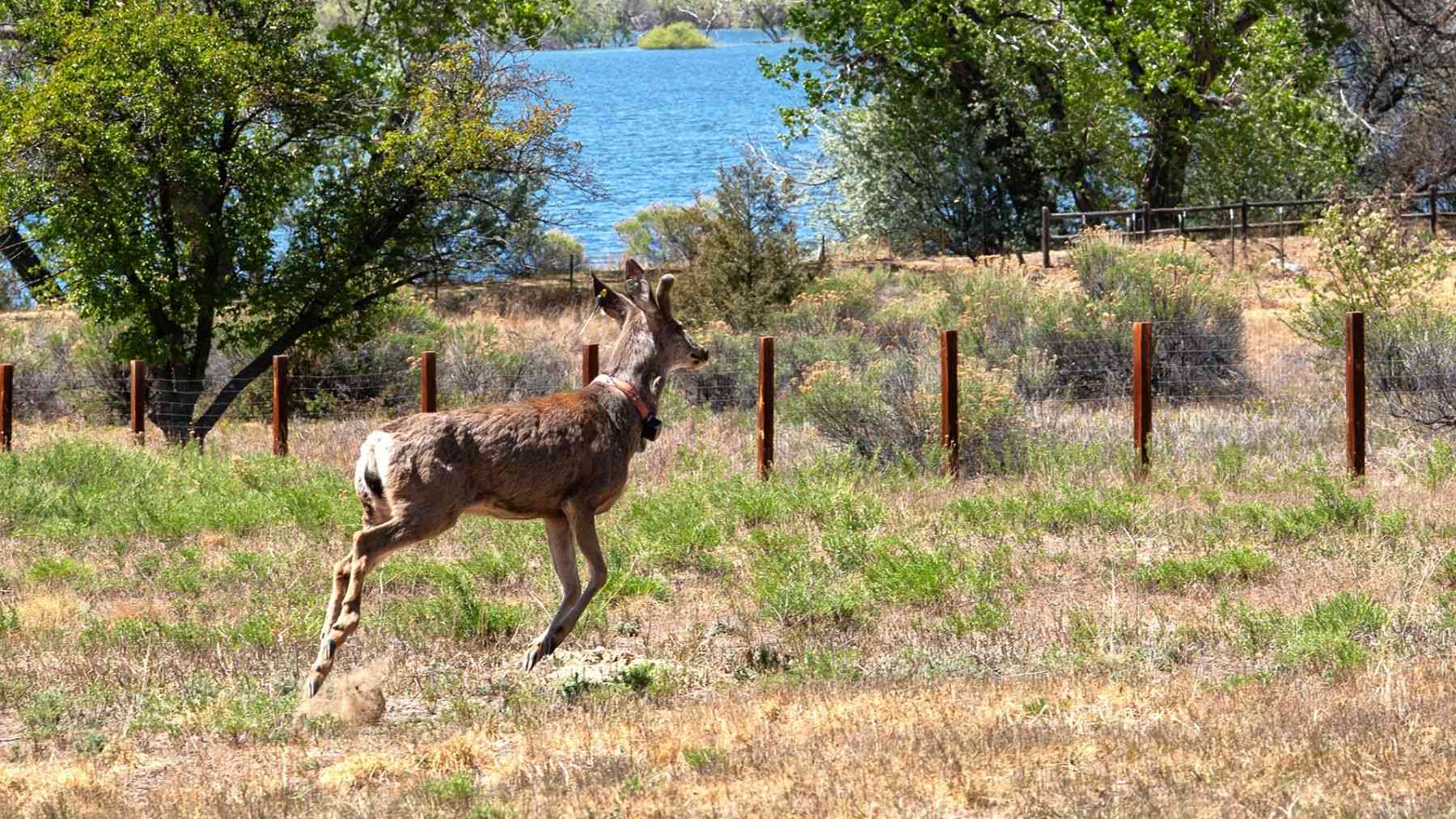
The Colorado State University group attached particulate monitors to wild mule deer at very affordable prices in order to monitor smoke exposure.
Fixed regulatory monitors do not always capture pockets of smoke from wildfires as they travel through valleys and mountains.
With the use of GPS monitoring collars on the mule deer, scientists used $100 air-quality monitors to measure the level of particulate pollution.
In the study, it was found that particulate pollution readings from the mobile animal-borne sensors differed by up to an order of magnitude—being either higher or lower—compared to stationary nearby monitors.
Using mobile air-quality monitors on the wild mule deer
Forest fires emit large amounts of fine particulates into mountainous environments in the American West during each summer season.
The air monitoring stations are spread miles apart, thus causing gaps in the network over difficult mountain terrains.
Custom-made $100 optical dust monitors were attached to rubberized GPS collars used to track wild mule deer.
The air sample collecting sensors collect air samples in an even interval, as the animals move across forests, mountain tops, and brush draws.
The air sampling by animals walking freely acts as mobile environmental surveillance in uncharted territory.
The tracking technology ensures consistent records of particulates collected by the animals within the microhabitat on the ground.
Capturing fine-scale fine particulate matter (PM₂.₅) variations
Fixed government monitoring stations capture general regional averages, but fine particulate matter ($PM_{2.5}$) levels vary significantly across localized terrain.
The animal-borne sensors demonstrated fine-scale spatial variations in particulate readings that differed by up to tenfold—both above and below static station measurements.
This highlights microclimate differences rather than establishing consistently higher exposure to heavy wildfire smoke.
With the placement of detectors on moving animals, one can observe exposure levels that are missed by fixed detection equipment.
Linking fine particulate matter exposure to lung problems of the wildlife
Fine particles less than 2.5 micrometers cause the deep lungs in the body of mammals to become inflamed.
Small soot is breathed by mammals into their lungs, thus making them unable to breathe well when exercising.
Motion and readings will enable one to to understand how the local smoke affects the deer’s behavior during feeding and rest.
Physical contact between wildfire smoke and deer helps biologists to understand how the interaction affects them.
The assessment of the longevity of sensors and batteries in rough terrains
Low-cost optical sensors offer unmatched spatial coverage; however, the harsh conditions of the wildland cause problems with hardware.
Winter and rain shorten the lifespan of the batteries, thereby decreasing the lifespan of the sensors in the field.
The sensors become less accurate due to the accumulation of dust and sap on their lenses over time.
Vegetation similar to that of the rope is hung around the sensors as the deer walk through thick brush.
Hardware cases help to ensure that all optical components inside function perfectly despite continuous impacts from trees and rocks.
Hardware reliability assists with maintaining the environmental sensors and their calibration for months of wildlife research.
Animal-borne environmental sensing in vulnerable ecosystems
Standard environmental tracking systems utilize costly stationary systems that cannot be employed effectively in remote wildernesses.
Deployment of low-cost mobile sensors for tracking migratory animals provides a viable method of keeping watch for any local environmental risks.
Advances in the engineering industry are geared towards reducing packs of sensors in order to monitor microclimates, poisonous gases, and temperature variations among small animals.
A greater rate at which data gaps vanish is provided when mobile sensors are used by wildlife.
Technological improvements in mobile sensing devices will help protect threatened wildlife species during a time that wildfires have become severe in western parts of America.
All the details of the study can be found here: Parlin, A. F., Ditmer, M. A., Steel, Z. L., Alder, J., Hersey, K. R., Stout, V., … & Wittemyer, G. (2026). Smoke signals: Measuring Earth smoke exposure with animal‐borne and stationary sensors. Methods in Ecology and Evolution.
Read the whole thing?
Get the week's signal, not the noise
Our sharpest reporting on energy, climate and nature — free, once a week.