Most discussions about offshore wind farms focus on the electricity they generate.
At Denmark’s Anholt Offshore Wind Farm, the focus shifted from the turbines above to the seabed below.
In 2022, Ørsted and WWF Denmark placed 12 three-dimensional printed reef structures on the seafloor between the turbines.
The structures were created to last for approximately two years, after which the researchers would come back to inspect them.
What the inspectors saw would be an initial glimpse into whether artificial reefs could establish new habitats within an operational offshore wind farm.
Cod losses pushed the ecosystem out of balance
A long-term ecological decline in the Kattegat region of Denmark formed the basis for this project.
For many years, overfishing and habitat destruction combined with decreased levels of dissolved oxygen in the bottom waters of the Kattegat have resulted in a dramatic reduction of cod populations.
Cod populations in the Kattegat have declined dramatically.
Today, there are approximately 10 percent of the number of cod in the Kattegat that existed in 1990.
Cod are located high in the food web; when cod populations drop, green crab populations increase.
Green crabs consume snails and eelgrass seedlings that remove algae from eelgrass.
Eelgrass is a productive habitat for marine organisms.
Therefore, it was hoped that introducing additional habitat would help to support cod populations and strengthen the overall ecosystem.
Missing habitat became part of the solution
The 12 reef structures were produced through a collaborative effort of WWF Netherlands, Reef Design Lab and the Ørsted Biodiversity Project and manufactured by D-Shape of Italy.
Each structure mimicked naturally occurring habitats. They resemble stacked wedding cakes, creating holes for fish to pass through while receiving shelter.
Hard surfaces and crevice spaces enable marine organisms to settle on the reef.
Biocompatible, natural-based materials were utilized so that the reefs would not be viewed as detrimental to the surrounding environment.
Each reef occupied roughly one cubic meter and weighed up to approximately half a ton per reef.
Two years underwater brought the reefs to life
Inspectors returned to examine the reefs in July 2024.
Conditions on the reefs were significantly different than what was seen during the 2022 inspection. Red algae covered each reef structure.
Observations nearby showed macroalgae and populations of bivalve mollusks.
Fish and invertebrates also began utilizing this new habitat.
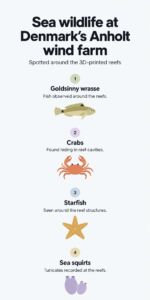
Inspectors documented goldsinny wrasse, tunicates, starfishes, and crustaceans around each structure.
Large amounts of barnacles settled on large areas of the reef surface.
The inspection indicated that a new microhabitat had developed on each reef since installation, according to the Ørsted Annual Report 2025.
Amongst the most common fish observed were goldsinny wrasses.
Cod need more than one place to recover
Artificial reefs represent only one component of a larger habitat strategy.
In addition to deploying artificial reefs, Ørsted and WWF Denmark installed biohuts in the port of Grenaa at the same time.
Biohuts serve as sheltered environments for young cod to eat and grow safely until they mature enough to migrate to deeper water.
More than a decade later, those reefs provide extensive marine life.
Collectively, these habitats offer various developmental stages for cod and other marine species.
Recovery across the ecosystem is the real test
The results of the inspectors’ visit in 2024 offered initial proof that artificial reefs are establishing habitat for marine organisms within the Kattegat region.
These reef structures are offering shelter, space, and food for species like sea bass, sea squirts, crabs, and starfish.
These findings align with a growing number of marine restoration projects being tested in different parts of the world.
Examples include ReCoral by Ørsted in Taiwan, where corals grown artificially support natural coral growth.
Ørsted has indicated that from 2030 onward, all new renewable energy projects it commissions are intended to have a net-positive biodiversity impact.
The Kattegat reefs show how biodiversity projects can be tested and monitored alongside renewable energy infrastructure.
Future inspections will reveal if these artificial habitats continue to develop and maintain marine life over subsequent years.
Read the whole thing?
Get the week's signal, not the noise
Our sharpest reporting on energy, climate and nature — free, once a week.