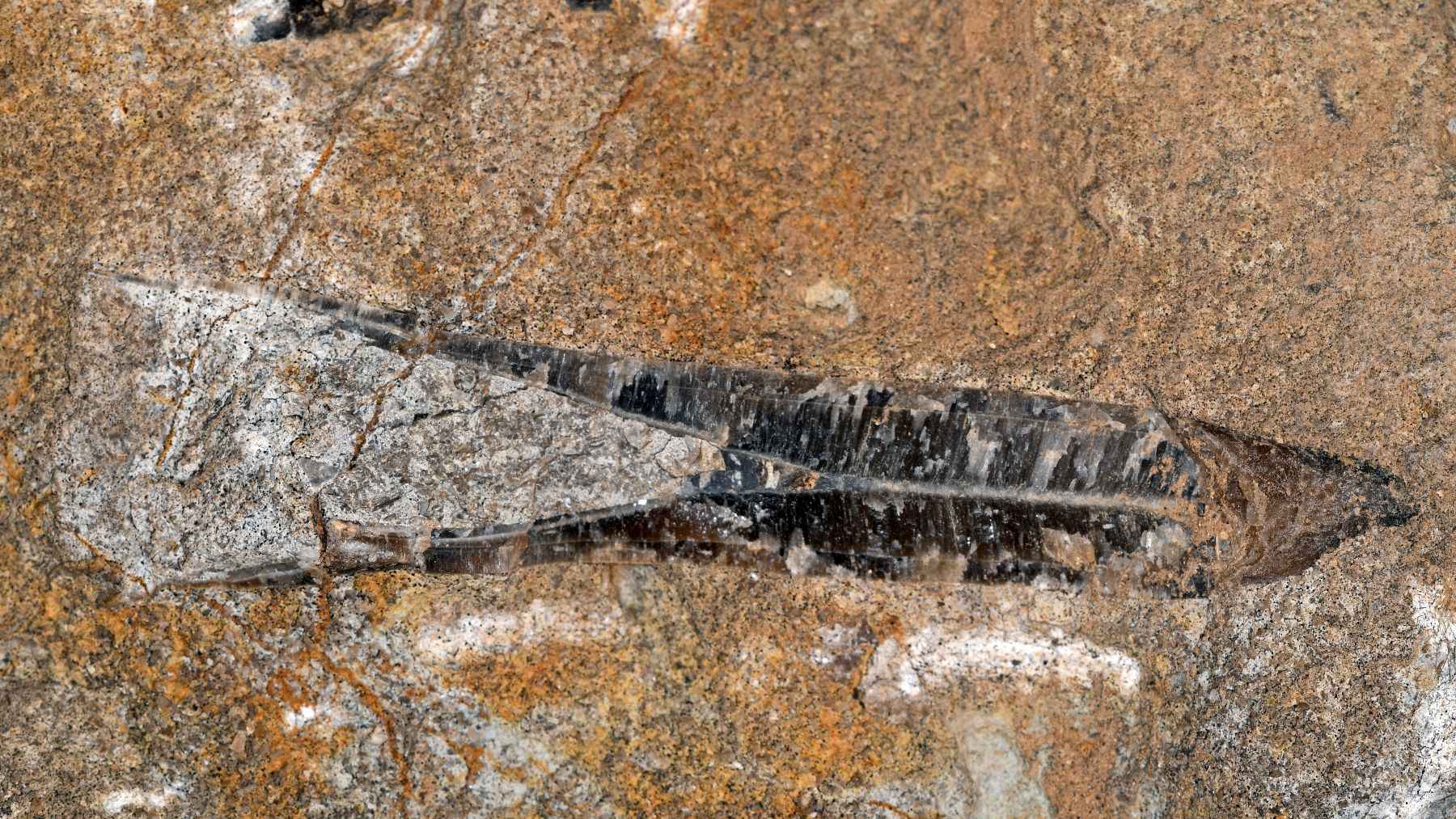
Wyoming paleontologist Bill Wahl had spent years pulling belemnite fossils from the ancient seafloor sediments of the Sundance Formation — narrow, bullet-shaped things, millions of them, so familiar they barely warranted a second glance. Then he opened a museum drawer and found something that stopped him cold: a belemnite rostrum roughly the shape and width of a small fist, barrel-like where everything else was sleek.
It had been sitting there, largely unexamined, for years. That stubby, oversized fossil from Wyoming’s long-vanished inland sea would eventually force scientists to rethink more than two centuries of assumptions about an extinct group of squid relatives.
A fossil that stuck out like a sore thumb
The Sundance Formation is belemnite country. Millions of narrow, bullet-shaped rostra have emerged from its ancient seafloor sediments — so common that locals call them “squid butts.” Most measure 5 to 10 centimeters long and just 1 to 2 centimeters across: slender, predictable, unremarkable.
The specimen Dr. Burkhard Pohl found in the late 1990s was none of those things. The Wyoming Dinosaur Center’s founder had come across a belemnite considerably larger than anything he’d seen before — its rostrum stretched roughly 10 centimeters long but ballooned to an extraordinary 6 centimeters wide, barrel-shaped where everything else tapered to a point.
Despite its obvious strangeness, the fossil sat unstudied in a museum drawer for years. A second specimen arrived in 2019, donated by fossil collector Cliff Linster, who had found it near Ten Sleep, Wyoming. Two specimens gave scientists something a single oddity couldn’t: enough comparative material to act on.
CT scans unlock a 160-million-year-old secret
Bill Wahl assembled an international team from the US, UK, and New Zealand to investigate the pair of fossils. Rather than risk damaging them, researchers turned to CT scanning — a technique that maps internal structures without touching the specimen.
The scans revealed something unexpected. The fossils’ internal architecture connected them to a belemnite family scientists had believed vanished millions of years before this animal ever existed. A supposed ghost lineage, preserved in Jurassic Wyoming rock — not what anyone was looking for.
Belemnite expert Alexey Ippolitov, now a PhD student at Victoria University of Wellington, described being “deeply surprised.” Belemnites have been studied for more than 200 years. The formal description of the new species, Wyoteuthis linsterorum, appears in the journal Papers in Palaeontology.
Big body, bigger appetite — how Wyoteuthis may have hunted
Size matters in the ocean, and Wyoteuthis had plenty of it. Scientists estimate the living animal reached roughly 60 centimeters — about two feet — in total length, arms included. That’s substantial for an ancient inland sea already populated by far smaller belemnites.
Those smaller neighbors, belonging to the genus Pachyteuthis, may have been more than just cohabitants. Ippolitov suggests Wyoteuthis‘s larger size could have given it a predatory edge, and modern squid readily hunt other cephalopod species — sometimes their own kind — making similar behavior plausible here. Its rarity in the fossil record may reflect narrow ecological specialization rather than low numbers: a creature finely tuned to a specific niche, leaving fewer traces behind.
Honoring the fossil hunter who made it possible
The species name linsterorum is a deliberate tribute. Cliff Linster’s donated specimen provided the second data point that made formal description possible; without it, the first fossil might have remained an unexplained curiosity indefinitely.
For Dr. Dean Lomax of the University of Manchester, the naming carries personal weight. He first met Cliff and Sandy Linster in 2009, spending a week as a teenager excavating a dinosaur bonebed on their Montana property. Cliff shared his passion for fossils during that dig — including, apparently, this belemnite. The Linster family’s record also includes ties to Bambiraptor, a well-known dinosaur find — a remarkable legacy for amateur collectors.
Cliff Linster passed away in June 2026, before the paper was published. He knew scientists were investigating his discovery and was enthusiastic about seeing it recognized.
What one oddly shaped fossil tells us about paleontology
The story of Wyoteuthis linsterorum is, in part, a story about patience. A fossil found in the 1990s, donated in 2019, formally described in 2026 — nearly three decades from discovery to publication. That timeline isn’t unusual. Museum collections aren’t endpoints; they’re waiting rooms.
Amateur collectors aren’t peripheral to science, either. Cliff Linster’s donation was the piece that unlocked the puzzle. Without fossil hunters willing to donate rather than keep, formal research often stalls.
Both known specimens of Wyoteuthis linsterorum are now on public display at the Wyoming Dinosaur Center in Thermopolis. A creature that lived 160 million years ago, belonging to a family thought long extinct, was hiding in a museum drawer — and it took a second fossil, found by a rancher with a sharp eye, to bring it into the light. How many drawers, in how many museums, still hold something equally strange?
Read the whole thing?
Get the week's signal, not the noise
Our sharpest reporting on energy, climate and nature — free, once a week.