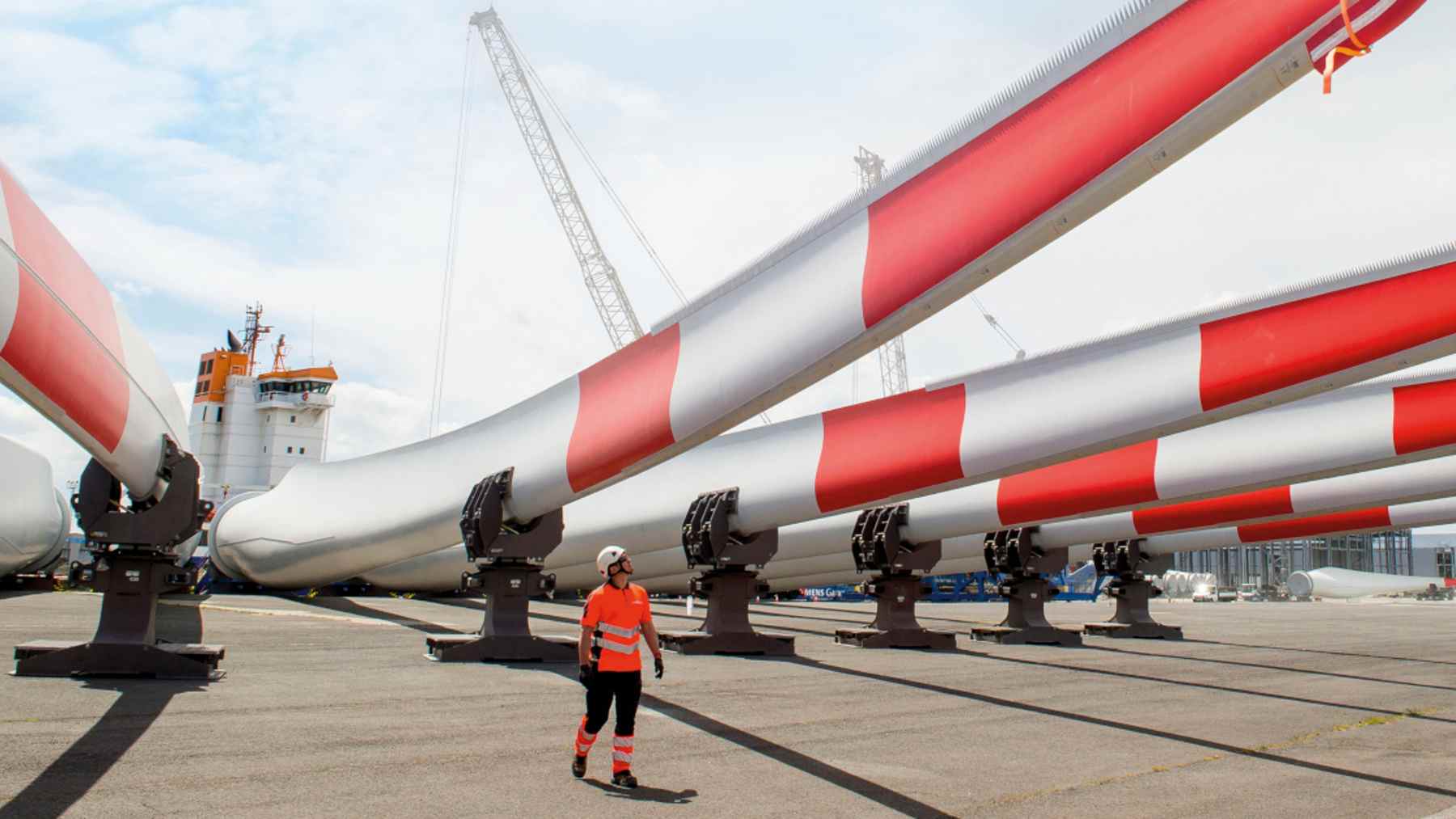
A blade nearly as long as a football field lies on its side in an English port, waiting for a boat.
It looks like any other blade bound for the North Sea.
But the resin inside its skin is built with a trapdoor nobody can see.
Put it in a heated, mildly acidic bath decades from now, and the structure is designed to come apart again.
Only three of the machines spinning off Heligoland carry that hidden trick.
So what makes a blade that can be taken apart on purpose, when almost every other blade out there is built never to be?
What makes this resin different
Ordinary turbine blades are cast with thermoset epoxy, a plastic that cures into a permanent tangle of molecules and never loosens again. That toughness is the whole point for decades of salt spray and flexing. But it also means a worn out blade is, chemically speaking, a dead end.
Towers and the nacelle already have established recycling routes. The composite inside the blades has always been the harder part to crack.
The blades on these turbines use an epoxy system built around a supplier’s proprietary recyclable resin technology. The chemistry relies on amine curing agents carrying engineered cleavage points at cross linking sites that, under set conditions, convert the thermoset epoxy into a thermoplastic, letting fiber and matrix be recovered. In the published literature those links are acid labile acetal bonds, robust once cured but selectively breakable under mild acid, leaving the reinforcing fibers intact.
So the blade spends its working life behaving like a normal one, stiff and load bearing. Only at the very end does the hidden chemistry matter.
The blades that actually went to sea
The wind farm sits about 22 miles off Heligoland, with 38 turbines and 342 megawatts of installed capacity. Of those, three turbines carry the first rotor blades designed to be recycled at end of life, using a resin system that lets the materials be separated from each other.
That is a small slice of one wind farm, not a fleet rollout. Which is exactly why the ratio is worth noticing.
The hardware itself is conventional in every other respect. The blades are handcrafted units, each roughly 266 feet long, developed in Denmark, manufactured in the United Kingdom, with nacelles produced and installed from Germany.
Even so, the scale says something true about where this sits. The other 35 turbines on that same seabed still carry the conventional blade nobody has yet taken apart cleanly at scale.
Why the ratio matters more than the headline number
Most of a wind turbine was never the problem. Roughly 85 to 90 percent of a turbine’s total mass can already be recycled, mostly steel and other metals moving through routine scrap channels. Blades are the biggest challenge, the stubborn remainder carrying almost all of the unsolved waste question.
A separate chemical route exists too. A process from an industry led project breaks existing epoxy blades down into raw material that can be reused, and partners are working to scale that decomposition into a commercial solution. That work is unrelated to the resin chemistry used at this wind farm.
None of it is a finished industry yet. It is a working proof that the chemistry exists in two independent forms, one of them already turning in open water.
What happens when the acid actually goes to work
The breakdown step is almost unremarkable to describe, which is part of why it matters. At the end of a turbine’s life the blade is dismantled, prepared, and immersed in a heated mild acid solution that separates the resin from the fiberglass, plastic, wood and metals. The materials are then rinsed and dried for secondary use.
What comes out is meant to be clean enough for genuinely different products rather than ground filler bound for cement kilns. Flight cases and flat screen casings are among the uses the manufacturer has pointed to. Similar early recovery work is already underway for retired solar panels, where a laser and a short chemical cleanup recover most of the silicon and silver locked inside.
The important caveat is timing. None of these blades has reached the end of its service life, so the acid bath remains a described route rather than something performed on a blade pulled from the sea.
What is left to prove out at sea
These blades have barely started. Wind farms like this one are expected to run for at least 25 years, so whether the chemistry still behaves on a storm battered, barnacle crusted blade is simply not yet known. The manufacturer’s stated goal is fully recyclable turbines within two decades.
Even so, three turbines already turning with the new material is different evidence than a bench result or a launch announcement. It is a bet running in open water, with a seabed address anyone can check on. Elsewhere, renewable hardware is being paired with other working systems, as with a Virginia solar field that now also hosts beehives.
A resin that cleaves in a tank is not yet proof of a resin that cleaves after two decades of salt and flex. But for an industry whose blades have been its one stubborn component, three turbines built to come apart is a start worth watching. The manufacturer’s own account and the operator’s figures agree on the modest scale of it.
Read the whole thing?
Get the week's signal, not the noise
Our sharpest reporting on energy, climate and nature — free, once a week.