The sea off Orkney runs fast enough to turn two underwater rotors 66 feet across.
A technician on a small workboat watches two steel arms swing up out of the waves.
No crane barge. No diver in the current.
Just a hull on the surface while its machinery rises to meet the air.
So why does this machine lift its own rotors instead of waiting for a lift vessel?
Why the rotors rise instead of the crew going down
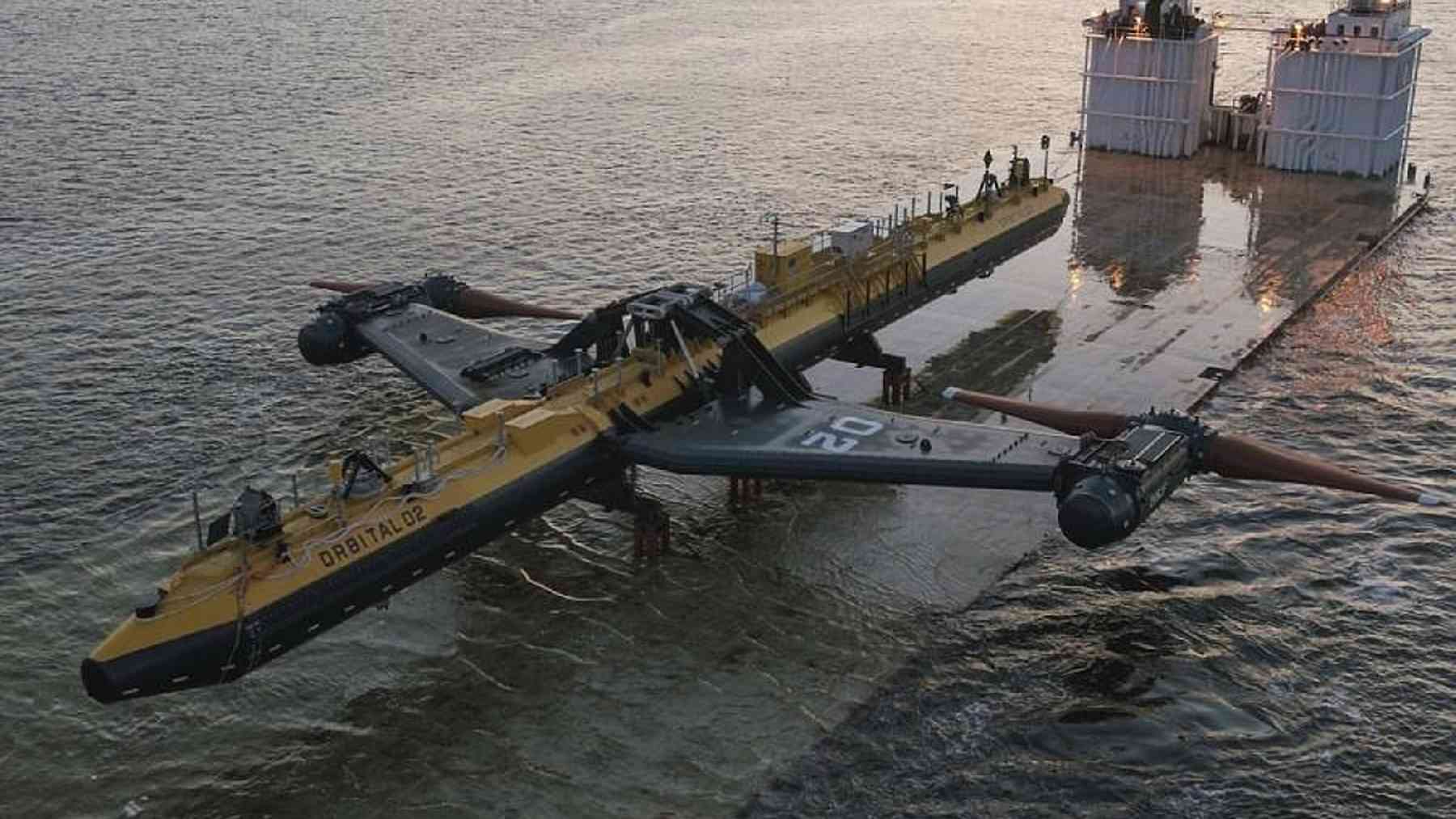
Most tidal stream machines are fixed to the seabed, which means an inspection or an oil change needs a lift vessel, a slack water window and divers working in moving water. The floating turbine moored in the Fall of Warness, Orbital Marine Power’s O2, takes the opposite approach with a pair of hinged legs, nicknamed gull wings, that carry the power generating nacelles below the surface while the machine operates.
When something needs attention, the legs fold upward instead. Each leg holds a nacelle assembly of about 100 metric tons, sitting roughly 46 feet down in the flow, and the whole assembly can be brought above the waterline while the platform stays on its moorings.
That hinge is the whole idea. The machine was built so the nacelles, pitch hubs and blades can be reached without a specialist heavy lift vessel, turning a blind underwater job into something closer to changing a tire in open air.
A machine about as long as a jumbo jet floating on open water
The O2 is roughly 243 feet long, about the length of a jumbo jet, and weighs 680 metric tons. Two nacelles of one megawatt each hang from the wings, and their twin bladed rotors use 33 foot blades that sweep circles 66 feet wide, for a combined swept area of about 6,500 square feet.
The hull rides on a four point mooring rather than a rigid tower, so it moves with waves instead of resisting them. Its shallow draft lets small workboats tow it into place. Once the wings are lowered, the tidal current does the rest.
The arrangement reduces what has to be built on the bottom, though it does not eliminate contact with it. Anchors, mooring chains and a dynamic power cable still reach the seabed, and the project’s environmental paperwork lists entanglement risk, underwater noise and disturbance to local species as things to monitor rather than assume away.
What the operating record at the Fall of Warness actually shows
The O2 was towed from Dundee in spring and has been exporting grid connected power at the test site off Eday since that summer, with a design life of 15 to 20 years. Some of its output has gone to an onshore electrolyser to make hydrogen, unusual for a single prototype machine.
The clearest maintenance evidence comes from an earlier prototype, the SR2000, which used the same surface access principle. The test centre, the European Marine Energy Centre, records that the prototype’s entire lifecycle was completed with small workboats or lighter, with no heavy lift vessels used.
Its quickest maintenance run took under 40 minutes from quayside to turbine. Published project documents for the O2 itself describe routine marine operations carried out by a multicat workboat and a rigid inflatable, with no public audited tally of heavy lift call outs, so the claim is narrower than it sounds, and still unusual.
Why the access design matters more than the megawatts
Every lift vessel a design avoids is also a vessel that never anchors, never idles for days waiting on weather and never puts a diver into a tidal race that seals, fish and seabirds use as a feeding corridor. The environmental argument for surface access is mostly about reducing hours on site.
That same tradeoff shows up on land. Technicians who drive past towers in a Swedish forest face a version of it, where reaching a machine decides how much damage a repair leaves behind.
The turbine produces 2 megawatts, enough for about 2,000 UK homes, and offsets roughly 2,200 metric tons of carbon dioxide a year. Those are modest numbers next to a wind farm, which is why engineers keep pointing at maintenance, not output.
What comes next for a design still proving itself at scale
None of this means tidal power has solved its hardest problem, cost per unit of electricity against wind and solar. A single two megawatt machine is a demonstrator, not a fleet.
The roadmap is moving that way now. In October the European Commission cleared the EURO-TIDES project to move into construction, pairing three next generation O2-X turbines with the existing O2 as a connected array at the Orkney test site, targeted for 2028 and sized for roughly 9,200 homes.
The developer says the O2-X is due to launch in 2027, and its development director framed the step as proving “that our turbines can operate together as a connected array.” The lesson from the Fall of Warness is plain: sometimes the cheapest fix for a machine stranded at sea is not a bigger ship but a hinge that lets the machine meet its repair crew halfway, a trick that would serve equally well on a test buoy bobbing off New Jersey.
Read the whole thing?
Get the week's signal, not the noise
Our sharpest reporting on energy, climate and nature — free, once a week.