There’s an overarching challenge to all low-wind turbines.
The goal is to capture more energy from available wind resources. Low-wind areas were previously uneconomic because turbines were too small to capture enough wind.
Since permitting and grid interconnects are constrained, manufacturers are pursuing larger rotors to increase energy production.
The German manufacturer Nordex developed its Delta4000 platform based on that last option. They announced the next generation of that platform on September 22, 2026, in Hamburg.
That next generation is called the N193/7.X.
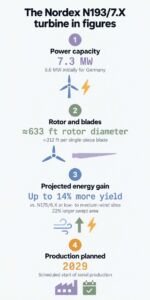
Capturing 14% more energy with 311-foot blades at the same site
The Nordex Group is expanding the Delta4000 series with the N193/7.X, which combines proven technology with improvements to increase energy yield.
The N193/7.X features 7.3 MW and a 193m rotor length, and 95m single-piece blades, just over 311 feet in total length. In comparison to the N175/6.X model, yields at typical low to medium-wind sites can reach up to 14% higher.
The increased yields come from the swept area. A 193m rotor sweeps a much larger volume of air than a 175m rotor.
For the German market, the turbine will initially be available at 6.6 MW to meet specific permitting and grid connection requirements.
It is designed to improve project economics at medium to low-wind sites.
Serial production is anticipated to begin in 2029. The turbine will be launched in a variety of nominal capacities designed to meet global market and site-specific needs.
Reusing proven Delta4000 components for faster deployment
The N193/7.X uses many of the same key elements as the proven Delta4000 platform. These include the nacelle, turbine control systems, and electrical architecture, all optimized.
This results in quick introductions for customers and well proven production and installation processes.
José Luis Blanco, CEO of the Nordex Group, stated that the N193/7.X is the next chapter in the Delta4000 success story.
It builds on the proven platform with targeted enhancements. It delivers a powerful and flexible solution for a wide range of market and site requirements.
Optimization modes are implemented to optimize energy yield, noise compliance, and lifespan.
In addition, multiple tower technologies provide flexibility across various markets without having to redesign the entire machine.
Expanding into moderate wind sites beyond Germany
South Africa illustrates why size matters when looking at moderate wind resources beyond conventional high-wind coastal sites like Cape Town.
Development of new wind resources in those Cape provinces is often cited as limited due to severely constrained local grid capacity.
Therefore, developers in comparable markets look toward provinces such as Mpumalanga and KwaZulu-Natal where grid capacity is available. However, wind conditions are moderate.
With a 193m rotor and 7.3 MW output, the turbine from Nordex has a power density of 250 W/m², producing more energy per MW of contracted grid capacity.
These developments often require significant upfront investment in new substations and transmission infrastructure.
Outlining operational limits of the N193/7.X launch
Their initial assessments indicated that the larger rotor could increase yield by approximately 14% at the same low-wind site.
The launch was a product announcement, not a fleet with 10 years of historical field data. None have experienced operation through 25 plus years of turbulence, erosion, or icing.
Long-term availability of 95m single piece blades after repetitive transport and lifting cycles is unknown.
No site has documented performance following 10 winters of snow load and lightning strike impacts on this rotor-nacelle combination.
Additionally, no site has investigated whether additional MWhs generated pay for greater logistical costs associated with transporting 311-foot blades along rural roadways.
Therefore, best practices are demonstrated in design rather than proven at large scale.
Where can you develop more wind power when permitting is stricter and grid interconnections are congested? Instead of viewing power as more turbines, developers are increasingly pursuing larger swept areas to improve energy capture at suitable wind sites.
Read the whole thing?
Get the week's signal, not the noise
Our sharpest reporting on energy, climate and nature — free, once a week.