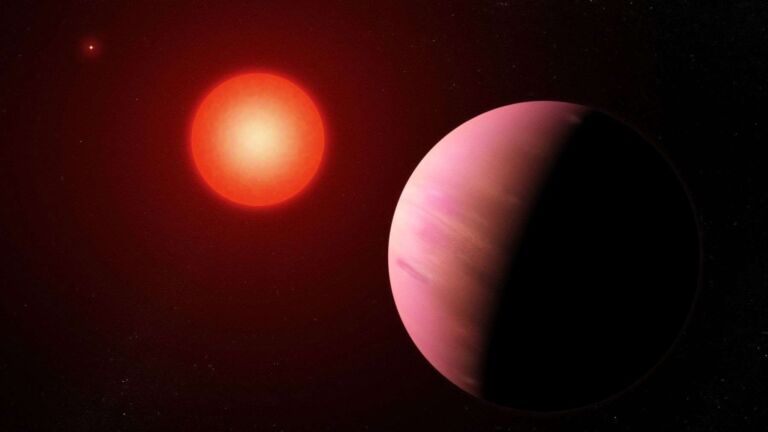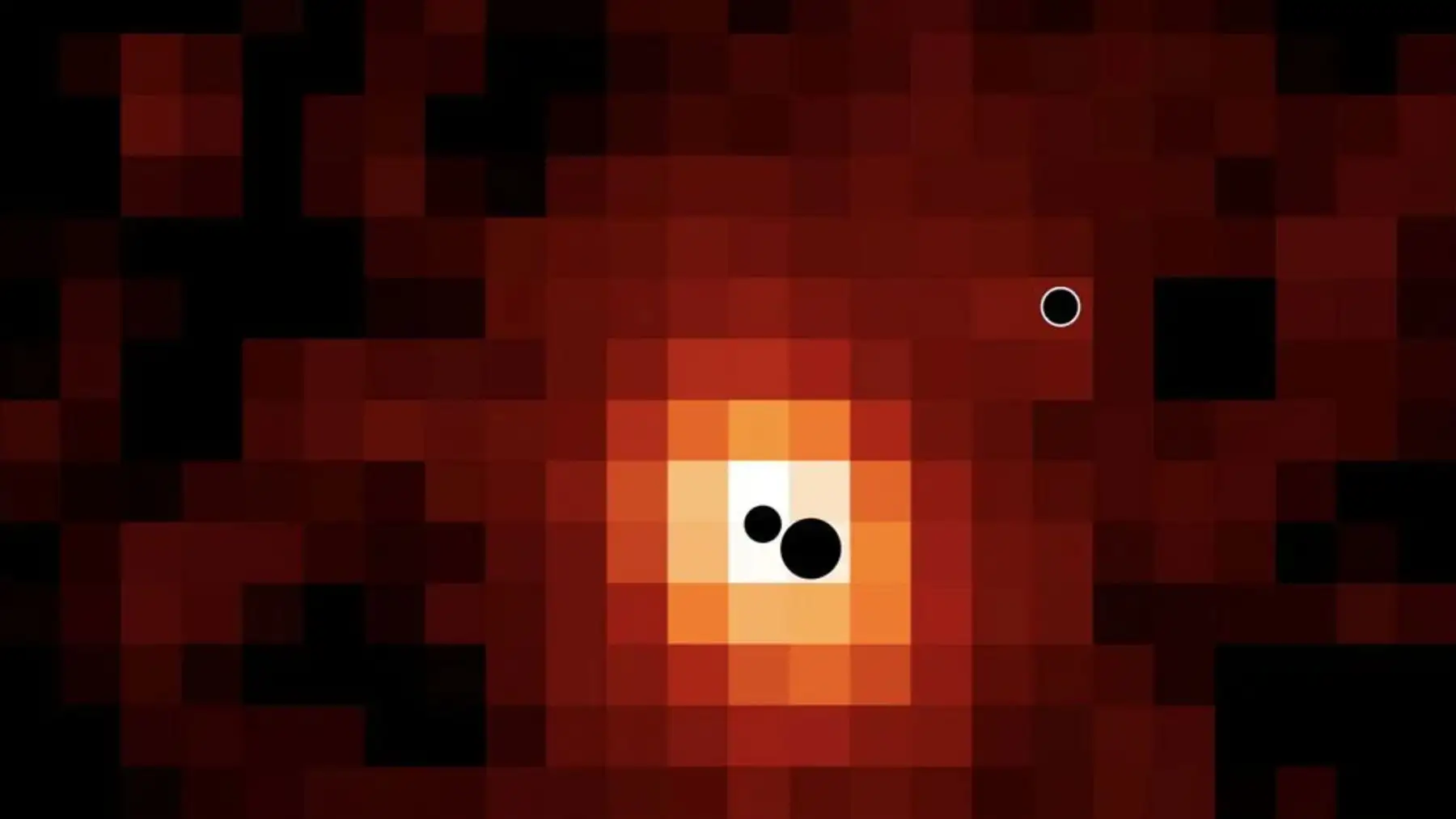
12.5 billion light-years from Earth, in a galaxy that existed when the universe was barely 1.2 billion years old, astronomers have found something that doesn’t fit the usual picture: three supermassive black holes, all actively pulling in gas and matter at the same time.
The galaxy is called J0148-4214, and it’s already an extreme object. But what makes this find stand out isn’t just the count — it’s how close two of those black holes are to each other, and what that closeness tells us about the universe’s earliest, most chaotic chapter.
A galaxy unlike any seen before
J0148-4214 sits at a redshift of z=5.02, placing it more than 12.5 billion light-years away. Its light has been traveling since the universe was only 1.2 billion years old — cosmically early, a time when galaxies were still assembling themselves from colliding clouds of gas and dark matter.
What sets this galaxy apart isn’t just its age. It’s the first known case of three simultaneously active black holes inside a single distant galaxy — all three accreting, all pulling in surrounding matter at once. Researchers at the Max Planck Institute for Extraterrestrial Physics (MPE) led the discovery, and the findings appear in the journal Astronomy.
Three black holes, three very different characters
The three black holes differ dramatically in mass. The largest comes in at roughly 80 million solar masses, while the other two are far smaller: one around 2 million solar masses, the third about 600,000.
Two sit near the galaxy’s center, separated by just 620 light-years — extraordinarily close on cosmic scales. The third is positioned roughly 5,500 light-years out, well beyond that inner pair.
The smallest of the central two is feeding the most aggressively, with an accretion rate that exceeds the Eddington limit — the theoretical ceiling for how fast a black hole can grow under standard models. That kind of runaway growth may help explain how black holes reached enormous sizes so early in cosmic history. The galaxy’s total stellar mass is around 1.3 billion suns, making the black holes a striking fraction of the whole — a ratio the research team flagged as significant.
How James Webb spotted what no telescope could before
Pinning down three separate black holes in a single distant galaxy took more than powerful optics. The team examined hydrogen emission lines — spectral signatures left by gas moving at extreme speeds near each black hole, with every active one producing its own distinct pattern.
At J0148-4214’s center, those patterns overlapped in ways too complex to explain with a single source. To untangle them, researchers used a technique called spectro-astrometry, applied through Webb’s NIRSpec integral field spectrograph. By tracking subtle positional shifts in spectral emissions across the galaxy, they could spatially separate the two tightly packed central black holes even though the telescope couldn’t resolve them as two distinct points of light. Without that method, the team would likely have found only one. The third, farther out, turned up through the same spectral analysis.
A merger hundreds of millions of years in the making
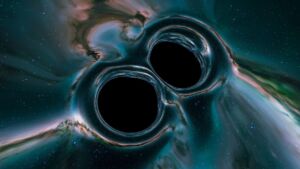
The two central black holes won’t stay neighbors. They’re expected to collide within a few hundred million years, producing a single, more massive object.
That kind of merger is considered one of the fastest paths to building a supermassive black hole. Co-author Roberto Maiolino, professor at the University of Cambridge, noted that the findings suggest black hole merging may be “an additional, fast route for their rapid growth in the early Universe.”
The third black hole adds another layer of complexity. One possibility is that it’s a gravitational recoil remnant — kicked outward during an earlier merger when gravitational waves were emitted asymmetrically. Another is that it’s slowly drifting inward, setting up a future three-way interaction. Both scenarios point to a galaxy with a turbulent, merger-driven past.
What this means for the hidden universe
This discovery raises an obvious question: how many other distant galaxies are hiding multiple active black holes that nobody has detected yet?
The answer may be many. The techniques used here — particularly integral field spectroscopy with JWST — are still relatively new for this kind of work, and overlapping spectral signals in other galaxies may have been misread as single sources all along.
Future gravitational wave observatories could eventually detect the mergers that systems like J0148-4214 are predicted to produce, offering independent confirmation of what Webb is beginning to reveal through light alone. For now, J0148-4214 gives us a preview of what those instruments might find: a universe in its youth, already busy assembling the cosmic giants that would shape the billions of years ahead.
Read the whole thing?
Get the week's signal, not the noise
Our sharpest reporting on energy, climate and nature — free, once a week.