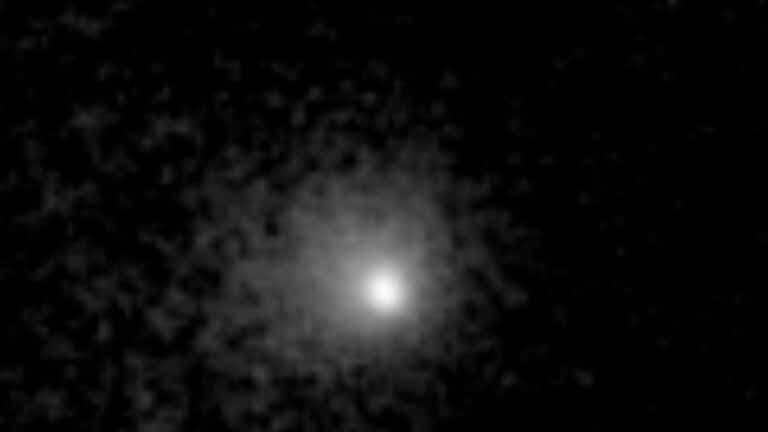
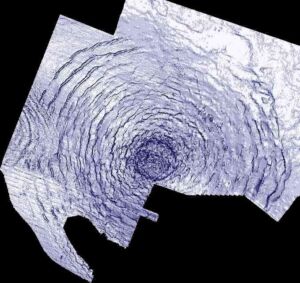
More than 2,300 feet beneath the North Sea floor, a near-perfect circle of fractured rock has puzzled geologists since its discovery in 2002. The Silverpit Crater — roughly 1.86 miles wide and ringed by concentric faults stretching 12 miles outward — looked like a cosmic wound. But looks, scientists argued, could be deceiving.
For over two decades, researchers remained split: asteroid impact or ordinary geology? In 2009, a formal vote among geologists landed against the space rock hypothesis. Now, new evidence has arrived that settles the argument for good.
A crater that refused to be explained
Silverpit was first spotted in 2002, buried roughly 2,300 feet beneath the seabed about 80 miles off the Yorkshire coast. Its nearly circular outline, elevated central peak, and rings of concentric faults spreading 12 miles outward matched the hallmarks of known impact structures. To many researchers, the resemblance seemed unmistakable.
But resemblance isn’t proof. Skeptics pointed out that underground salt deposits can migrate and warp rock layers above them, producing circular deformations that mimic cosmic scars. Volcanic collapse could create similar-looking formations too. Both explanations had precedent, and the debate dragged on for years. In 2009, geologists formally weighed the competing hypotheses — a vote documented in Geoscientist magazine — and the majority rejected the asteroid impact theory.
The smoking gun hidden in an oil well
The case reopened when a team led by Dr. Uisdean Nicholson of Heriot-Watt University brought together new seismic imaging, computer simulations, and microscopic analysis of rock samples pulled from a nearby oil well.
The seismic data gave researchers an unprecedented look at Silverpit’s internal architecture. The decisive evidence, though, was far smaller — nearly invisible. Rock cuttings from the oil well, retrieved from the exact depth of the crater floor, contained shocked quartz and feldspar crystals. These minerals carry a distinctive internal structure altered by extreme pressure that ordinary geological processes simply can’t generate.
Dr. Nicholson called it a “needle-in-a-haystack” discovery. Shocked minerals are a recognized fingerprint of hypervelocity impacts, and their presence at the crater floor depth closes the debate. As Nicholson put it, they “prove the impact crater hypothesis beyond doubt.”
Reconstructing a catastrophic impact 45 million years ago
With the impact confirmed, researchers used numerical simulations to reconstruct the event. A roughly 524-foot-wide asteroid — far smaller than the one linked to the dinosaur extinction, yet still capable of releasing enormous energy at cosmic speeds — approached from the west and struck the seabed at a shallow angle, somewhere between 43 and 46 million years ago.
The collision was immediate and violent. Within minutes, it launched a 0.93-mile-high curtain of rock and water — nearly a mile into the air. As that debris collapsed back into the ocean, it displaced a colossal volume of seawater, and the resulting tsunami exceeded 328 feet in height. For reference: a 30-story building stands roughly that tall. The wave was generated by rock and water falling back from near-orbital height.
Why preserved craters like Silverpit are so rare
Earth is a geologically restless planet. Plate tectonics, erosion, and sediment deposition continuously reshape its surface, erasing evidence of ancient collisions. Most impact craters simply don’t survive long enough to be found — only around 200 confirmed examples exist on land, and fewer than 33 have been identified beneath the ocean. That’s a remarkably small number given the billions of years Earth has spent in a debris-filled solar system.
Silverpit survived because sediment buried it quickly and kept it sealed. Its structure remains exceptionally intact, giving scientists a rare window into what a hypervelocity impact actually does to rock layers underground. That kind of preservation is scientifically invaluable and almost never available.
What Silverpit can teach us about planetary history — and future threats
With its origins confirmed, Silverpit now joins a short list of significant impact structures, alongside the Chicxulub Crater in Mexico and the recently confirmed Nadir Crater off the coast of West Africa.
For Prof. Gareth Collins of Imperial College London — who participated in the 2009 debate and contributed simulations to the new research — the confirmation is personally meaningful. He called the shocked mineral evidence the “silver bullet” and noted that the team can now focus on “the exciting job of using the amazing new data to learn more about how impacts shape planets below the surface.”
Subsurface impact damage is difficult to study on other planets, and Silverpit’s preservation offers a terrestrial reference point for interpreting craters elsewhere in the solar system. Dr. Nicholson noted that studying Silverpit can help scientists “predict what could happen should we have an asteroid collision in future.” A 524-foot rock isn’t an extinction-level threat — but a tsunami over 524-foot tall is a reminder that even modest impactors can reshape coastlines.
More information is available here: Uisdean Nicholson, Iain de Jonge-Anderson, Alex Gillespie, Thomas Kenkmann, Tom Dunkley Jones, Gareth S. Collins, James Frankel, Veronica Bray, Sean P. S. Gulick, Ronnie Parr. Multiple lines of evidence for a hypervelocity impact origin for the Silverpit Crater. Nature Communications, 2025; 16 (1) DOI: 10.1038/s41467-025-63985-z
Read the whole thing?
Get the week's signal, not the noise
Our sharpest reporting on energy, climate and nature — free, once a week.