Drawing a fence onto a building plan is measured in minutes. Deer paths often take years to develop.
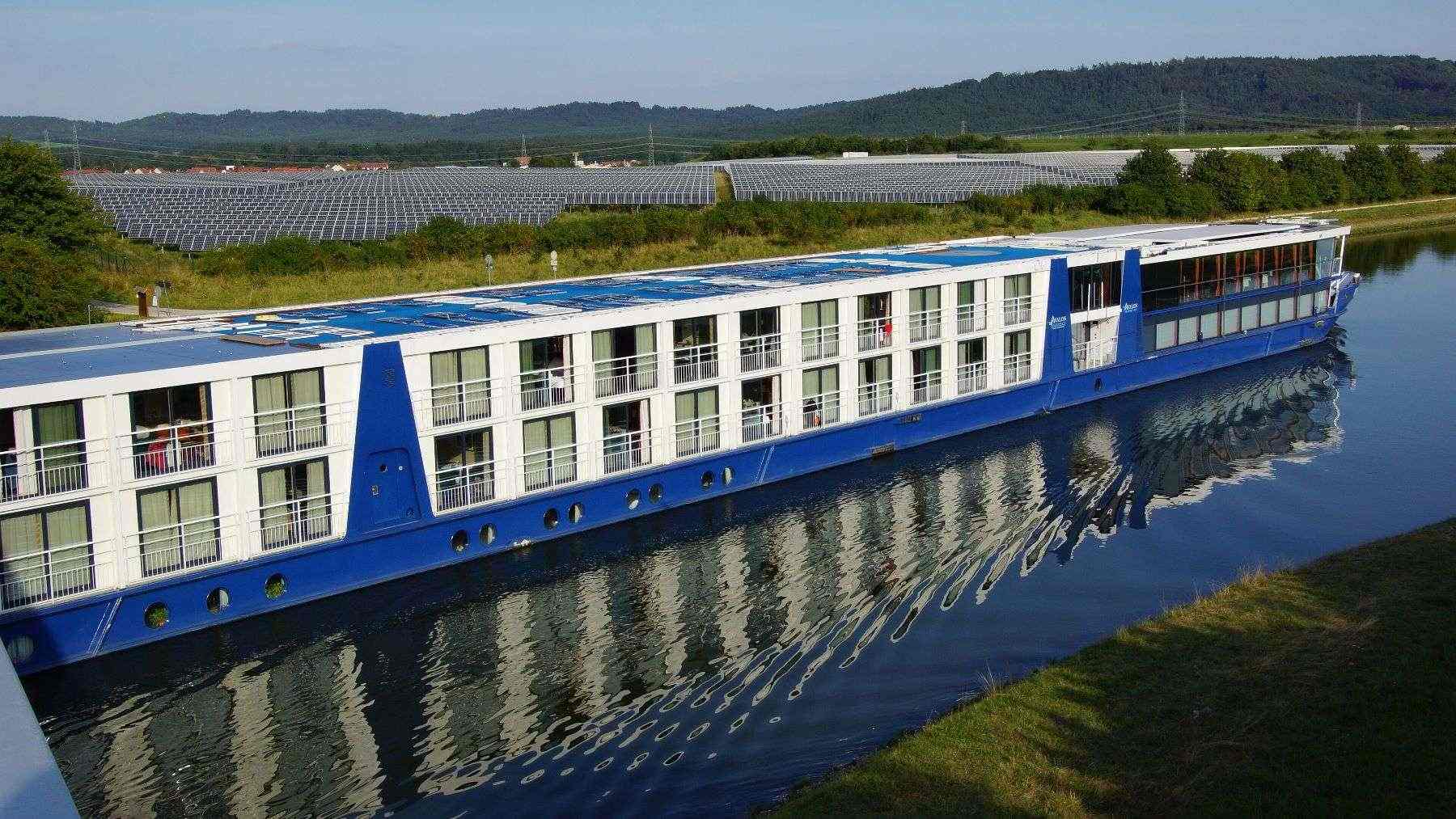
This contrast shaped the development of the solar park at Memmelsdorf in northern Bavaria.
When completed, the solar park is expected to cover approximately 16.3 hectares and produce around 22 million kWh of electricity annually.
Most visitors will notice the rows of solar panels first. Three openings in the perimeter fence are easier to miss.
They may become the most unusual part of the entire project.
The fence created a problem that needed solving
Before construction began, wild animals didn’t care where the fence lines would be placed.
Animals move through landscapes using routes established through years of repeated movement. Some of those paths crossed the area where the solar park would be built.
A fence can interrupt those patterns the moment it is completed.
That possibility emerged during planning for the Memmelsdorf solar park.
The challenge was not the solar panels themselves. It was figuring out how to avoid cutting across movement routes that already existed.
What happened to the deer already using the area suddenly mattered.
Hunters pointed out what the plans could not show
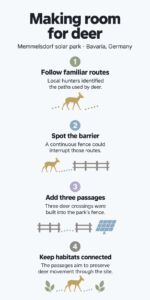
Local hunters who had been tracking the deer population in the surrounding region had observed deer traveling across the area that would eventually contain the solar panels.
Some of these deer routes were utilized frequently. Others provided connectivity between various habitats.
The information itself was relatively simple. Build a continuous fence, and you will lose many of those deer routes.
Finding a solution was not quite as straightforward.
Following information from local hunters, SÜDWERK incorporated three openings into the fencing.
Three openings changed the final design plans
These openings allow deer to continue utilizing established travel corridors throughout the area.
The fence still does its job. It is merely no longer solid from end-to-end.
SÜDWERK Energie GmbH included the deer crossings in the fencing after consultation with local hunters.
The thinking behind that decision was straightforward.
Wildlife should be allowed to continue utilizing established travel routes through an area they were already using prior to the onset of construction.
Nothing related to the power generation aspect of the system needed to change. Instead, three specially designed passages were incorporated into the fence.
A feature many visitors may never notice
Most visitors will likely notice the solar modules but not the fence openings. Only a tiny part of the overall development is devoted to the deer crossings.
They are also among the easiest features on the site to overlook.
The idea came from someone who already knew the landscape well.
One person familiar with the landscape identified potential problems prior to their occurrence.
The route could be protected before the fence ever went up. Existing deer paths were already mapped across the site.
Instead of making adjustments later, changes were made after deer routes were identified for this particular project.
What happens when solar parks face the same problem
SÜDWERK Energie GmbH brought up the issue of deer crossing as one of their solutions to find a balance between building solar parks in the region and allowing animals to move freely.
This is not limited to a singular solar park within Bavaria.
New renewable energy installations are being placed on land that has been previously inhabited by wildlife. Many of those routes have existed for far longer than the developments being built around them.
As such, there will likely be many more future developments where the same choice needs to be made.
Changing only three small sections of fencing changed the outcome.
By the time people look back at this solar park, they will remember it as a source of power, not for the route that remained in place across the landscape.
Read the whole thing?
Get the week's signal, not the noise
Our sharpest reporting on energy, climate and nature — free, once a week.