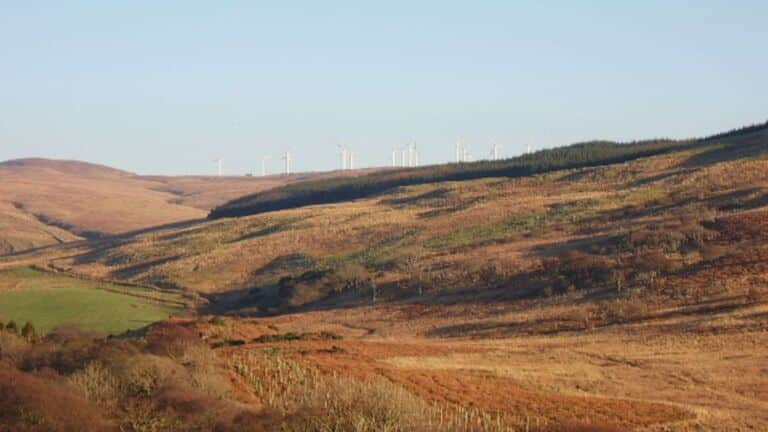
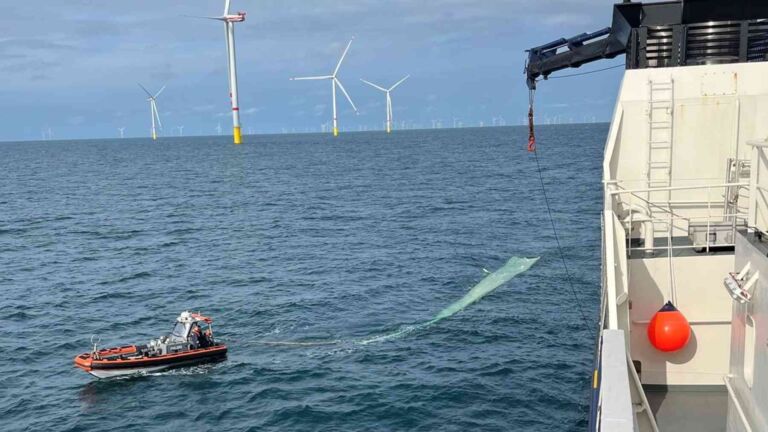
A bird radar sits in wet farmland on Germany’s North Sea coast, sweeping the dark.
A few hundred yards away, five tall turbines turn.
Cameras on two of them watch the rotor plane, frame by frame, all night.
Geese, ducks, gulls, waders and songbirds all pass this way.
The question was simple.
When a migrating bird reaches a spinning rotor, what does it actually do?
What happens in the final seconds before a bird reaches a turning rotor
An avoidance rate is the share of birds approaching a turbine at rotor height that never cross the rotor plane. They climb over it, slide around it, or break off their approach entirely before committing to a path through.
At this coastal German site, that figure came out to an estimated 99.87 percent of birds at night and 99.86 percent by day, for birds approaching at rotor height while the turbines were running.
That matters because avoidance is behavior, not luck. No correlation was found between migration intensity and collision rates, and even on the heaviest migration nights, very few birds ever entered the rotor area at all.
What is not settled is the sensory side. How birds detect a rotor in darkness, and at what distance they commit to a course change, remains open. Scientists working on the same question note that understanding the sensory basis of this behavior could inform deterrent design for other tall structures.
Rotor crossings jumped sharply once the blades stopped turning
One of the clearest signals in the data is the gap between a turning rotor and a parked one. Transits through the rotor plane were very low when turbines were operating, and at night an average of just one transit was recorded every 132 hours once blade speed reached two revolutions per minute or more.
The moving blade itself appears to be doing much of the deterring, not the tower or the noise around it.
That pattern is not unique to this one site. An independent US project using three dimensional thermal videography and weather radar reports the same direction of effect, with avoidance above 99.8 percent and rotor transits far higher when turbines sat idle than when they spun.
Four million bird movements tracked over eighteen months
The site is Windtestfeld Nord, near Husum, Germany, covering roughly 370 acres with five prototype turbines of varying sizes, in an area where geese, ducks, gulls, waders and songbirds are common. Camera systems on two turbines recorded bird and bat passages through the rotor plane day and night, with infrared cameras and emitters covering the dark hours. A bird radar ran alongside them without pause.
The study ran across four migration seasons, two springs and two autumns, with camera data spanning more than three of those seasons. Crews also searched for carcasses every five days, correcting totals for search area, searcher skill and how long a body persists before scavengers remove it.
In total the team analyzed more than four million bird movements over 18 months. The work is a consultancy report by BioConsult SH, commissioned by the German offshore wind association and funded by a group of operators including EnBW, Iberdrola, Ørsted, RWE and Vattenfall. “We used record breaking methods,” said Dr Jorg Welcker, head of research and development at BioConsult SH, describing AI controlled stereo cameras in the rotor area checked against a specialized bird radar.
Carcass counts still point to roughly 100 dead birds
None of this means collisions stopped entirely. Carcass monitoring estimated 99.7 fatalities over the study period, with a confidence range of 55 to 168, against 76.6 fatalities calculated by the collision risk model, a strong overall agreement between the two approaches.
About 100 birds at five turbines is a real cost. It still matters to the coastal species that make up most of the traffic passing through this stretch of farmland.
What the agreement buys is confidence in the modeling itself. The full findings describe the combination of radar and AI cameras as a step change in how precisely this kind of flight data can be recorded. A separate radar tracked migration study over the Alps points the same way, toward targeting shutdowns with live data rather than blanket rules. Offshore, turbine structures also accumulate marine life, as seen in inspections of artificial reefs at a Danish wind farm.
One German test field cannot settle every coastline’s risk
One coastal test field in northern Germany is not every wind farm. The dominant species here were migrants moving at night in flocks, and raptors and other soaring birds carry higher collision risk at sites where they concentrate in smaller numbers. Taller towers with longer blades change that geometry again.
Still, the policy implication is already in play. The data push back against the old assumption that heavy migration automatically means more collisions, which makes blanket shutdowns during busy nights look like a poor match for how birds actually behave.
Evidence gathered from the rotor plane itself, rather than from a desk estimate, is turning into the stronger basis for deciding exactly when a turbine should stop turning.
Read the whole thing?
Get the week's signal, not the noise
Our sharpest reporting on energy, climate and nature — free, once a week.