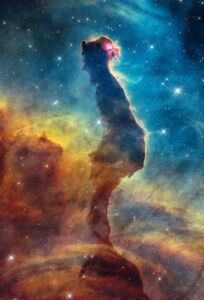
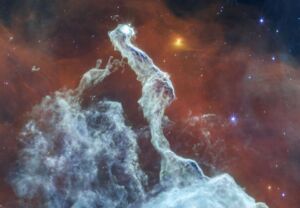
Something in the Carina Nebula looks back at you. Released on Oct. 29, 2026, NASA’s latest James Webb Space Telescope image reveals a towering cosmic pillar that bears an uncanny resemblance to a cat’s head — rendered in glowing mid-infrared light, its contours etched with a precision that feels almost deliberate.
What looks like sculpture is something far more turbulent. The intricate folds and ridges caught by Webb’s instruments are the visible record of forces still actively reshaping this structure today.
A portrait carved by starlight
The Cat’s Head Nebula earns its name honestly. In Webb’s mid-infrared image, the silhouette is unmistakable — a broad, rounded crown narrowing toward a base, with internal ridges and glowing folds that suggest something almost anatomical. The shape isn’t a trick of perspective. It’s been physically carved over long timescales by forces that continue working on it right now.
What makes this image especially striking is the wavelength Webb used. Mid-infrared light passes through dust that would block optical telescopes entirely. Where Hubble might see an opaque wall, Webb sees the internal architecture — layered folds, bright filaments, pockets of denser gas holding their shape against surrounding pressure. Image processing was handled by Joseph DePasquale at the Space Telescope Science Institute, whose work translates Webb’s raw data into the visually coherent portrait now circulating widely.
The Carina Nebula’s role as a cosmic sculptor
The Cat’s Head Nebula doesn’t exist in isolation. It sits within the Carina Nebula — one of the largest and most energetically active star-forming regions visible from Earth, home to some of the most massive stars known. These are objects so luminous they pour out ultraviolet radiation at rates that dwarf anything our sun produces.
That radiation, combined with powerful stellar winds, creates what astronomers call stellar feedback: a continuous outward pressure that pushes into surrounding gas and dust, heating it, ionizing it, and gradually stripping it away. Over millions of years, entire molecular clouds get reshaped into the dramatic structures Webb keeps revealing.
Ground-based observatories and Hubble have both mapped Carina’s major features, but Webb’s sensitivity and resolution let scientists revisit this familiar region and find detail that simply wasn’t accessible before.
Denser material holds its ground — for now
The key to the Cat’s Head Nebula’s survival lies in density. Not all gas and dust within a molecular cloud is evenly distributed — some regions are clumpier, more compact, harder for radiation and winds to erode quickly. The pillar’s distinctive shape reflects exactly this dynamic, where denser material resists while the surrounding environment gets stripped away.
“Resistance” here is a relative term. The same stellar feedback that sculpted the cat’s head will eventually erode it too. What Webb is capturing is a moment in a long transformation — a snapshot of a structure mid-dissolution. Molecular pillars like this are potential sites of ongoing or future star formation, and the dense cores that resist erosion longest are also the regions most likely to collapse under their own gravity and ignite new stars.
Whether that happens before stellar feedback disperses the material entirely is one of the open questions these observations help scientists investigate.
What Webb’s infrared vision adds to the picture
Mid-infrared imaging is particularly well suited to environments like the Cat’s Head Nebula. Dust that absorbs and scatters visible light is largely transparent at mid-infrared wavelengths, letting Webb’s instruments reach structures buried deep inside molecular pillars and producing interior detail that optical telescopes couldn’t resolve in regions like this.
That resolution matters for the science. Mapping how radiation and stellar winds interact with molecular gas at this scale helps researchers build more accurate models of how star-forming regions evolve — where the erosion front sits, how quickly material is being lost, which dense clumps are most likely to survive long enough to form stars. Webb’s data provides the spatial detail needed to start answering those questions.
This image fits a broader pattern. Webb keeps revisiting iconic cosmic regions with instruments that reframe what we thought we understood, and each return tends to surface new complexity.
The Cat’s Head Nebula is a reminder that some of the most turbulent processes in the universe can produce something that looks, from the right distance, almost serene — and that the calm is always temporary.
Read the whole thing?
Get the week's signal, not the noise
Our sharpest reporting on energy, climate and nature — free, once a week.