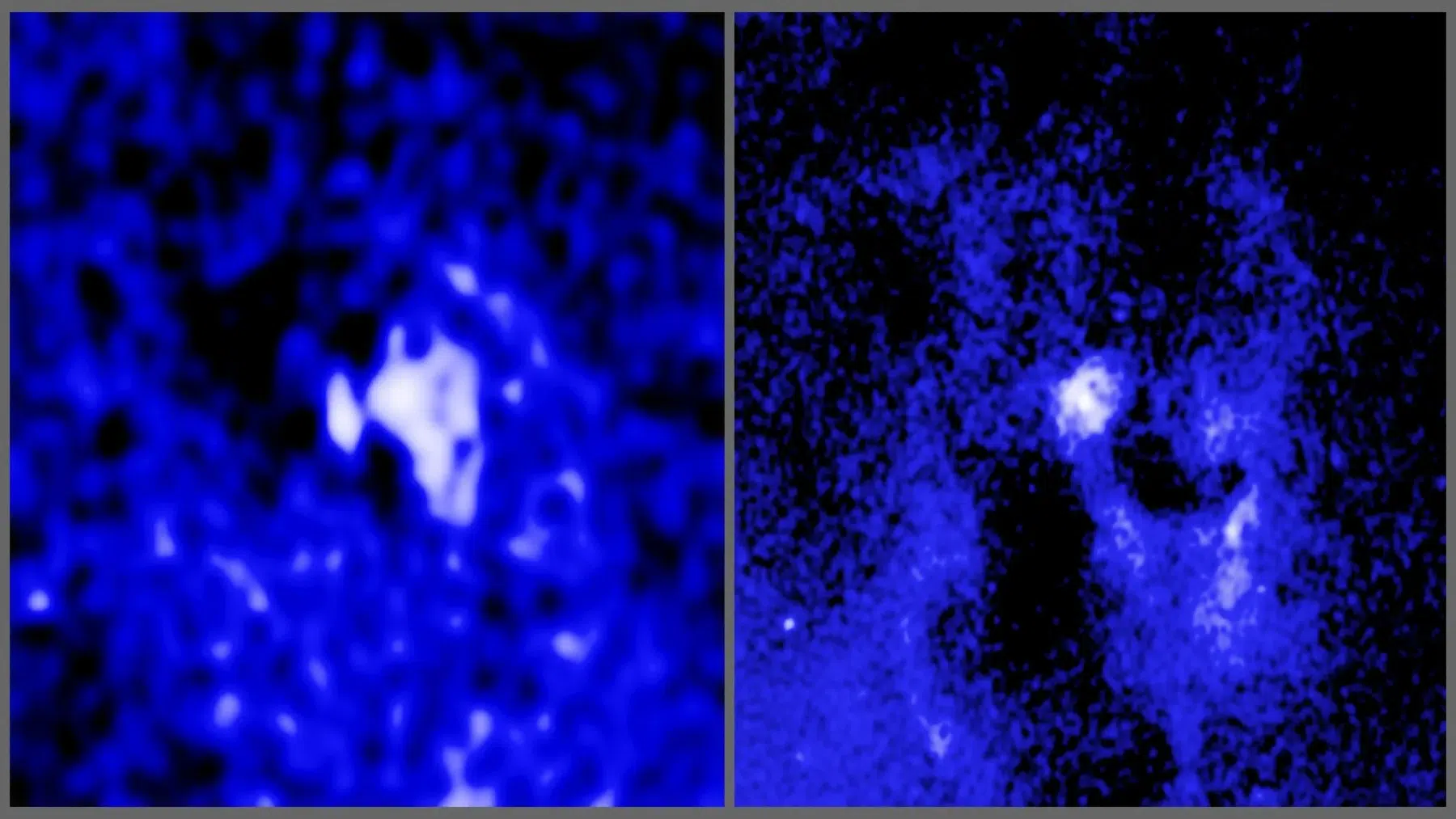
James Webb is not the only super telescope used to identify cosmic phenomena, especially because many things can’t be directly observed. Something NASA uses to identify discoveries is X-ray technology, like the Chandra Observatory in space, which is NASA’s flagship mission for X-ray astronomy, unlike the Hubble and Spitzer Space Telescopes which observe in optical/UV and infrared respectively. To figure out the hidden mysteries of space, scientists couldn’t only stay on Earth. Using this telescope, scientists looked into another galaxy and found black holes shooting energy beams, but not directly to a target.
NASA’s telescope revealed a phenomenon in another galaxy
Using the Chandra X-Ray Observatory and working along with the U.S. National Science Foundation’s National Radio Astronomical Observatory’s Very Large Baseline Array, NASA found something strange in the middle of the galaxy cluster Abell 478 and another group named NGC 5044.
While observing these two galaxy groups – a total of 16 galaxies, each one with its own supermassive black hole – scientists found out that these cosmic destroyers were firing powerful beams into space. To figure out where these jets were pointing and where they aimed in the past, NASA used Chandra and the Very Large Baseline Array to find out that the beams have changed directions, not aiming directly at one specific direction, but at multiple targets over time.
Across the sample studied, NASA found out that about a third of the 16 galaxies had their beams changing their targets by almost 90 degrees – and even though these black holes are 10 billion years old, this is a rapid change for these galaxies.
This can explain how new stars are born
NASA scientists believe that the jets from the black holes help determine how many stars are formed inside their galaxies. The hot gas in and out of the galaxies, when in contact with these beams, is filled with energy and prevents it from cooling down and forming multiple stars.
This is not a new phenomenon – given that the black holes have billions of years. It occurred over timescales of millions of years – a time gap of a blink of a cosmic eye.
According to the theory of relativity of Albert Einstein, time passes differently in other places in the universe, and for people on Earth this is happening right now, but in that point of space it happened a couple of millions of years ago.
Why are the black holes shooting jets?
Black holes shoot these jets when matter falls onto them through an accretion disk. Some material is redirected outward, becoming highly energetic — these are the jets we observe. Not even light is capable of escaping the gravitational pull of these cosmic monsters once it crosses the event horizon.
The direction of the beams is aligned with the rotation axis of the black hole. If the material falls in at a different angle, it could affect the direction of the rotation axis, causing the difference in the direction the beams are shooting at, but this is not the first time NASA found black holes shooting ‘fireworks’ in the universe.
The author refers to the black hole as a ‘death star’
The author of the study published in The Astrophysical Journal, Francesco Ubertosi, a researcher at the Department of Physics and Astronomy of the University of Bologna, shared in an interview with BBC that about a third of the jets coming off the black holes are pointing to different targets than before. The nickname comes from the fictional space station from Star Wars, the home of Darth Vader in the movie saga.
Read the whole thing?
Get the week's signal, not the noise
Our sharpest reporting on energy, climate and nature — free, once a week.