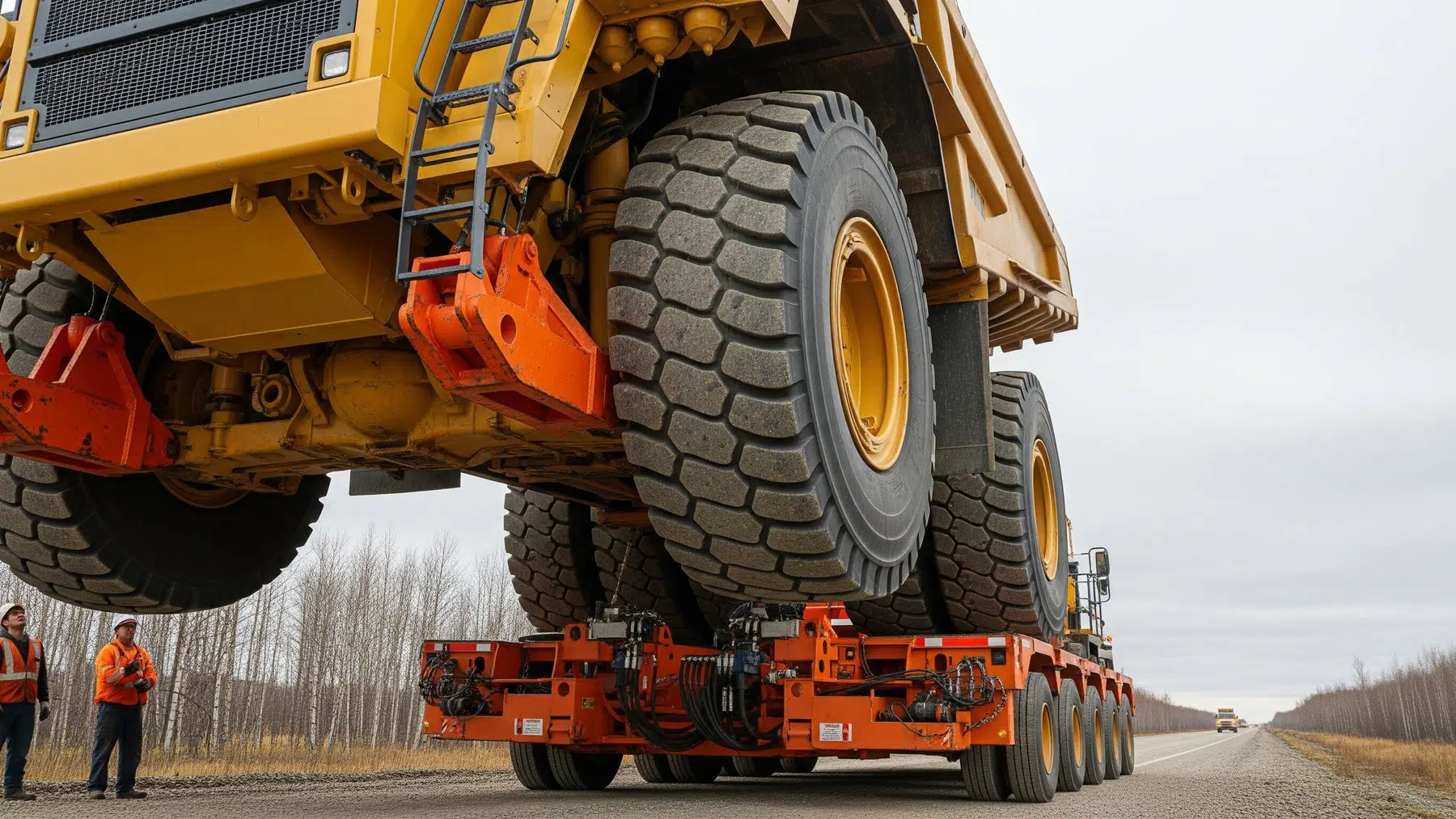
A load that fills a northern Alberta highway curb to curb, with nothing left over for anyone else.
Four pilot cars, four tractor units, a crew of at least ten people.
Underneath all of it sits a mining truck that nobody has taken apart.
The first one travelled that way in October of 2015, and the method has been routine since.
What changed was not the weight. It was never the weight.
Which is the thread worth pulling. What actually stops a whole truck from using a road?
Why 32 feet beats 600 tons
Weight is the easy half of an oversize move, and the trade solved it decades ago.
Spread a load across enough axles and the pressure under any one wheel drops to something a pavement can carry. That is arithmetic, and a permit office will sign it.
Loaded, one of these machines grosses nearly 690 short tons, and that figure frightens nobody who books heavy transport for a living.
Width has no equivalent trick. A road is as wide as it is, and nothing an engineer bolts on makes it wider.
A hauler in this class measures about 32 feet across the outside of the body and a shade over 31 across the tires. A highway lane is 12.
So the assembled machine is not a wide load in the ordinary sense. It is both lanes and both shoulders at once.
That is why the convoy occupies the entire road, and why the permits are held to untrafficked hours.
3 loads and what each one removes
Look at what the teardown actually takes off, because it gives the game away.
The dump body comes off first, lifted away with cranes. That kills the height, since a raised body on these machines reaches past 51 feet.
Then two rear tires come off. Each stands over 13 feet tall and weighs about 11,700 pounds, and pulling that outer pair is what narrows the chassis.
Whatever is left travels as the third load.
The two published accounts do not even agree on the count. One says the machine goes to site in eight pieces across three loads, the other describes three loads and lists what sits in each.
Nothing in that sequence is about shedding tons. Every step of it is about getting under a height line or inside a width line.
The teardown is a geometry fix wearing a weight problem’s clothes.
1 steel frame and 5 to 7 days
The replacement is less exotic than the write ups suggest, which is the interesting part.
A heavy haul contractor took two standard trailers, set them side by side and bolted them together. Onto that went a steel lifting frame 32 feet across, fitted with hydraulic jacks that pick the machine up off its own wheels.
No self propelled transporter, no dozens of independently steered axle lines. Two trailers and a plate.
The saving is where the accounts part company. The contractor puts it at five to six days, while a project manager at the dealership told a trade magazine on the fourth of November, 2016 that each move spares the mine 5 to 7 days of downtime.
Speed never entered the bargain.
A delivery to a site an hour away still takes two full days.
The bridge that sorts the mines
Here is the limit that stays out of the brochure.
The route out of the dealership’s Fort McKay shop crosses the Athabasca River, and that crossing cannot take the assembled load, in the way that a rolled bridge or a mill generator turns into a routing problem.
Whole truck delivery therefore reaches the more southerly mines and not the ones beyond the river, and the contractor case never mentions the crossing at all.
The first claim deserves the same reading. The contractor calls that October the first permitted haul of a whole truck of this model, while the trade account gives the same month and never calls it a first.
The weights do not quite agree either, 320 tons on one page and about 330 on the other.
Neither of those is the truck’s rating.
What 400 tons actually means
That last point is the one most write ups get backwards.
The 400 in the name is payload. It is what the bed holds, 400 short tons of rock, and it says nothing about what rolls down a highway.
Loaded, the machine grosses 1,375,000 pounds, which is nearly 690 short tons.
Empty, the published chassis and body weights add to about 285 tons, while the two accounts of the move say 320 and 330.
None of those three figures is 400, and the one in every headline is the only one that is not a weight at all.
A mining truck is a bucket that drives, and hauling it whole was only ever hauling the bucket.
Read the whole thing?
Get the week's signal, not the noise
Our sharpest reporting on energy, climate and nature — free, once a week.