Many islands still rely on diesel generators for electricity. In remote locations, electricity often begins with a ship arriving at the harbor.
Power is needed every day whether fuel prices rise or not, and so this cycle repeats itself again and again because reliable electricity must be available daily.
Therefore, when one resort in the Maldives announced that it could run on up to 90 percent renewable electricity, the claim was certainly unique.
Achieving such high levels of renewable energy on small island systems immediately raises a question. How did they manage to do this?
Getting close to 90 percent was difficult enough
The resort is called Soneva Secret, and its core objective was to reduce diesel reliance to the greatest extent possible. This was done to dramatically increase the amount of renewable energy available to the island compared to most island-based systems.
Small islands are not generally recognized for providing adequate space for building large-scale energy infrastructure.
As soon as an island decides to pursue a large-scale renewable energy project, it quickly realizes that it is faced with another issue.
That’s where the real problem appeared
While renewable energy may appear to be a viable alternative to diesel energy production, there is always a catch. Finding sufficient space to develop enough renewable energy to meet the energy demands of the island is the main problem.
Typically, large-scale solar projects require a great deal of area.
On many islands, land is being used for multiple purposes simultaneously.
Buildings require space. Tourism requires space. Nature requires space. Energy development requires space too.
And so, the more the project relied upon diesel reduction, the harder this problem became.
There was now a question as to where all that solar capacity could actually be developed.
The solution wasn’t where most people would think to look
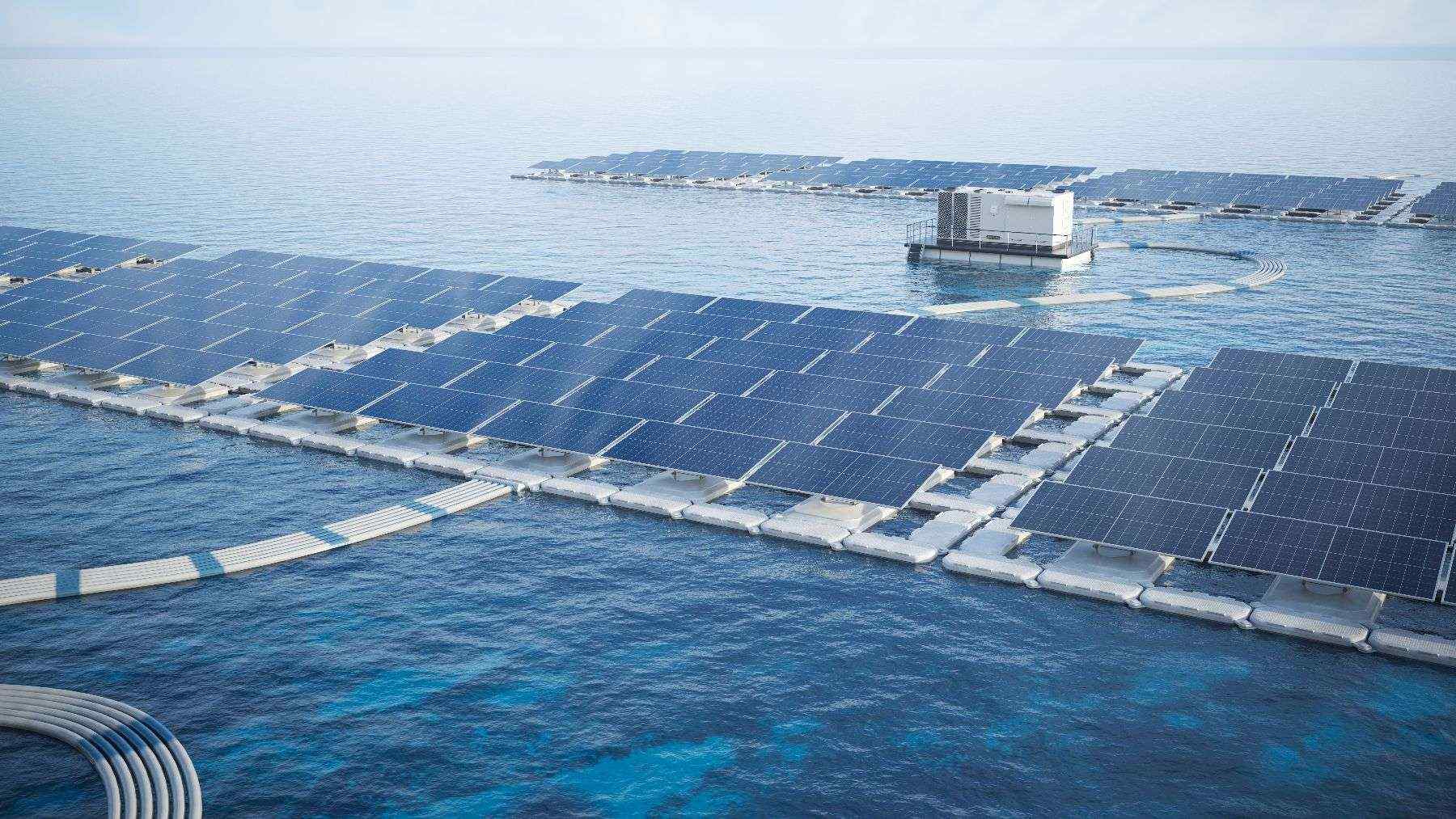
Developers didn’t try to find new land for the solar installation. Instead, the solar installation was built directly on the water.
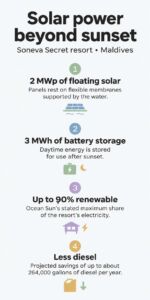
A floating solar array was developed along with battery storage that would hold excess electricity generated during daylight hours. The system was based on technology developed by Ocean Sun.
Therefore, the system developed and integrated by Canopy Power could contribute to meeting energy demands long after sunset rather than losing the benefits of that energy with the loss of daylight.
Yet eliminating the need for large areas of land alters the equation entirely. Once this barrier is removed for an island, many other operational barriers become less relevant.
One success story doesn’t answer everything
Nonetheless, while this project represents one model for overcoming common barriers to renewable energy development on islands, it does not provide proof for solving all island-related problems.
Rather than serving as a universal solution, it shows that at least some barriers traditionally associated with developing renewable energy on islands can be overcome in different ways.
That distinction matters for anyone looking at wider adoption.
But the percentage was only part of the story
This project also shows that success can be evaluated in terms of more than just percentage points.
That capability translates to potentially avoiding up to 1 million liters of diesel per year. Avoiding that quantity of diesel results in preventing more than 2,000 tons of CO₂ emissions annually.
What made the difference was the ability to eliminate a considerable amount of diesel generation.
Now imagine that challenge on hundreds of other islands
The Maldives is certainly not the only place that faces these challenges.
Island communities throughout the world continue to experience and respond to competing demands of limited land availability, increasing energy requirements, and dependence on foreign fuels.
None of these issues will disappear anytime soon. Projects similar to Soneva Secret will not solve all of the energy-related issues faced by islands.
They do, however, represent examples of a different approach to addressing them.
Read the whole thing?
Get the week's signal, not the noise
Our sharpest reporting on energy, climate and nature — free, once a week.