Drone technology has improved immensely over the past few years.
From big, basic unmanned aerial vehicles to highly advanced, minuscule devices, drones are more advanced than humans could have ever thought possible.
Drones are used in numerous sectors,s from conservation to public safety, from military to entertainment, and much more in between. Their advancements are intriguing, but one thing remains a concern.
How can they navigate novel areas and promise a completely safe flight?
The navigation systems of modern drones
Basic drone navigation systems operate in a straightforward manner. One sets a route beforehand, and the drone is able to follow the route from start to finish.
In these cases, a drone cannot see an obstacle that happens to enter its predetermined route, like a bird or a branch, for example.
More advanced systems have the addition of cameras or sensors to avoid obstacles in their paths. These are able to move around still objects like a branch, and perhaps move away from something that was moving slowly in their path.
But can a drone navigate a route laden with constantly moving and shifting obstacles?
MIT researchers announced a new drone navigation system that claims it can do just that.
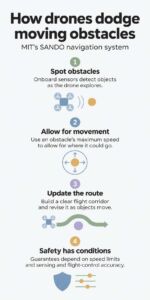
MIT’s new drone navigation system claims it can do what no other drone can
Let’s imagine a scene of a burning building, or a wildfire raging through a forest. Usually, a drone would be unable to navigate such a scenario.
In such a rescue scenario, a drone could be highly beneficial. Drones could be used to scout areas and offer important visual feedback.
But with too many falling hazards that could damage the drone, it has not yet been a successful operation. But if a drone had a heightened navigation system that could dodge moving objects, that would be a different story.
Not only would this benefit search and rescue operations, but conservation drones such as these could see improved flight outcomes as well. MIT researchers could have the system that the world has been waiting for.
Most modern navigation software can’t include moving objects in its flight path, and is only able to say they are safe when obstacles around it are still.
But Kota Kondo, who recently earned his doctorate at MIT, is leading a research team that may have the answer.
New drone navigation system that comes with a mathematical proof of safe flight
His system is called SANDO, and it is able to create flight paths through unmapped spaces while obstacles keep moving around it.
This system can actually create a safety corridor ahead of the drone, which is a chain of connected spaces that have no obstacles. As the drone flies, the corridor changes or updates. It keeps the drone away from areas with lots of obstacles, allowing a safer and faster route.
And this is not just in computer simulation. In over 10 test flights using a real drone, the SANDO system has flown without hitting a single moving obstacle. Very promising results for a new navigation system.
Of course, the system cannot predict where an obstacle will appear, or what path it will take, but it can plan for the worst-case scenario. Which is what it does.
SANDO uses the identified obstacle’s top speed and draws a buffer around the obstacle. This buffer sphere then predicts the various places that the obstacle could hit over a specific time period.
Use that for every obstacle around the drone, and it can avoid each one, creating this safety corridor mentioned before.
This type of invention could be extremely valuable to many industries, offering almost automatic flight for the drone. MIT students are clearly able to create incredible inventions, but this development from NC State students might just top it.
Read the whole thing?
Get the week's signal, not the noise
Our sharpest reporting on energy, climate and nature — free, once a week.