Astrophysicists have been aware for many years that stellar wind accretion allows some dead stars to feed on material from nearby stars.
Many of the powerful X-ray flares indicate that this is indeed happening. However, what has proven to be extremely difficult to measure is the actual material being captured.
Recently, a binary system approximately 13,000 light-years away from our solar system has given us that opportunity.
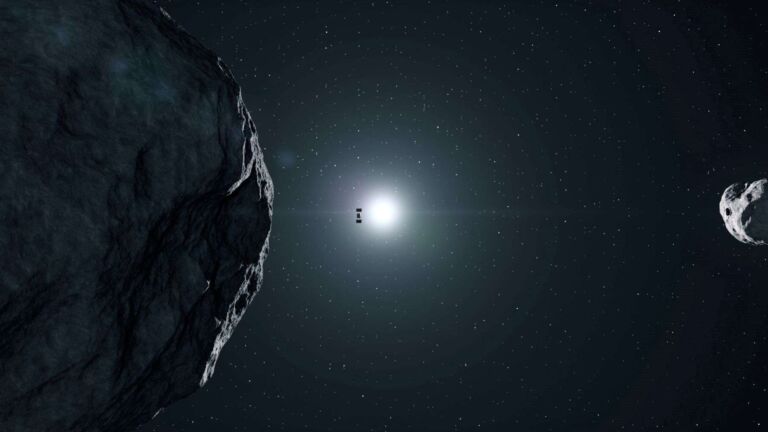
In this system, there is a neutron star gathering material from the stellar wind flowing away from a giant companion called Wray 977.
During the interaction, a temporary disk formed around the neutron star and later broke apart. A second disk then formed, spun in the opposite direction, and disappeared.
One star spent days feeding on another
Wray 977 is a blue hypergiant, roughly forty times the mass of the Sun and sixty times its volume.
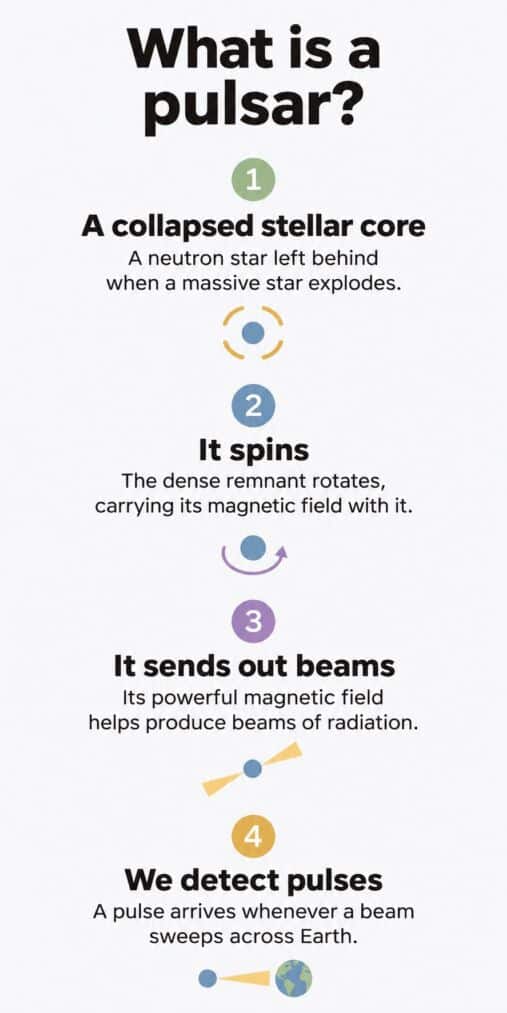
The other component in the binary system is GX 301-2. It is a neutron star produced when a star died in a supernova explosion.
Despite having more total mass than the Sun, the neutron star is only twenty kilometers wide.
Wray 977 continuously loses massive amounts of gas into space.
As GX 301-2 moves through part of that outflow during its orbit, astronomers believe that its gravitational pull may produce an area of particularly high density in the outflow.
A four-day journey through a stream of gas
GX 301-2 passes through this area twice during each 41.5-day orbit. Each event lasts approximately four days.
It appears that both events result in increased X-ray brightness.
Astronomers were able to measure the movement of gas near the neutron star and obtain strong evidence of material falling toward the compact object.
For the first time, researchers were able to directly track the movement of this material as it approached the neutron star.
They measured the gas moving toward the neutron star at about 540,000 kilometers per hour.
An unstable disk shifts through multiple structural phases
As GX 301-2 initially encounters the high-density flow, the captured material develops into a turbulent disk around it, a process illustrated by NASA XRISM. Material then spirals into this disk until it reaches the neutron star.
When the object penetrates further into the flow, something unexpected occurs. The disk breaks up.
Instead of forming an orbiting pattern, material starts falling straight onto the neutron star.
By the time it has reached near the end of the event, a small disk forms again but now spins in the reverse direction. However, once again this disk disappears as GX 301-2 leaves the flow.
The overall sequence appears to resemble a cosmic version of a machine building itself up repeatedly, breaking down and reassembling in a different configuration.
A long-standing idea finally has direct evidence
For many years, astronomers have developed theoretical models describing how neutron stars collect material from their companion’s stellar wind.
Now, thanks to BP Crucis, scientists have an opportunity to test these theories against actual observational evidence.
Rather than rely solely on calculations, researchers can now observe how captured material behaves shortly before reaching GX 301-2.
As a result, BP Crucis provides one of the clearest views yet of wind-fed accretion.
One unusual stellar partnership may reveal much more
Although BP Crucis is only one such system, its behavior gives scientists a valuable opportunity to study some of the most extreme environments in the universe.
Each passage through the gas-flow region gives scientists another opportunity to study matter under intense gravity.
These initial observations suggest that the material-transfer process is significantly messier and more complex than previously thought.
Direct observations of gas falling toward the neutron star now allow astronomers to test long-standing theories.
Read the whole thing?
Get the week's signal, not the noise
Our sharpest reporting on energy, climate and nature — free, once a week.