
A fish no longer than a pencil slides headfirst into a steel pipe.
On the other end, a runner is already spinning.
For a young sturgeon, that trip has usually had one of two endings.
At a test facility in Alameda, California, engineers wanted to know whether a different blade shape could change the odds.
So they built one, bolted it into the same rig, and started sending fish through.
What came out the other side looked nothing like the textbook result.
A blunt, slanted edge replaced the usual knife shaped one
The mechanism behind the result is almost embarrassingly simple. A conventional turbine runner has a thin, straight leading edge, built that way because thin edges are efficient at turning moving water into electricity.
The trade off is that a thin edge meeting a fish at speed behaves like a blade meeting a target. The redesigned runner, called the Restoration Hydro Turbine and introduced by Natel Energy, flips that geometry to thick, slanted leading edges with minimum gaps.
A blunt, swept edge pushes water ahead of it, so a fish is more likely to be shoved aside than cut. The same geometry had already been tried with alewife and American eel, at blade speeds of about 51 and 63 feet per second, with full survival reported in both.
What nobody had confirmed was whether a bony, armor plated fish like a sturgeon would respond the same way, since its stiff scutes and rigid body are built differently from a soft bodied eel.
Groups of young sturgeon were released by hand into the spinning runner
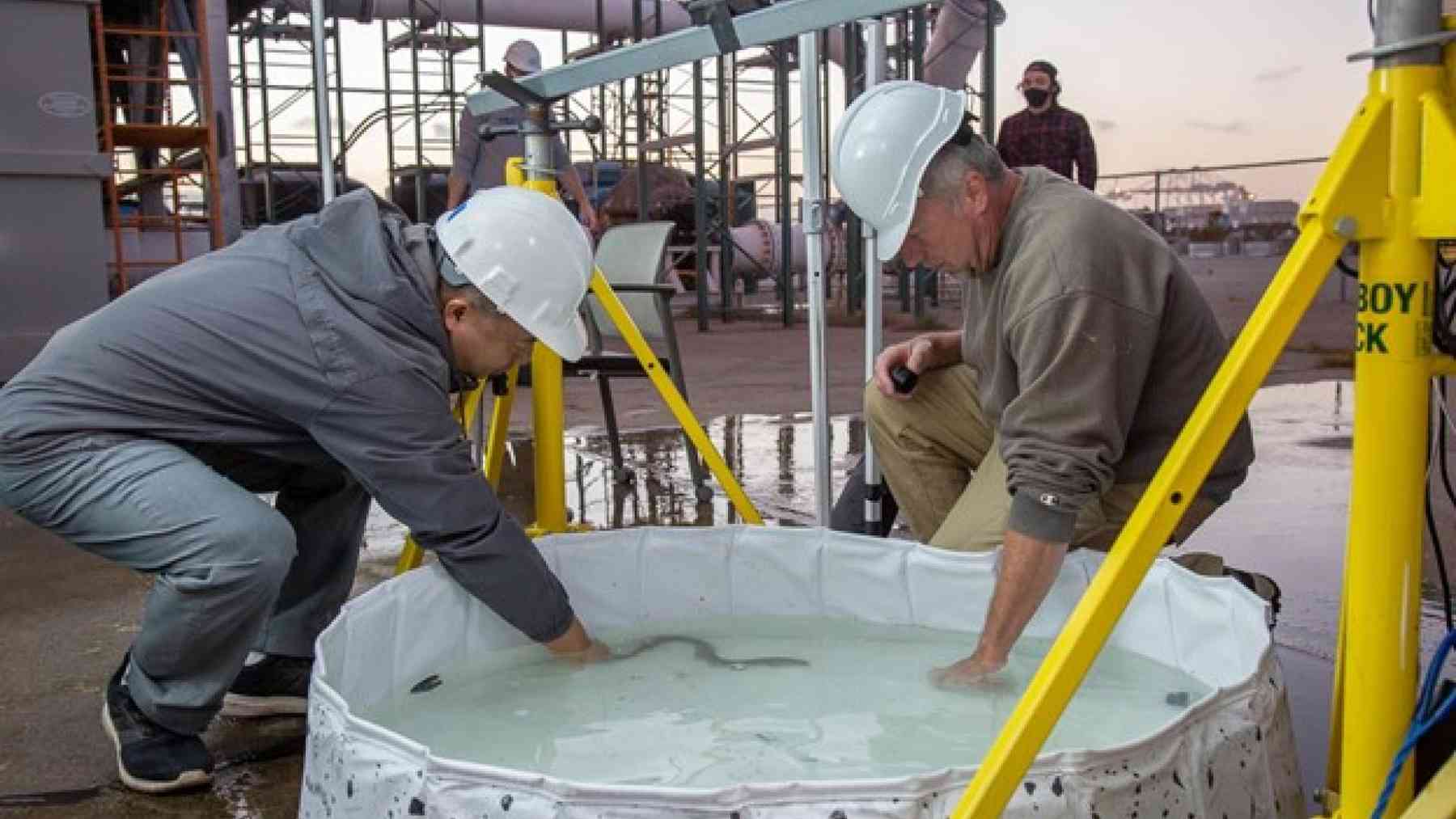
The scene inside the lab looked almost ordinary. Technicians carried small groups of juvenile white sturgeon to the turbine intake and released them five at a time, letting the current carry each fish into the spinning runner.
Downstream, waiting hands recaptured every animal within seconds for inspection.
High speed cameras recorded passages so researchers could see how a fish’s body moved against the blade in the instant of contact. That footage turns a survival tally into an explanation, showing which fish were struck, which were nudged clear, and where on the body the metal landed.
112 fish went through the new runner, and only one did not survive
The numbers, once tallied, told a blunt story of their own. Researchers passed 112 juvenile white sturgeon through the redesigned runner and a comparable group through the conventional one, with the same head and rotational speeds producing five blade speeds between 49 and 91 feet per second, or roughly 34 to 62 miles an hour.
Through the conventional runner, 48 hour survival ran from 42 to 78 percent depending on speed, averaging 64.5 percent, with about a third of all tested fish killed by severing.
Through the redesigned runner, immediate and 48 hour survival held at 100 percent at every speed except the fastest, 62 miles an hour, where 48 hour survival was 95.6 percent. Control fish handled the same way but routed past the turbine survived at 100 percent, 119 out of 119.
The fish were fully anaesthetized for passage, which removes any role for a fish’s own swimming or startle response. The work was done with the UC Davis Fish Conservation Physiology Lab, and the Department of Energy funded the sturgeon passage project.
Earlier tests on eels and herring pointed the same direction
None of this emerged from nowhere. At the same Alameda facility, working with Pacific Northwest National Laboratory, 131 American eels were passed through a 22 inch model of the design, and 48 hour survival was 100 percent for both the passed eels and the controls, with no major injuries.
Juvenile alewife run through the design at a Maine hydro plant showed 98.2 percent immediate and 100 percent delayed survival, and a trout test with Pacific Northwest National Laboratory reported 100 percent survival of all 60 fish. Those trials sit inside a broader rethink of what turbine blades are shaped from and what becomes of them, a thread that also runs through blade recycling work.
Because sturgeon are armored and rigid rather than soft bodied, their strong showing suggests the blunt edge principle is not limited to one body type. Even so, these are model scale laboratory results covering one manufacturer’s design, and two of the paper’s authors work for that manufacturer.
A wear advantage may matter as much as the fish survival number
What makes the finding more than a curiosity for dam operators is a second, separate claim about durability. The developer has published separate work on how runner blade shape affects hydro abrasive erosion, arguing that a thick leading edge holds up better in sediment heavy water and so buys a longer service life before parts need replacing.
That durability question matters wherever river flow swings hard, as it does at the hydropower dam beside a northern Finnish city.
The erosion finding sits outside the sturgeon paper, so it deserves scrutiny before anyone treats it as settled. Still, a runner that protects both fish and its own blades is a rarer combination than either benefit alone.
It is also already leaving the lab. The first fully submersible unit of this type was installed for an Austrian utility in late 2022, the company says its runners are now operating at sites in North America and Europe, and a feasibility study is under way for retrofitting far larger turbines on the St. Lawrence River, where the next real test is whether a model scale survival rate holds for wild fish in a working powerhouse.
Read the whole thing?
Get the week's signal, not the noise
Our sharpest reporting on energy, climate and nature — free, once a week.


