Putting sheep under solar panels isn’t so straightforward.
The assumptions that they will eat the grass and the sun will power the electricity sounded good.
It turns out that the number of sheep was significantly more important than previously thought.
Smaller flocks increased beneficial insects, whereas larger flocks decreased the population of honeybees.
These studies demonstrate that simply increasing the number of sheep does not consistently lead to better ecological outcomes.
The smallest flock provided the biggest surprise
Cornell University conducted a study at the Cascadilla Community Solar Farm in Dryden, N.Y.
They studied various grazing densities, from none to ten sheep per hectare, and examined how these grazing levels affected beneficial insects.
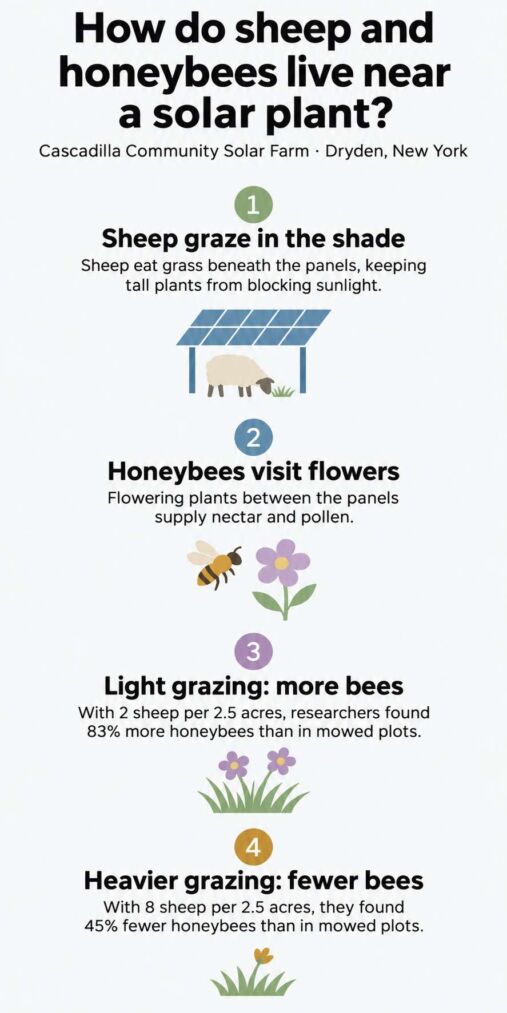
Fields with two sheep per hectare resulted in 38% more beneficial insects than the unmowed fields.
Honeybees made up almost all of this increase, with their populations rising by 83%.
Ladybugs and wild bees were also tracked over the course of the project.
A total of 2,445 beneficial insects representing 53 species were documented over three years of tracking.
More sheep did not mean more bugs
The scientists initially hypothesized that increasing grazing pressure by adding more sheep would produce a suitable environment for beneficial insects.
Compared to the mowed control plot, the beneficial insect population remained about the same at four sheep per hectare.
At six sheep per hectare, however, honeybees began to decline.
By the time the researchers reached eight sheep per hectare, the honeybee population dropped 45%.
At ten sheep per hectare, their population decreased 68%.
Everything seemed to depend on what the sheep left behind
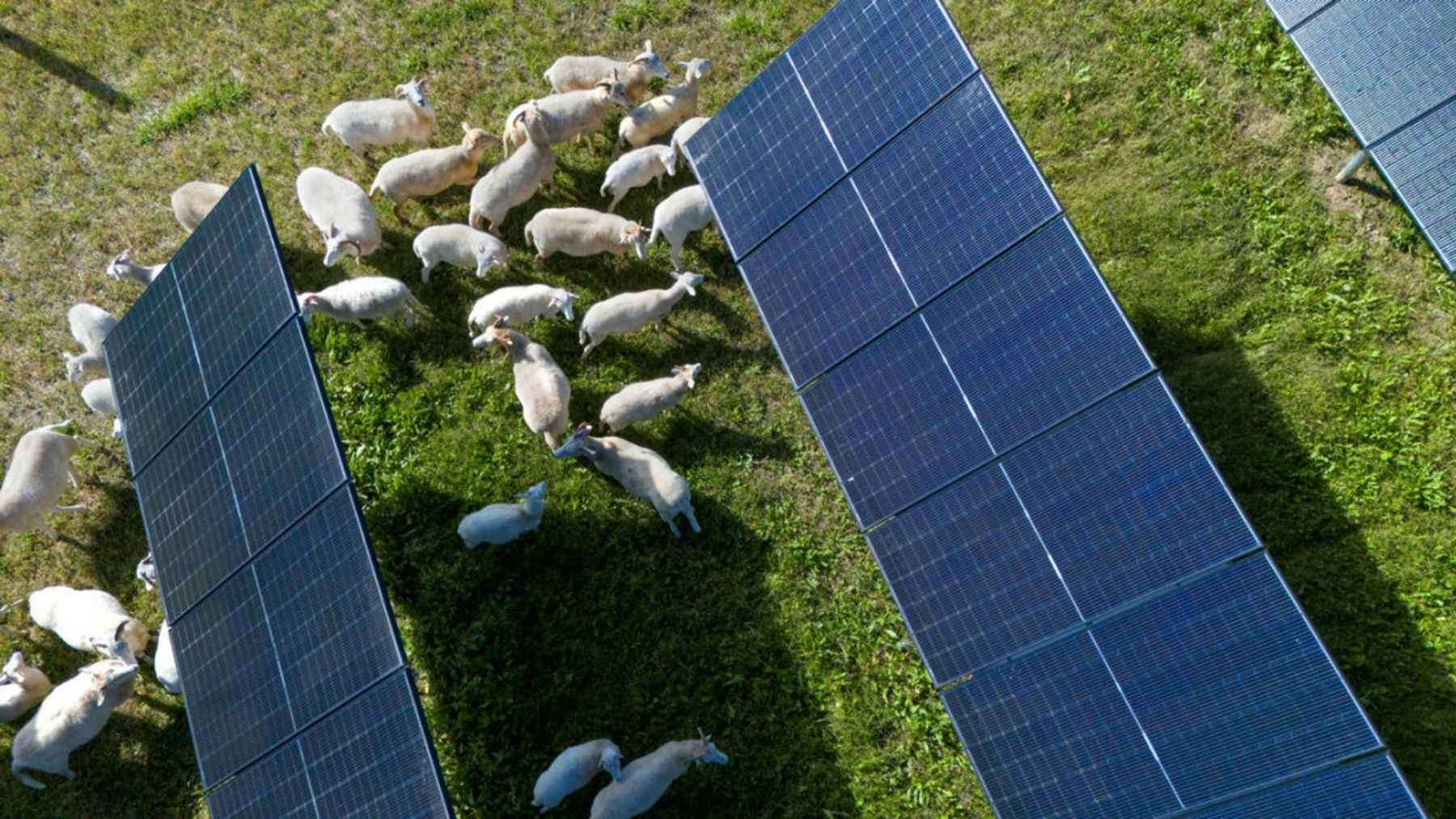
Solar grazing has been gaining popularity over the last several years, with approximately 100,000 acres in the United States currently being grazed using this method, according to Cornell University.
In these dual-use systems, animals prevent vegetation from shading solar panels, a relationship highlighted in Environmental Research Letters.
The panels provide shade for the animals. The mechanics of this balance appear to lie in stocking density.
Light grazing leaves more flowers and varying plant structures intact. Heavy grazing can destroy flowering plants and disrupt insect habitats.
The study confirms that pollinators respond directly to these structural environmental changes.
One answer solved one problem, not two
One single result towered over all others. The ecological optimum wasn’t aligned with the operational optimum.
For beneficial insects, two sheep per hectare produced the greatest results.
For vegetation management, a separate study at the same site determined that eight sheep per hectare represented the optimal amount.
Because these two objectives did not naturally intersect, a distinct operational trade-off exists.
Land managers are forced to optimize primarily for insect abundance or vegetation control.
A compromise may already exist
To resolve this tension, researchers determined that there is a middle-ground stocking rate that falls between these conflicting objectives, four sheep per hectare.
At four sheep per hectare, insect communities were statistically equivalent to those of ungrazed controls.
Vegetation control remained vastly superior to light grazing alone.
The study’s findings provide practical guidance for farmers grazing sheep beneath solar panels.
Solar companies and land managers may benefit as well.
What started as weed control could become something larger
Expanding on these field findings, Cornell researchers developed a dedicated planning tool for solar-grazing farmers.
It helps operators manage flock sizes, operational costs, revenue streams, and vegetation growth.
For sheep farmers, this represents commercial opportunities extending far beyond basic weed control.
Solar grazing contracts provide a stable source of long-term income.
Several regional farms have already expanded their operations as a result.
At scale, solar grazing has the potential to support the expansion of large-scale domestic sheep production.
Approximately 50 percent of lamb and mutton consumed in the U.S. is currently imported.
Widespread adoption of solar grazing could therefore drive significant growth in domestic livestock operations.
Read the whole thing?
Get the week's signal, not the noise
Our sharpest reporting on energy, climate and nature — free, once a week.