

A planet was hiding in plain sight inside another star’s solar system until researchers taught a computer to “peel away” blinding starlight our greatest telescope couldn’t escape.
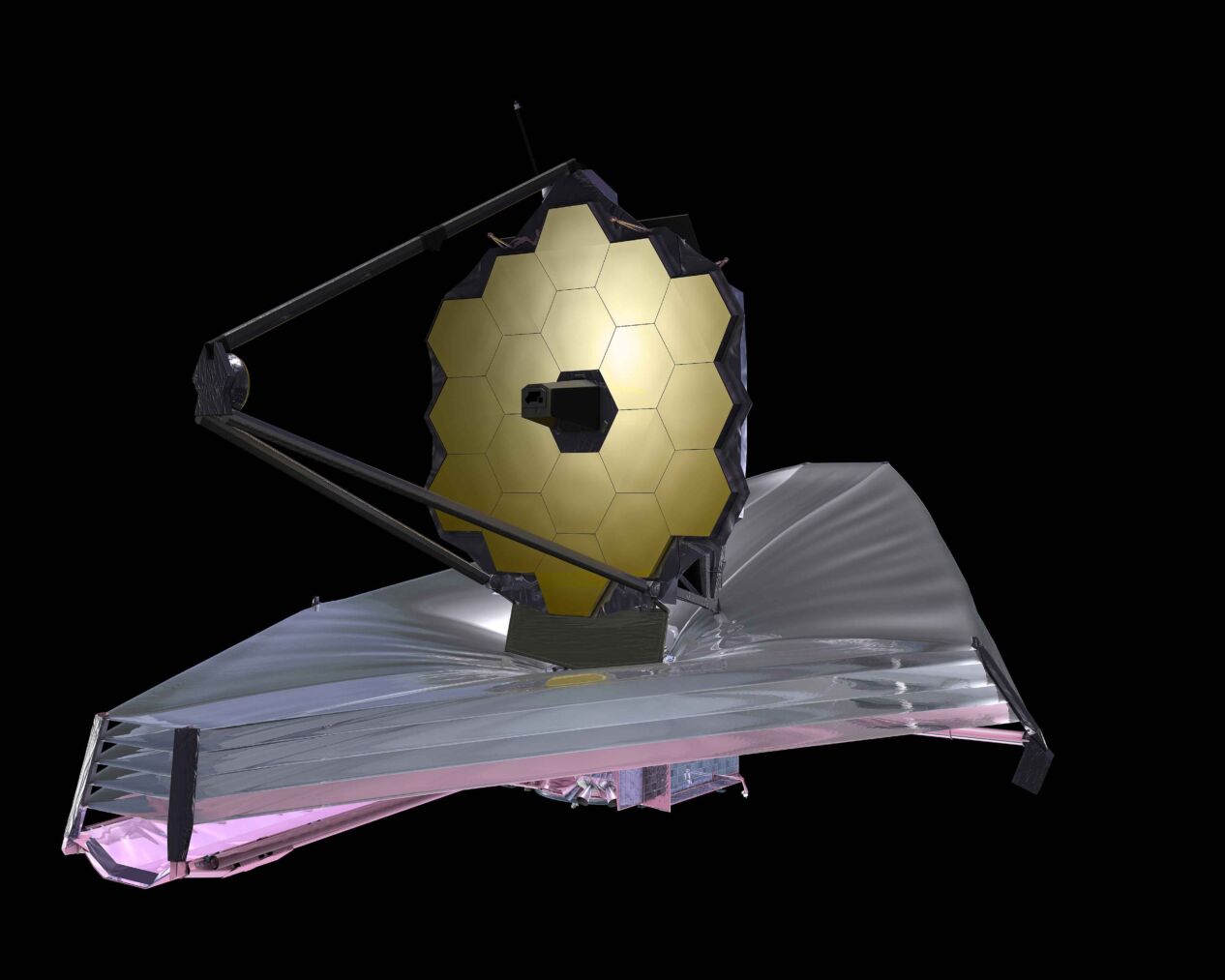
The James Webb Space Telescope keeps its mirrors aligned to within a nanometer of perfect — a level of precision that’s almost impossible to imagine. And yet, it still isn’t enough. Across billions of collected images, the blinding glare of distant stars routinely drowns out the very planets astronomers are hunting for.
A team of researchers now believes the answer was never another telescope. It was a smarter way of looking at what the most powerful one already saw.
When the most powerful telescope still can’t see the planet
Stars are brutally bright neighbors. A planet like Earth, orbiting a Sun-like star, can be roughly 10 billion times fainter than the star itself. That gap makes direct imaging of exoplanets one of the hardest problems in modern astronomy — even for a telescope as extraordinary as JWST.
Webb’s mirrors hold their alignment to within a nanometer, one billionth of a meter. Distortions even at that scale scatter enough starlight to bury a planet’s faint signal completely, according to Caltech.
Astronomers use coronagraphs — instruments designed to physically block starlight — to help. They reduce glare meaningfully, but can’t eliminate every source of interference. Tiny optical imperfections still leave residual patterns that can mask a nearby planet. The Milky Way is believed to hold billions of planets, most remaining invisible not because they aren’t there, but because the surrounding light is simply too overwhelming to see through.
Building a virtual telescope to outsmart the real one
The core idea behind the new technique is disarmingly simple: if you can’t fix the telescope, model it precisely enough to undo what it does to the light.
Researchers built a detailed computer simulation of Webb’s Near Infrared Camera, known as NIRCam. This “digital twin” maps exactly how starlight spreads through the telescope’s optical system. To refine the model, the team borrowed computational optimization tools from machine learning, adjusting millions of variables simultaneously until the simulation closely matched what the real telescope produced. The resulting technique is called FLIP: Physics-based Learning for Imaging Planets. It works on images already collected — no new hardware, no additional telescope time, no modifications to Webb itself.
How a failed thesis became a planetary breakthrough
The path to FLIP wasn’t straightforward. Lead author Rodrigo Ferrer-Chavez first encountered the problem as an undergraduate at the Autonomous University of Yucatán in Mexico, where he joined a summer research fellowship with astronomer Jason Wang.
His early approach — training machine learning models to predict starlight patterns directly from telescope data — didn’t work. That failure turned out to be essential. “Rodrigo’s senior thesis was an exploration of possible approaches, none of which ended up being what we did for this paper,” Wang says, “but it helped rule out what not to do and also helped us understand the problem better.”
The pivot was conceptual. Rather than asking an algorithm to predict glare, the team modeled the telescope’s physics from the ground up. Ferrer-Chavez describes watching the star’s glare begin to “disappear in very bizarre ways. It gets dimmer and very deformed until at the end you get a pretty clean image and, if you’re lucky, there’s a blob there, which is a glowing planet.”
A planet found without leaving Earth — and more may follow
FLIP has already delivered. Researchers applied the technique to existing JWST archival data and uncovered an exoplanet hidden in images already collected — found without a single new observation.
In tests involving known planets, FLIP achieved two to fifteen times greater detection sensitivity than conventional methods. That’s a significant margin, not a marginal one.
The implications are real. Many archival images were analyzed with older methods and found to contain nothing but bright stars. FLIP gives astronomers a reason to look again — and a practical one. “We can try to find planets that may have been missed there, and also planets that perhaps we tried to image, but we could not actually detect at the time,” Ferrer-Chavez explains.
From James Webb to the search for another Earth
FLIP isn’t exclusive to Webb. Wang notes that the technique “could be used on any telescope” trying to directly image exoplanets, including ground-based observatories and future missions still in development.
One consequential application could involve NASA’s proposed Habitable Worlds Observatory, or HWO, designed to photograph Earth-like planets in habitable zones of Sun-like stars. Imaging something 10 billion times fainter than its neighbor requires suppressing starlight to a degree that pushes physical limits. FLIP suggests some of that burden could shift from hardware to software — a meaningful redistribution of where the hard work happens.
“We’ve now gone beyond the telescope stability limit for the first time with this new technique,” Wang says, “and this new paradigm, I think, can be applied to every instrument that’s trying to image exoplanets.” The team plans to extend FLIP to additional instruments, including the Nancy Grace Roman Space Telescope.
Read the whole thing?
Get the week's signal, not the noise
Our sharpest reporting on energy, climate and nature — free, once a week.


