Solar farms are typically found in wide open spaces, deserts, and flat areas.
But the Swiss Alps seem an unlikely place to build one! Above the village of Sedrun lies a huge solar farm, situated over 6000ft above sea level.
Some parts of the project are even already producing electricity.
It seems like a challenging place to build a solar farm, but actually the mountains are the reason this project is happening!
Winter creates a growing energy challenge
During colder times of the year, we still need electricity.
Often there is more pressure on our energy systems during the winter months as heating requirements rise and the days get shorter.
Winter electricity supply has become a particularly important issue in Switzerland. By generating enough energy during the colder months, we can limit how much electricity we need to import.
This has led to new ideas on where and when to produce our energy.
Not every solar farm can solve that problem
Solar energy is often seen as an energy source in the summer.
Longer days and clearer skies mean we can produce more electricity.
During the winter, however, the sun will be lower in the sky. There will often be more fog in certain areas.
Lower altitude areas can suffer from the snow and weather, meaning they do not perform as well as expected. As a result, traditional solar farms struggle to keep up during the winter.
New methods have come into focus in order to maximize the energy generated during the colder months.
One project is taking a different approach
SedrunSolar has taken a completely different approach.
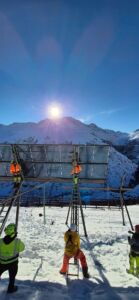
The solar farm has been built up in the Alps at an altitude of between 1950 and 2100 meters.
Located in the Scharinas and Cuolm Val area above Sedrun, the farm itself covers around 33 hectares of land.
Once completed, there will be over 34,000 solar modules mounted across thousands of structures. Construction has been built in phases.
As a result, the finished parts are already sending out power while the rest is still being built.
The fact it has been built in the mountains is not a problem. It is actually a huge advantage.
The Alps offer more than just open space
There are many advantages to building this project in the Alps.
Higher altitudes often give more direct sunlight. There will be less fog.
The cooler temperatures help the solar modules perform better.
Snow actually helps because it can reflect sunlight, which can then be captured by the bifacial solar panels that gather sunlight from both sides.
All of this can drastically improve the performance of the solar farm during the winter months.
Almost half of the electricity produced throughout the year will be during the winter months.
This is often when extra renewable energy can be most useful, adding to the value of the Primeo Energie project.
Few solar projects operate on a scale like this
The project is large. Once operating at full capacity, it is expected to produce 19.3 megawatts.
Overall, the project is expected to produce around 29 gigawatt-hours annually. This will power around 6,500 homes.
The combination of thousands of solar tables, tens of thousands of photovoltaic modules, transformers, inverters and computer monitoring systems creates a massive energy hub in the Alps.
This unusual idea is becoming a functioning power plant.
Similar ideas may soon appear far beyond Sedrun
This is a trial to see if we can use solar farms at high altitudes more in the future.
The project is expected to run at full capacity by 2028. Performance will be monitored carefully.
This is because it will help answer the question many countries are starting to ask.
What if the best places for winter solar are actually the mountain slopes above the clouds?
The Swiss Alps have been known for being a tourist destination, snowy, and having hydropower.
SedrunSolar shows the possibility of the alpine landscape becoming a valuable source of electricity during the months when it is needed most.
Read the whole thing?
Get the week's signal, not the noise
Our sharpest reporting on energy, climate and nature — free, once a week.