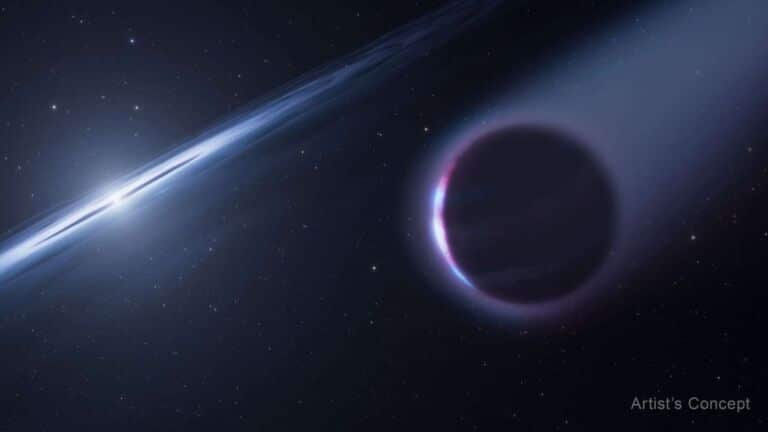
Everything we thought we knew about the age of the universe may be off by 13 billion years.
Astronomers have grown increasingly unsettled by a recurring problem: galaxies observed in the early universe appear far too large, too structured, and too mature for the timeline the standard model allows. A small team at the University of Ottawa believes they have a framework that could resolve these tensions — one that puts the universe’s age at 26.7 billion years and dispenses entirely with the invisible, undetected forces scientists have long relied on to make the math work.
The Standard Model under pressure
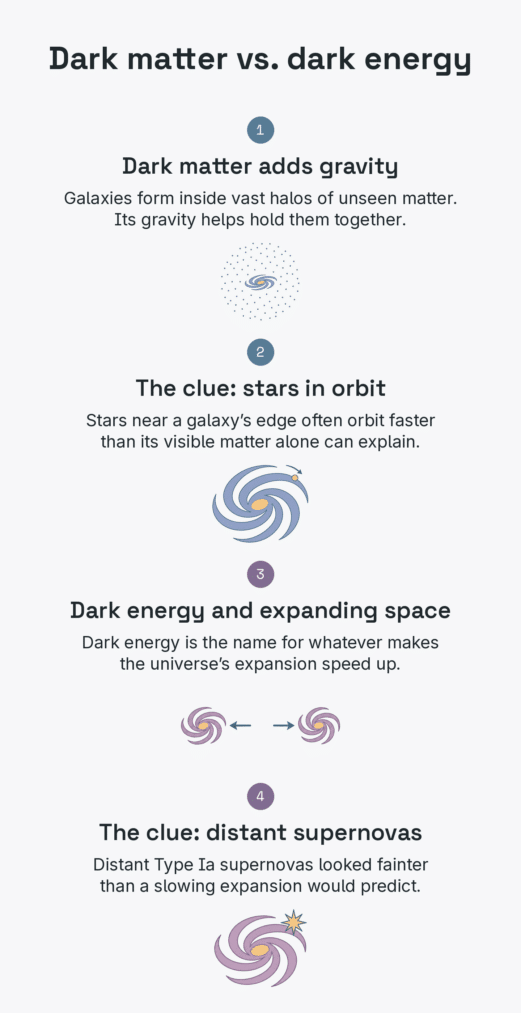
The current cosmological consensus — called ΛCDM — holds that the universe is 13.8 billion years old. It relies on two undetected components: dark matter, which provides extra gravitational pull to explain how galaxies move, and dark energy, the name given to whatever is accelerating the universe’s expansion. Neither has ever been directly detected, yet both are deeply embedded in how astronomers understand the cosmos.
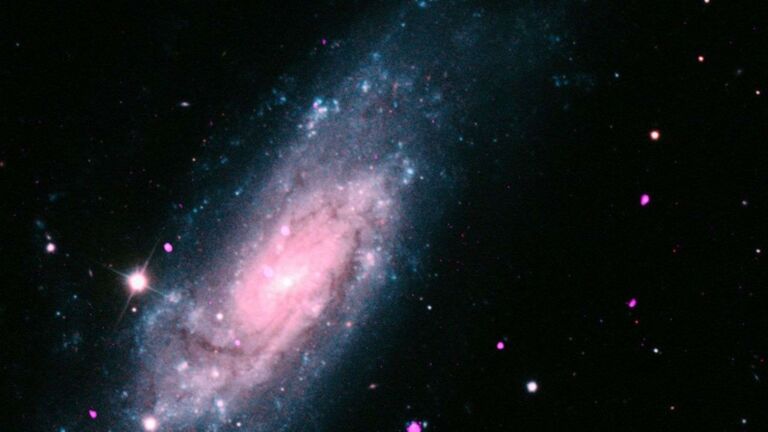
That foundation has been cracking since the James Webb Space Telescope began returning data. Webb has spotted galaxies that appear far too massive and too structured for where they sit in cosmic history. Under ΛCDM, the universe was only about 300 million years old when these galaxies supposedly formed — nowhere near enough time to build what we’re seeing. These “impossible early galaxies” suggest something may be fundamentally wrong with the timeline itself, or with the physics underlying it.
What CCC+TL actually proposes
The model Gupta and Samaras developed at the University of Ottawa is called CCC+TL — short for “covarying coupling constants plus tired light.” Rather than invoking dark matter and dark energy, it proposes that fundamental physical constants — the numbers governing how particles and forces interact — have shifted over time. If those constants weren’t always what they are today, many effects we attribute to invisible matter and mysterious energy might have a different explanation entirely.
Building this model required modifying the Einstein and Friedmann equations, which describe gravity and cosmic expansion, along with developing entirely new computational tools to apply them. The result places the universe’s age at 26.7 billion years — nearly double the accepted figure.
Passing the tests: What the data showed
A cosmological model has to clear several high bars to be taken seriously. CCC+TL cleared a number of them. It correctly reproduced the observed abundances of light elements — hydrogen and helium — created shortly after the Big Bang, matching what the standard model predicts. It also agreed with cosmic chronometer measurements, which reconstruct the history of cosmic expansion by comparing galaxy ages at different distances.
The researchers tested the model against all 175 galaxies in the SPARC database, examining galaxy rotation curves. Standard gravity alone can’t explain these curves using visible matter — one of the main reasons dark matter was proposed in the first place — and CCC+TL reproduced them without invoking it. The team also analyzed time dilation in supernova observations and found further support, though that paper remains under review.
The Bullet Cluster and the dark matter problem
The Bullet Cluster is often cited as the most compelling evidence for dark matter, according to the study published in Universe. When two galaxy clusters collided, the hot gas got separated from the galaxies, yet gravitational effects tracked the galaxies, not the gas. The standard explanation: invisible dark matter traveled with the galaxies through the collision.
CCC+TL makes the same prediction — gravity follows the galaxies — but without requiring dark matter at all. The researchers are careful to call this a proof of concept, not a definitive result, and more detailed work is needed before it can be treated as a robust explanation. Gupta suggests that effects long attributed to both dark matter and dark energy may stem from covarying coupling constants, a claim he explores in a separate paper.
James Webb as the ultimate referee
Here’s where the model makes its boldest, most testable prediction. Under ΛCDM, the universe was roughly 300 million years old during cosmic dawn. Under CCC+TL, the same observed redshift corresponds to an age of about 4.6 billion years — giving early galaxies vastly more time to grow. The researchers calculate that early galaxies should be roughly 12 times larger in size and mass than standard cosmology predicts.
Webb’s GLIMPSE program is designed to search for galaxies at redshifts greater than 50, probing deeper into cosmic history than any prior observation. CCC+TL predicts large galaxies are there. Finding them wouldn’t automatically validate the model — confirmation would be suggestive, not conclusive. What GLIMPSE could do is sharpen the question and force both sides to answer it more precisely. That, for now, may be the most important next step.
Read the whole thing?
Get the week's signal, not the noise
Our sharpest reporting on energy, climate and nature — free, once a week.