A diver steps out of a steel chamber and picks at a scatter of small beads with a pair of tweezers.
His hands are slower than they were an hour ago.
Ten minutes earlier he was breathing ordinary compressed air at a pressure equal to 164 feet of seawater.
The water never touched him, and he never left a windowless room on dry land.
But his balance still behaved as if he had been down there.
What separated him from the divers beside him was one change in what they breathed on the way back up.
Nitrogen trapped in the body keeps acting like a sedative after the pressure drops
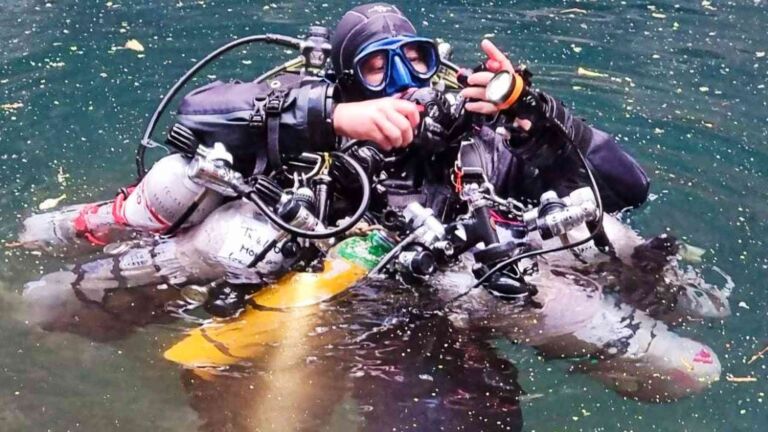
Nitrogen makes up most of the air we breathe and does nothing to us at the surface. Compress it and it turns mildly intoxicating, slowing reaction time and fogging judgment in a way divers have always compared to drinking. The rough rule passed around dive boats is roughly one drink’s worth of impairment for every 50 feet of depth.
Exactly why pressurized nitrogen does this is still argued. Some researchers favor the gas dissolving into the fatty membranes of nerve cells, while others point to nitrogen interacting directly with proteins in the brain. What is better established is the part that matters on the way home, because nitrogen diffuses out of tissue slowly and the narcotic effect can outlast the dive itself.
Divers have long assumed the fog clears the moment they surface. That assumption is what the chamber work set out to test.
Air breathing divers stayed unsteady for minutes after the chamber opened
Divers who breathed ordinary air through the whole ascent came out swaying. More of them failed a simple eyes closed balance check after the dive than before it, and their hands were no quicker at lifting small beads with tweezers than they had been at the start.
That flat result on the beads is the quiet finding. Almost anyone repeating a fiddly manual task does it a little better the second time, and the air breathing group did not improve at all.
The divers who switched to pure oxygen before surfacing did get faster, which is about what practice alone should buy them. Their balance held where it had been before they were pressurized, so oxygen did not sharpen them beyond normal, it simply kept them from arriving back dulled.
Eighty six firefighter divers spent five minutes at a simulated 164 feet
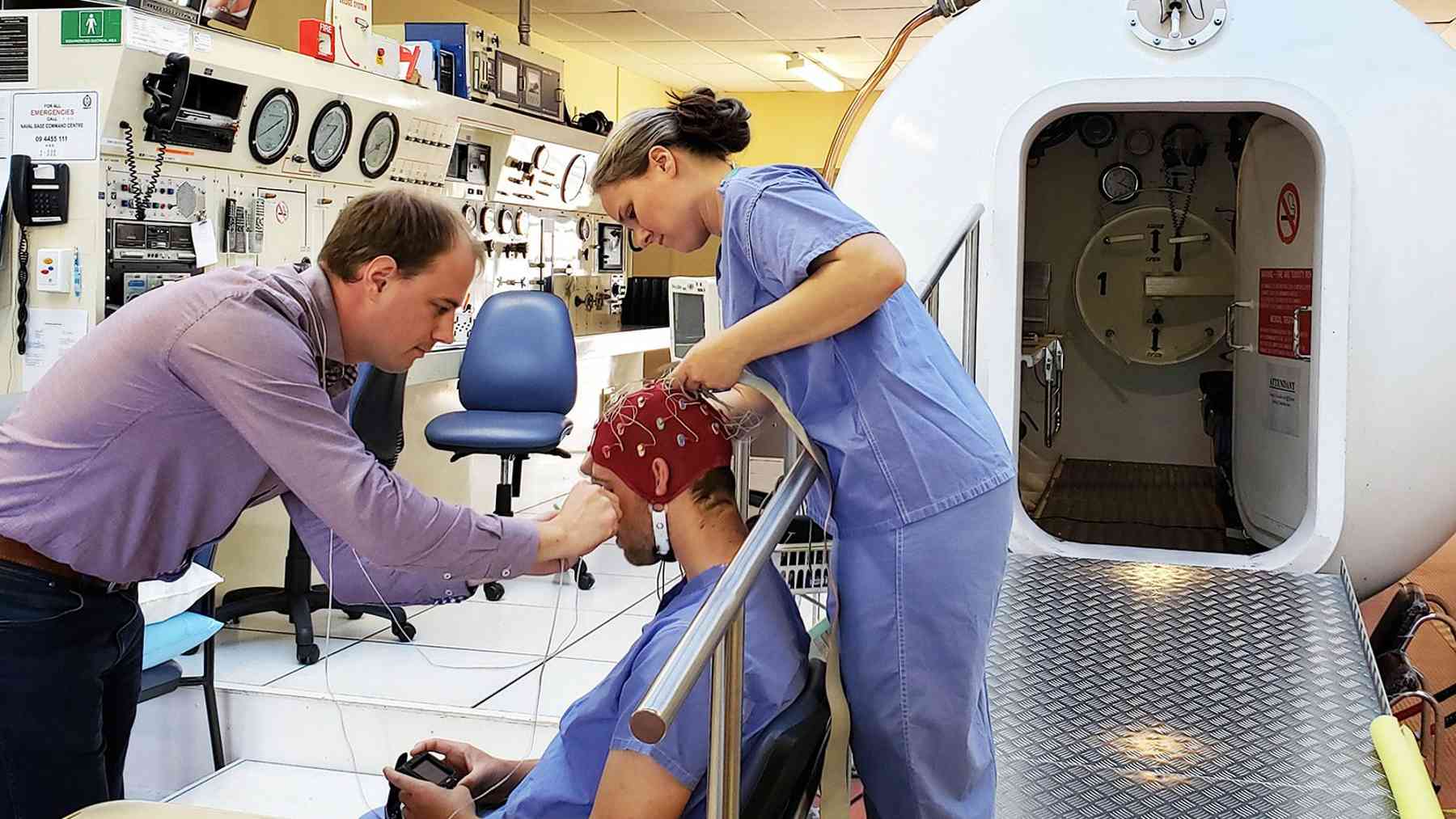
The work was done in a 12 person hyperbaric chamber with 86 male professional firefighter divers, pressurized for a five minute stay at a depth equal to 164 feet of seawater as part of their ongoing training. Of those, 58 decompressed on air, while 28 breathed 100 percent oxygen through masks during the last 30 minutes of the ascent.
Positive balance test results in the air group climbed from 47 percent before the dive to 67 percent after. In the oxygen group the figure sat at 68 percent both times.
Bead counts told the same story, 40 down to 39 in the air group against 36 up to 44 in the oxygen group. The results were published in the journal Medicina, with modest effect sizes, and the authors read the missing practice gain as lingering nitrogen acting on the region governing balance.
The same slow gas exchange shapes every real dive in open water
None of this plays out only in a steel chamber. In the ocean, nitrogen dissolves into tissue the deeper and longer a diver stays down, which is exactly why dive tables and computers exist, to keep that invisible gas load within limits the body can later release safely.
A dry chamber is also the easy case, since researchers use chambers precisely because they strip out cold, immersion and darkness. A separate team wired 18 recreational scuba divers with scalp electrodes in an Istanbul chamber for a simulated dive to 131 feet.
They found a brain response tied to noticing and reacting to sounds was still slowed after pressure returned to normal, not unlike the way overheated runners cool at very different rates depending on the method used.
Thirty minutes of oxygen may be diving’s cheapest safety upgrade
What makes the finding interesting is how little it asks. No new equipment beyond oxygen that many dive operations already carry, and no drug of any kind.
Breathing it during the final minutes of ascent, while the body is already shedding dissolved nitrogen, appears to speed that washout along before a diver has to drive home or make a safety call. The authors describe the result as consistent with faster nitrogen clearance rather than any stimulant effect.
It is worth being clear about what has not happened yet. Oxygen breathing during decompression rests on limited evidence and is not standard practice, and these were trained divers tested under controlled conditions.
Office workers have found their own small fixes for sluggish minds, like treadmill desks that let people keep typing and solving puzzles while walking at a gentle pace. Divers may now have a comparable one, a few extra minutes of oxygen before their feet touch the dock.
Read the whole thing?
Get the week's signal, not the noise
Our sharpest reporting on energy, climate and nature — free, once a week.