Rain kept falling on a stretch of coastal highway outside Brunswick, Maine, when a box truck drifted toward the shoulder.
It went down a steep grassy embankment.
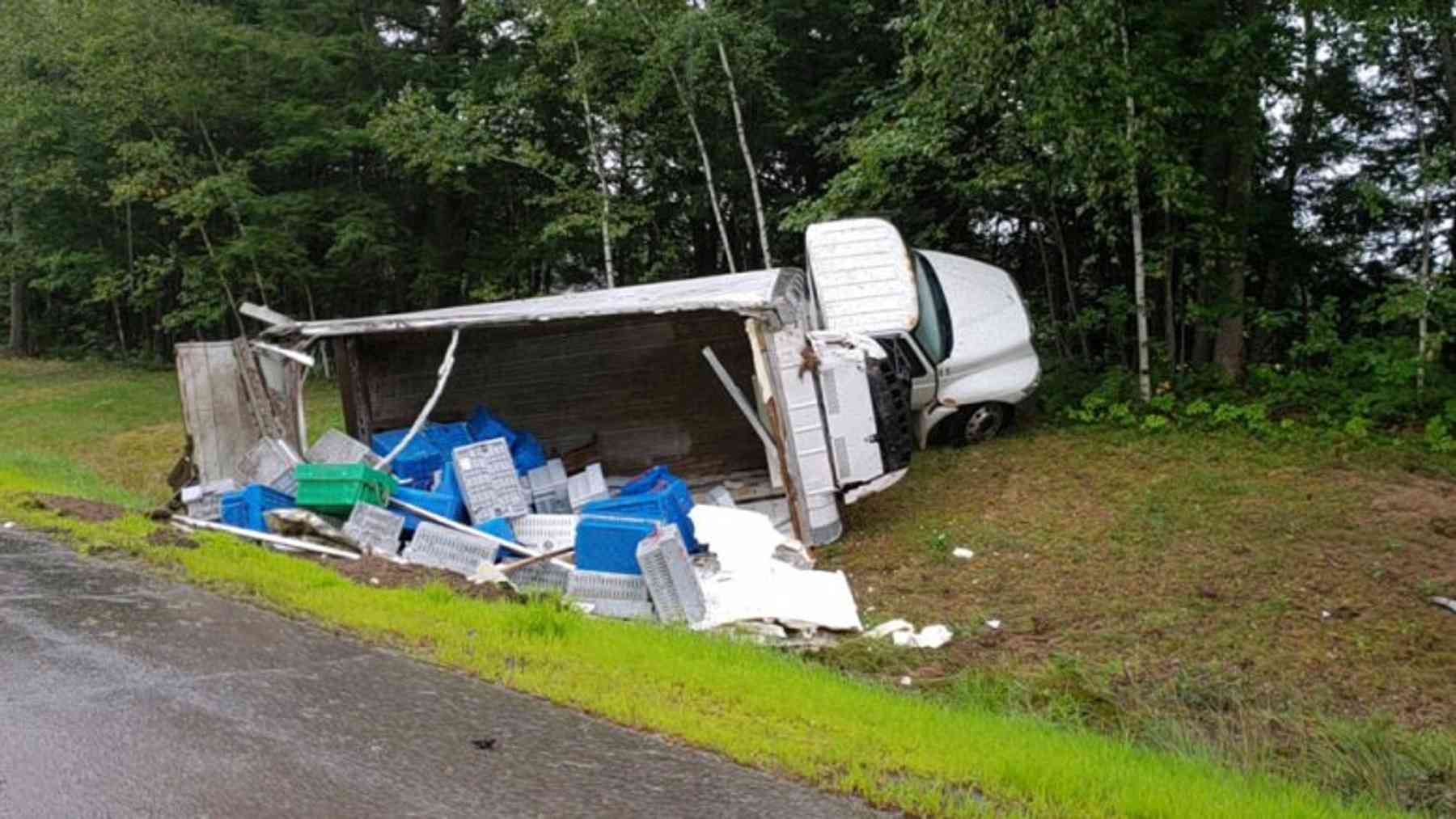
The body of the truck tore open on impact.
What spilled out was not lumber or furniture.
It was thousands of live lobsters, scattered through the grass beside the road.
Officers arriving on scene had to work out how any of it could be saved.
Wet pavement and one lost grip put the truck off the road
The wreck happened on Route 1 north, just east of the Cook’s Corner ramp in Brunswick. Authorities said the driver drifted off the right shoulder and hit an embankment, causing the truck to roll over, and police said they believed the truck probably hydroplaned on the wet road, sending it rolling down a steep embankment.
That single loss of traction was enough. A refrigerated box truck is built to keep a tightly packed load cold and still, not to survive a roll down a hillside. The top of the truck was ripped open in the crash, and from there the crates inside had nowhere to go but out.
Gravity did the rest, carrying sixty to seventy crates down the slope in one long scattering arc. The driver was treated for injuries that were not life threatening at Mid Coast Hospital.
Seven thousand pounds covered the embankment and the shoulder
Once the rain eased, the scale of the spill became clear. A truck carrying 7,000 pounds of lobster rolled over on Route 1 in Brunswick late on a Wednesday morning, spilling 60 to 70 crates of live lobster on the side of the road. Local reporting described the crustaceans strewn along the roadway. The vehicle was a refrigerated box truck registered to a seafood company based in Portland.
The officers who worked it had no template for the scene. A Brunswick police detective told a local television station, “It was something I’ve never seen before,” and described crates spilled open with crews trying to recover the ones still moving.
Traffic was backed up for hours as crews worked to clean up the crustaceans. Police said several of the lobsters were crushed when the truck rolled.
Rain and hours without cold made the catch unsellable
Lobster travels well out of water, as long as its gills stay damp and the animal stays cool. Neither condition held for long on a wet August roadside.
The company sent a second truck to collect the living lobster, but the animals were considered unmarketable after being unrefrigerated for several hours and exposed to rainfall. That left responders with an unusual task, gathering up a cargo that was still, technically, alive, with nowhere for it to go.
Much of the catch was packed up and hauled away from the scene, but none of it would be sold, and police said the lobster could not be eaten because of how long it had gone unrefrigerated.
Maine’s lobster numbers dwarfed the loss
Against the scale of the fishery, the crash barely registered. Maine landed 110.8 million pounds of lobster the year before the spill, the sixth highest total on record and a 16 percent decline from the 132.5 million pounds landed the year before that, and the year of the crash the fleet landed 119.64 million pounds worth $484.5 million.
A single spilled truckload, not unlike the corn that spilled into a Kansas ditch, was a rounding error against a fishery measured in hundreds of millions of pounds.
Even so, the image of lobsters scattered across a highway shoulder struck a nerve well beyond Maine. An animal rights group asked the Maine Department of Transportation for permission to place a five foot tombstone memorial near the crash site urging passersby to “Try Vegan.” The department refused, saying that stretch of Route 1 is a limited access highway where signs are prohibited for safety reasons.
State rules left little room either way. Roadside memorials in Maine can stay up only 12 weeks and cannot stand taller than four feet, a department spokesman said. The spill still sits among a run of odd roadway cargo stories, including a truck carrying crabs that tipped over on a coastal road.
A reminder that even tough cargo has limits on the road
Lobster is one of the few cargoes loaded alive and expected to arrive alive, packed into crates, kept cold and handled rough. Yet a single skid on a wet highway proved tougher than any claw or shell.
The crash is a small, oddly specific lesson in how fragile even a resilient cargo becomes once it leaves the truck built to carry it. It sits alongside other strange roadside spills, a reminder that even a major seafood fishery moves one crate at a time.
No one was seriously hurt. The road cleared after several hours, and the fishery absorbed the loss without a visible dent in its annual totals.
What remains is a strange little footnote on a Maine highway, a reminder that the ocean’s toughest export still depends entirely on staying inside the box.
Read the whole thing?
Get the week's signal, not the noise
Our sharpest reporting on energy, climate and nature — free, once a week.