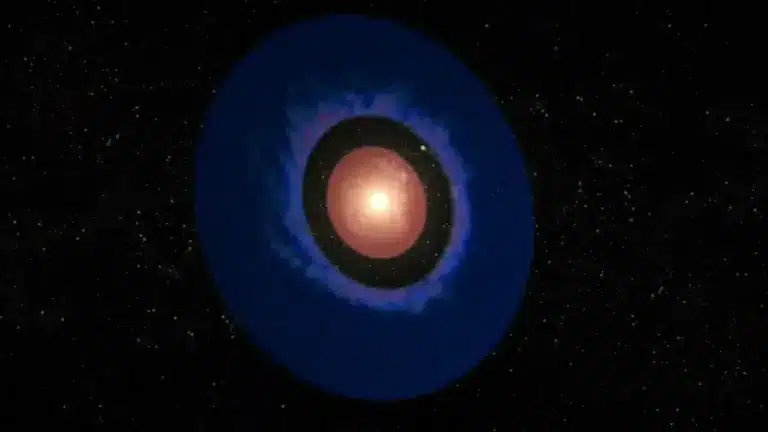
Every eight minutes, a dead star more than 5,000 light-years away sends out a burst of radio energy — then goes quiet, only to pulse again. Astronomers have now traced those signals to something unprecedented: a dense stellar remnant locked in orbit with a star strikingly similar to our Sun.
A stellar pair unlike any seen before
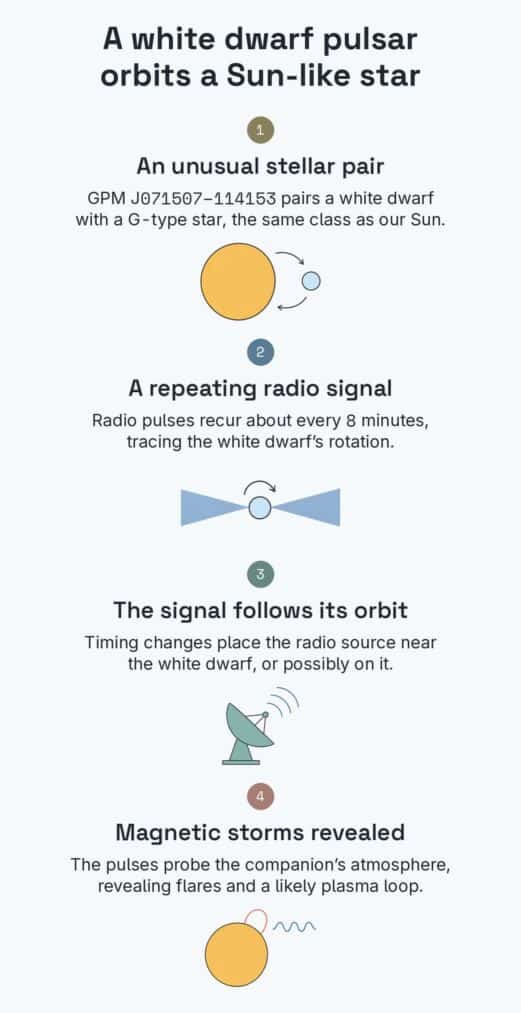
The system carries the designation GPM J071507−114153 and contains two very different stars sharing the same orbit. One is a white dwarf — the dense remnant left behind when a star exhausts its nuclear fuel. The other is a G-type star, the same broad category our Sun belongs to. Earlier detections of similar signals involved white dwarfs paired with red dwarfs. This is the first confirmed case where a white dwarf orbits a Sun-like companion and produces these signals.
The signals belong to a class called long-period transients, or LPTs — objects that emit radio pulses lasting minutes to hours, fall silent, then repeat. Since the first LPT was identified in 2021 by the same ICRAR research team, only about a dozen have been found, and their origins remain poorly understood.
Pinpointing where the pulses come from
Figuring out which star in a binary system actually produces the pulses has been one of the biggest challenges in studying LPTs. This discovery addresses that directly. Researchers gathered radio observations detailed enough to track the white dwarf moving through its orbit, giving them a precise fix on the pulse source.
“This is the first time the pulses are clear enough to see the white dwarf moving in its orbit around its companion, so we know that the pulsations are coming from a region close to the white dwarf, or possibly even from the white dwarf itself,” said lead author Dr. Sam McSweeney.
Confirming that finding required analyzing more than 100 hours of radio observations using resources at the Pawsey Supercomputing Research Centre.
Magnetic storms detected across thousands of light-years
The radio data offered an unexpected reward. Buried in the same signals were signs of intense magnetic activity on the Sun-like companion — mirroring, on a far grander scale, the processes behind auroras on Earth. Researchers detected stellar flares linked to powerful magnetic disturbances, and found evidence that the white dwarf passed behind what appears to be a stellar prominence — a massive loop of electrically charged plasma held in place by magnetic fields.
Associate Professor Natasha Hurley-Walker, a co-author on the study, noted: “It’s amazing that by using radio wavelengths we can detect the storms on a star over 5,000 light-years away.”
The telescopes that made it possible
The discovery drew on four distinct facilities. The system was first spotted during a wide radio survey using the Murchison Widefield Array (MWA) in Western Australia on Wajarri Yamaji Country. The MeerKAT radio telescope in South Africa’s Northern Cape then pinpointed its precise position. Optical observations from the W.M. Keck Observatory on Maunakea, Hawaiʻi, confirmed the G-type companion star. Both the MWA and MeerKAT are precursor instruments to the Square Kilometre Array (SKA) telescopes currently under development.
What the SKA era could reveal
The SKA project is building two next-generation facilities — SKA-Low in Australia and SKA-Mid in South Africa — offering far greater sensitivity than their predecessors. For LPT research, that difference could matter considerably. Greater sensitivity means fainter or more distant systems that currently escape detection may finally come into view.
Dr. McSweeney noted: “If we are already making such discoveries with precursor telescopes, just imagine how many more star systems we will be able to find, and what a beautifully detailed view of their signals we will have, once the SKAO telescopes are completely built.”
The findings were published in Nature Astronomy under the title “A long-period transient with a Sun-like companion.” Systems like GPM J071507−114153 suggest the catalog of strange stellar pairs is likely far larger than the current dozen entries imply.
Read the whole thing?
Get the week's signal, not the noise
Our sharpest reporting on energy, climate and nature — free, once a week.