The water moved fast enough to move the ground.
In a 55 and older community off US 1 in Palm Bay, Florida, a street became a channel.
When it drained, a section of pavement was simply gone.
On the far side sat dozens of homes with no way to drive to them.
What turned an ordinary residential street into an island comes down to what moving water does to sand.
Why sandy ground gives way when a canal runs backward
The failure starts underground. Palm Bay drains through the Melbourne, Tillman canal network, and city officials told council members that during the flood the system filled and then flowed backward, with four neighborhood canal crossings failing and remaining closed, pushing drivers onto Emerson Drive and DeGroodt Road. Water that cannot leave through a canal pushes instead through the sand the roads sit on.
That sand is the weak link in flat coastal Florida, where a roadbed is often little more than asphalt laid over fill. The city manager said that as water continued to move west to east through the ground, the city expected further disruptions and possible failures of infrastructure including roads, stormwater and utilities.
Saturated fill does not hold a street together once the current finds a path beneath it. So the road did not simply flood. Residents of Palm Bay Estates described water piling up behind the community until a berm gave way and carried off the pavement in front of their homes.
A section of road dropped out in minutes and took the neighborhood’s access with it
The flooding washed out part of Indian River Drive in Palm Bay Estates off U.S. 1, cutting off access for some residents. A chunk of the road was carried away Monday by fast moving floodwater.
At the 55 and older community, a large sinkhole destroyed what had been a key connection for residents. The community’s board president described the moment plainly, saying “It looked like Niagara Falls over here at one point.”
The damage did not stop at the asphalt. A mobile home beside the washout was damaged, then caught fire and burned down after the rushing water took out its foundation, and a carport ended up in another resident’s driveway. One resident said the damage left her separated from her own vehicle, parked on the wrong side of the gap.
Melbourne logged more than eleven inches of rain in a single day
Just north of Palm Bay, Melbourne recorded 11.51 inches of rain that Monday, the wettest day in the city’s history since record keeping began in 1937, according to weather service data. The previous mark was 10.23 inches during Hurricane Irma in 2017.
Two days into the month, Melbourne had also passed its wettest November on record with 13.51 inches, beating the 9.72 inches set in November 1963. Nearby totals ran higher still, with about 24 inches falling in Malabar in 24 hours, the event’s peak.
The setup behind it was a stalling pattern rather than a passing storm. Forecasters pointed to slow moving low pressure over the eastern Gulf paired with high pressure off the Eastern Seaboard, a combination that channeled deep tropical moisture into Florida. Round after round fell on soil that was already saturated.
Eighty to one hundred residents were left reachable only on foot
The only road connecting dozens of Palm Bay Estates residents to the rest of their neighborhood washed away, and three days later they were still relying on outside help just to get dinner, local News 6 reported from the scene. The community’s board president estimated that about half the community, roughly eighty to one hundred people, live beyond the washout.
Neighbors built a makeshift footpath to cross the gap. Public works officials visited the area to assess the damage and talk with residents about next steps, while aid workers provided meals and firefighters helped move supplies to people on the far side.
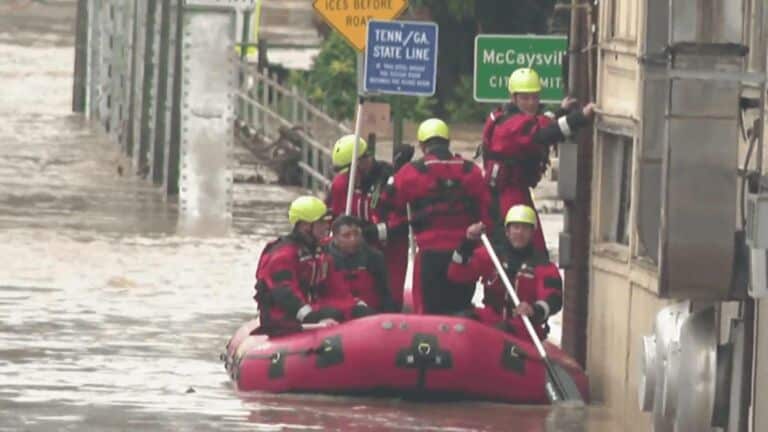
A timeline for restoring vehicle access had not been confirmed. The scale of this storm echoes other recent extremes, including river flooding in Tennessee that forced emergency crews into flooded streets. In both cases the limiting factor was the same, how quickly rainfall arrived rather than how much fell in a season.
A road that has now failed twice in one year
This was not the first time. Palm Bay Estates had a washout at the same spot earlier in the year after a stormwater pipe failed, and the city helped pay for repairs. The private road and drainage pipe had been deteriorating for roughly two years, and a repair once estimated at about $40,000 had grown to as much as $500,000.
Now the arithmetic is citywide. Palm Bay’s city manager put the cost of restoring roads and bridges at somewhere between $10 million and $15 million. Aging drainage meeting rainfall that outruns old design assumptions is not unique to this street.
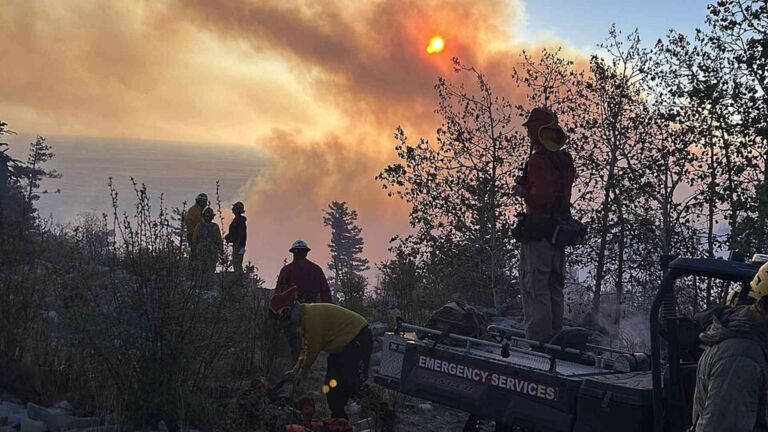
That pattern of stalling storms also echoes the slow moving systems behind repeated flooding elsewhere in recent seasons. For now the footpath remains the practical route home for dozens of families, in a quiet retirement community that never needed one before.
Read the whole thing?
Get the week's signal, not the noise
Our sharpest reporting on energy, climate and nature — free, once a week.