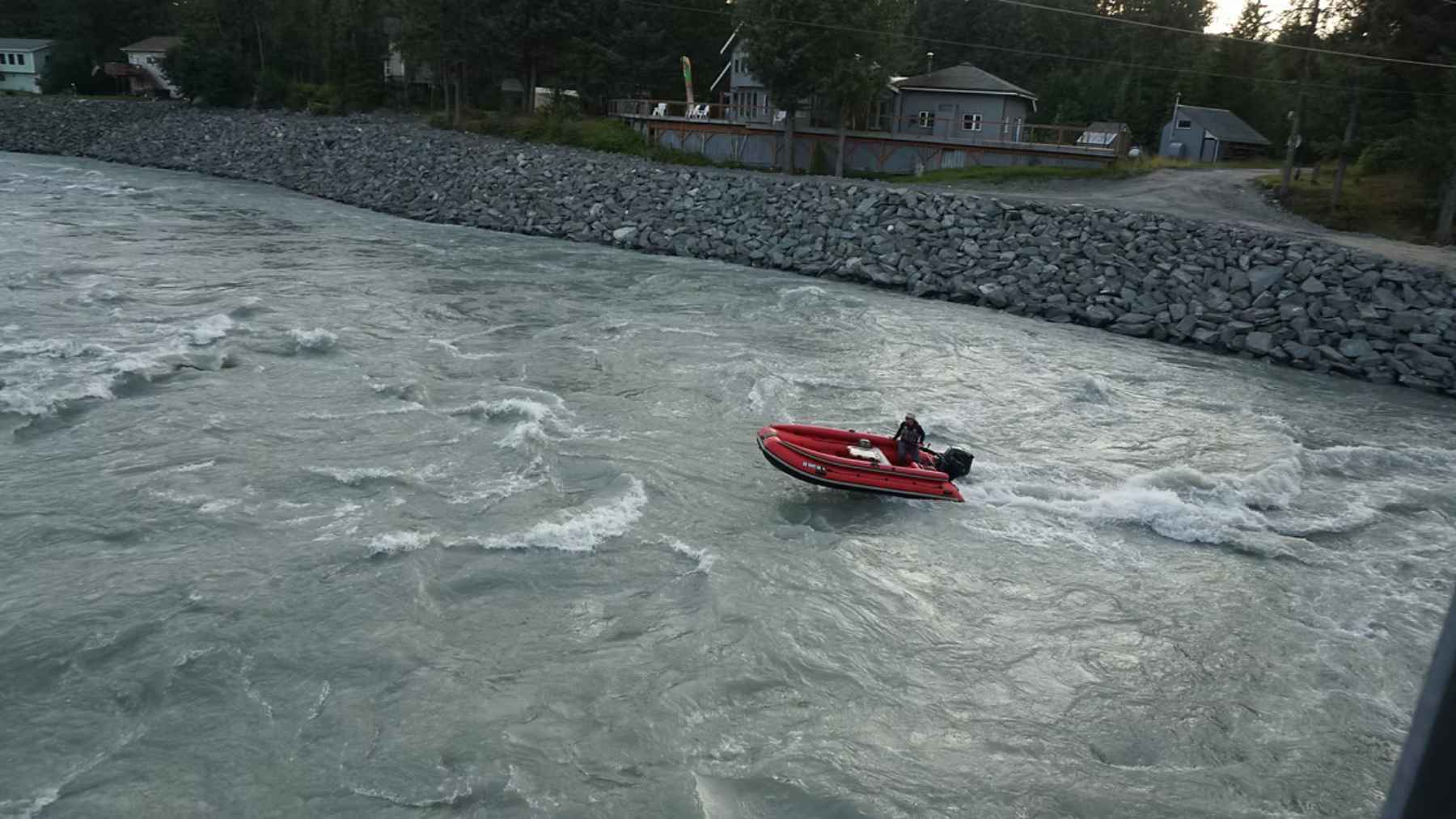
On the morning of Tuesday, August 11, 2026, the river running past the houses stood at about 4 feet.
A year earlier, on the same morning of the same event, it had been sitting near 9.
That difference was already in the bank before a single drop moved.
Upstream, a pocket in the side of the ice had filled to the brim and started to spill over.
Six weeks later it filled and let go again.
So what sets the height the water reaches, if not how full it got?
Why 2,000 cubic feet a second decides it
A crest is not a measure of how much water is stored. It is a measure of how fast that water arrives.
The release works by melting a channel through the ice. Water under pressure gives up heat as it moves, which widens the channel, which lets more water through, which widens it further.
That feedback is the whole event. A channel that opens fast empties the pocket in hours and stacks the river up. A channel that opens slowly moves the same volume over a longer stretch and the river never piles it.
Both years the pocket was full. What differed was the rate, and it was measured.
This year the river gained about 2,000 cubic feet per second each hour. The year before it gained 3,200 to 3,300 an hour, and held that for hours.
Then add the 5 feet of river it never had.
1,345 feet of water behind a wall of ice
The pocket sits in a side valley above the main glacier, where a tongue of ice seals off a bowl that would otherwise be a stream.
Rain, snowmelt and melting ice collect in that bowl all spring and summer. There is no outlet, so the level climbs until it reaches the top of the ice, which in August sat at an elevation of about 1,345 feet.
Then the water goes under. It finds the bed beneath the ice, works along it and comes out into the lake below.
Downstream the defense is literal. Wire mesh baskets lined with fabric and filled with sand, run end to end along the riverbank through a residential neighborhood.
They are stacked, strapped and raised again every spring by contractors working between the thaw and the flood.
The basin has done this every summer since 2011.
14.7 feet in August and 10.18 in October
The gage record is short and it is the only thing that settles the argument.
Four crests: 14.97 feet in 2023, 15.99 in 2024, 16.65 in 2025, and 14.70 on the afternoon of August 13 this year. The 2026 flood was the lowest in four years, against a forecast that had run from 16.1 to 16.55.
The second release crested at 10.18 feet at 5:45 on the morning of October 2. By 6:30 it was already falling, down to 9.88.
Second releases run small. The one in September of 2025 reached 9.6.
About 1,900 homes sat inside the evacuation zones in August, twice as many as the year before. Of 133 properties checked afterward, 12 had minor water intrusion.
Against nearly 300 damaged in 2024, that is a different outcome.
What the wall that worked is being replaced by
Here is the part that does not follow from any of it.
The sand walls held, and the plan to keep building them is over. Three months before the flood, on the fourth of May, the assembly voted seven to two to shrink the wall’s design from 90,000 cubic feet per second down to about 63,500, roughly 30 percent above the previous peak rather than double it, because the larger version was not fundable, and the local account put the city’s share at 19.8 million dollars.
Nine days after the crest, the federal engineers shelved the barrier path entirely, in the way that the August crest or a collapsing slope reads like a closed case.
What replaces them is a tunnel bored through rock to drain the bowl continuously, priced between 613 million and 1 billion dollars, with a partner due to be chosen on the twelfth of December under the bid process.
Nobody has dug it yet.
25 more years of a bowl that refills
One mild year is not a trend, and the people who measure this say so plainly.
A hydraulic engineer for the federal side puts damaging floods roughly another 25 years out, and adds that the estimate could move. The same analysis gives any single year a 2 percent chance of a flood twice the size of the record, and the next 25 years a 40 percent chance of one.
So the valley spent this season protected by a wall sized to a flood it has never seen, while the thing that would end the problem is still a procurement.
Both are reasonable. Neither is finished.
The ice keeps melting into the same bowl, and the bowl keeps filling.
A quiet year below a glacial basin is weather, not a solution.
Read the whole thing?
Get the week's signal, not the noise
Our sharpest reporting on energy, climate and nature — free, once a week.