A fish as long as a baseball bat drifts toward a spinning steel runner many times its own length.
It does not always come out in one piece.
For decades, the St. Lawrence River has been one of the hardest places on the continent to be an eel.
Under normal flows, nearly the whole river passes through the turbines, and so do the eels.
Engineers have now run the numbers on a new blade shape at that exact crossing.
So what actually changed inside the machine itself?
A blunter blade turns a cut into a shove
The mechanism behind the new number is almost insultingly simple. A conventional turbine blade is built thin and sharp for efficiency, so a fish caught in its path meets something close to a knife edge moving at highway speed. The replacement runner uses a more curved blade with a thick, blunt leading edge, delivering a more glancing blow that lowers the chance of injury if a fish is struck.
The design also minimizes the gap between the blade and its housing, the pinch point where a long, flexible body can get caught.
The developer’s patents describe the same trade in engineering terms: a slightly larger runner turning at a lower speed, with a much thicker and slanted leading edge, so the strike force a fish feels drops sharply. The same class of machine that once sliced eels can, in principle, shove them past instead. It is a small concession on blade sharpness in exchange for survival, with no change to the dam wrapped around it.
One crossing kills roughly a quarter of migrating eels
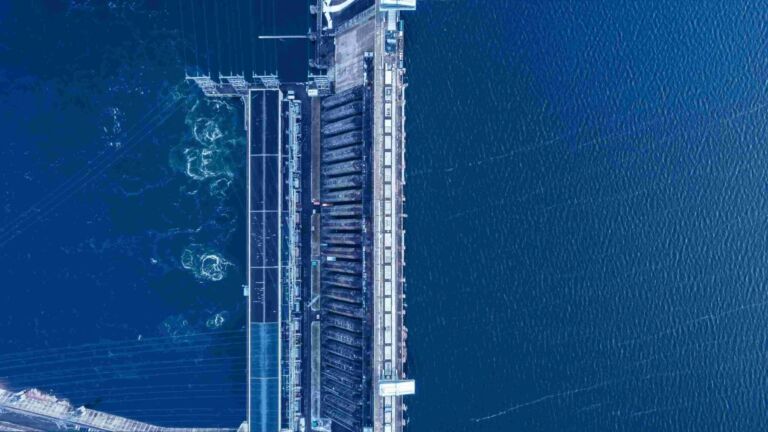
The crossing in question is the Robert Moses, Robert H. Saunders Power Dam, which spans the river at the New York and Ontario border. Turbine passage mortality for migrating eels there has long been put at roughly 26 percent, about one in four. Eels that survive it then face the Beauharnois station downstream, and cumulative losses across the two have been estimated near 40 percent.
The eels making that trip are not ordinary stragglers. They are overwhelmingly breeding age females bound for the Sargasso Sea, which makes their survival a matter for the whole species.
Losing a quarter of them at one crossing means losing a quarter of the next generation’s mothers, which is why this dam became the test case for a gentler turbine.
A simulation pushed modeled survival past 98 percent
The hardest number in this story did not come out of the river. A feasibility study by a turbine developer working with the New York Power Authority, funded by the Fish Enhancement, Mitigation and Research Fund, used computational fluid dynamics to model replacement runners for the two unit types on the American side of the dam. It predicted American eel survival above 98 percent across all simulated operating conditions, and a later company update put the projection above 98.5 percent.
That is the same site and the same flows, modeled with a reshaped runner swapped in for the old one. It is also, firmly, a prediction. The study’s hydraulic and fish survival findings remain simulation results, not measurements taken in moving water at this dam.
A direct swap could spare a 2,000 megawatt plant a rebuild
What separates this from past turbine fixes is the lack of disruption. The modeled runners are designed as direct replacements for existing equipment, with predicted peak efficiencies of 94.6 and 94.3 percent, inside the measurement uncertainty of the record breaking efficiency already logged by the units installed today. An operator would not have to drain a reservoir or pour new concrete to try one.
That matters because this is not a small run of river plant. Sixteen units on each side give the dam close to 2,000 megawatts of combined capacity, and pulling it apart for a civil works rebuild would cost far more than fish passage ever could.
The broader pattern shows up elsewhere. At a Snake River dam, a rebuilt turbine runner, a different design from a different manufacturer, carried 98.25 percent of tagged juvenile salmon through alive while also lifting output. On other systems, operators have reworked intakes for a different reason entirely, as when crews dealt with frazil ice clogging the works each winter.
131 lab eels survived a scaled test at 100 percent
Simulations invite a fair question: will the river agree with the computer? The strongest evidence so far comes from test rigs. A peer reviewed study in Transactions of the American Fisheries Society passed 131 American eels through a 22-inch version of this runner and recorded 100 percent survival over a 48-hour hold, with no major internal or external injuries.
A later self run test spun a similar small runner at tip speeds near 92 feet per second, roughly 63 miles an hour, closer to real operating conditions. It passed 120 eels and recorded 100 percent immediate survival and 99.2 percent after 48 hours.
Outside the lab, the developer told reporters it recently installed runners of this type at a plant in France subject to European eel protection rules, and that those units have since been tested with live eels. Its co founder has put the measured survival there at about 99 percent, though none of that is the St. Lawrence.
Which is exactly why the 98 percent figure at this dam remains a modeled estimate rather than a measured one, and a field trial would be the next step toward closing that gap. Still, for a river where about one in four breeding eels is lost at a single crossing, a blunt edged blade and a credible simulation are the most encouraging news that stretch has had in a long time.
Read the whole thing?
Get the week's signal, not the noise
Our sharpest reporting on energy, climate and nature — free, once a week.