
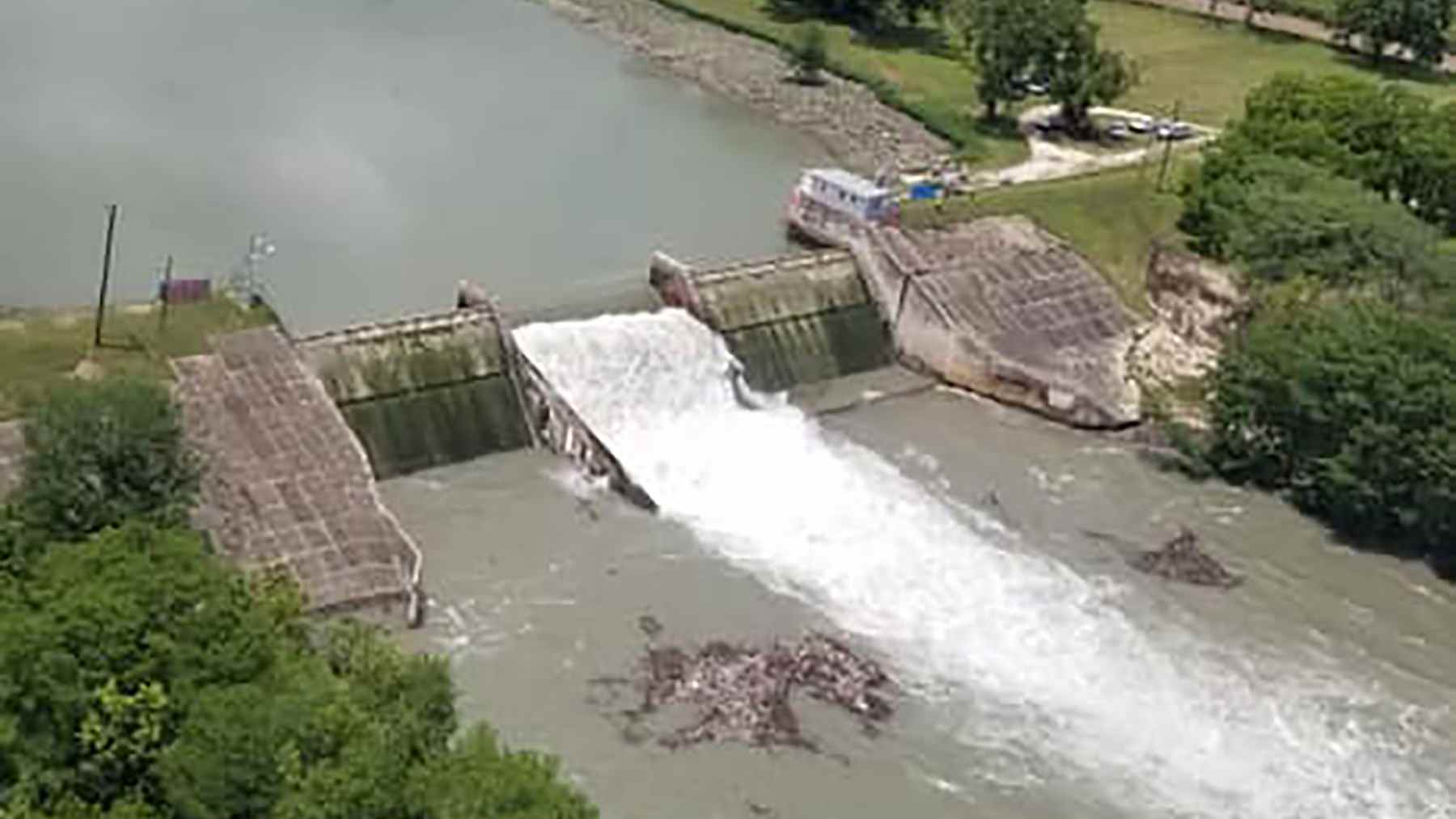
A camera was recording on an ordinary Tuesday morning when the middle gate of a Texas dam gave way.
Within seconds, a wall of brown water was tearing downstream.
By that evening, a lake that had sat full for nine decades was reduced to the river that fed it.
Docks stood above an exposed riverbed.
The dam itself never moved.
The piece that failed was far smaller than the aging dam people assumed had worn out.
The steel inside one gate had been corroding out of sight
The structure that failed at Lake Dunlap near New Braunfels was not the dam itself but one of its three spillway gates, record breaking in age but tiny in size, panels that lean against the river’s push and can be raised or lowered to hold the lake at its level. River authority officials said the failure was likely caused by a failure of structural steel members inside the spillgate and the aging of the steel. That steel sat underwater, hidden from view and effectively impossible to examine without dropping the lake around it.
The authority said the failure happened at 7:49 a.m. on a weekday morning, and once the panel let go it had nothing left holding it upright against the water stacked behind it.
The dam did not crumble. One gate failed, and that gate was the thing keeping the lake in place.
Eleven thousand cubic feet a second found the gap
Once the gate was gone, the Guadalupe River did not trickle through, it rushed. The middle spill gate failed, dumping water downstream at about 11,000 cubic feet per second, forcing river and lake levels downstream to rise. That is roughly enough to fill an Olympic size swimming pool in about eight seconds.
By noon the water had dropped six feet, and by the end of the day the lake was drained, with a second flood gate opened to help control the release. By that afternoon the drop had reached about seven feet.
The lake that residents had fished and water skied on for generations became a muddy channel carrying the river’s normal flow. There were no mandatory evacuations, but the boat ramps, the lakefront porches and the whole social life of the lake lost their water within hours.
A gate on the same river chain had already collapsed years earlier
This was not an isolated surprise. The authority had experienced a similar spillgate collapse at Lake Wood, four miles west of Gonzales, caused by a failure of structural steel members inside the gate. That smaller reservoir sits on the same river system and had still not been rebuilt when Dunlap went.
The resemblance was not exact. A preliminary investigation indicated the Dunlap failure differed from the earlier Lake Wood failure, where tie bars gave way. Dunlap’s tie bars had been repaired years before, and an engineer for the authority said aging gate hinges were the likely cause. High river flows kept crews from recovering the failed gate for a fuller investigation, so the detailed mechanism was never nailed down, only the broad verdict of aging steel.
After the Lake Wood collapse the authority had already decided to act on the rest of the chain. It moved to replace the aging spillgates with a modern gate system and planned a similar design for its other dams, including Dunlap. Its general manager said the agency was “committed to finding a solution to replace the spillgates at all of our aging dams.”
Ninety one years of river pressure ended in one morning
What makes this case worth returning to is the mismatch between cause and effect. The lake was completed in 1928, and its hydroelectric plant held two generating units with a total capacity of 3,600 kilowatts, a modest machine on an old river project. It did not go down to a flood, an earthquake or a design miscalculation, but to metal fatigue inside a single panel.
The same lesson shows up elsewhere in dam and turbine engineering, where small components decide outcomes far larger than themselves. At one Canadian plant, crews learned that, at Chats Falls on the Ontario-Quebec border, a hydro plant can turn into a giant frozen Slurpee machine, when ice chokes an intake screen rather than the turbine failing first.
Elsewhere, engineers testing a four foot rotor inside a test tank examined whether bendable rubber blades could smooth out damaging load swings. A hinge, a screen, a tie bar: these are the parts nobody budgets for until they are gone.
Drained for years before a replacement finally rose
Lake Dunlap stayed empty for a long stretch while the river authority and a voter approved local water control and improvement district worked out the financing for a rebuilt gate system. The replacement swapped three self leveling crest gates for new hydraulically actuated steel crest gates, a project put at roughly two years of construction and about 35 million dollars when it was authorized.
The authority completed construction of the new spillgate system, restored the lake and resumed hydroelectric generation more than four years after the failure of the 91 year old dam. The dam that looked permanent for nine decades had depended on steel nobody could see from the water’s edge.
It is a useful caution for anyone who assumes old infrastructure fails gradually and visibly. Sometimes it holds for ninety one years, then goes in a morning, and the fix takes far longer than the failure did. The lake is full again, but the corroded steel that let it go is a reminder of how little margin century old hardware leaves once it finally gives way.
Read the whole thing?
Get the week's signal, not the noise
Our sharpest reporting on energy, climate and nature — free, once a week.


