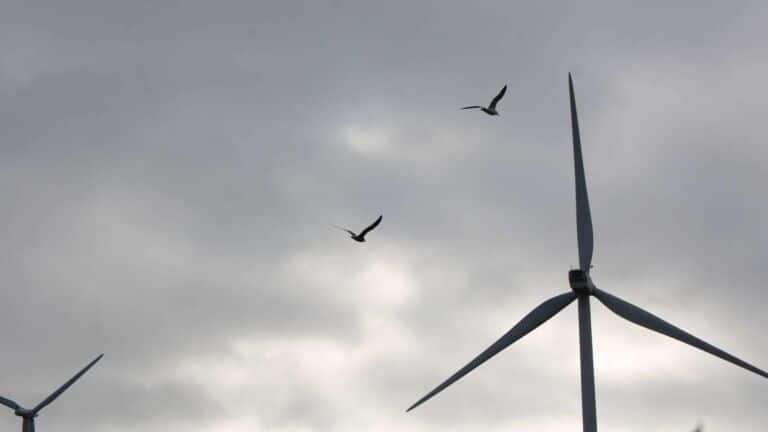
Offshore wind turbines operate in harsh winds and ocean conditions.
As a result, regular maintenance and inspections can be difficult and costly.
If blade inspections are needed or regular maintenance is required, sending specialist technicians to each turbine can be expensive.
Toshiba Energy Systems & Solutions has developed a solution using Unmanned Aerial Vehicles (UAVs) to perform many of these inspections.
During the trial, the UAVs were able to assess turbine conditions in real time, reducing the need for manual inspection steps.
Automatic tracking removed a major step in inspections
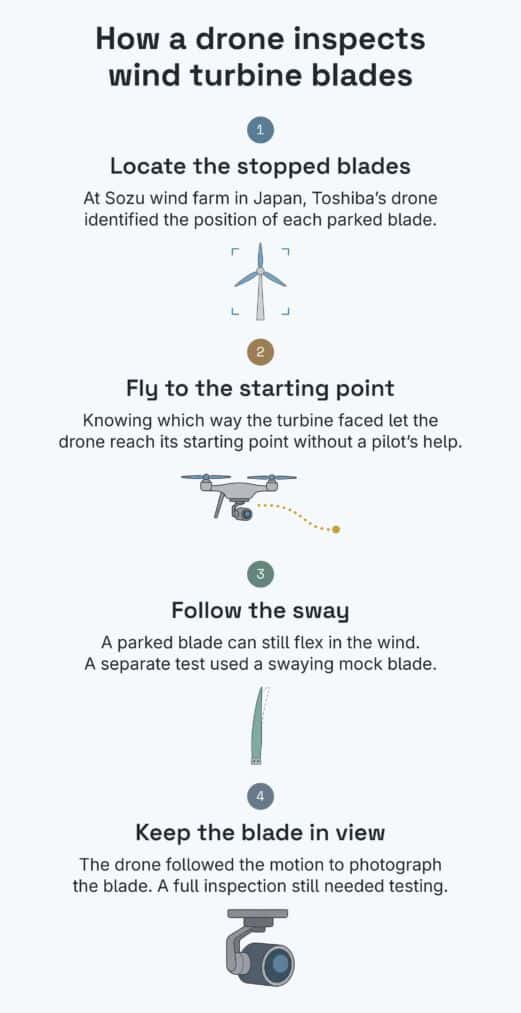
The UAV can automatically identify the turbine’s position, nacelle angle, and the stopped positions of the blades.
From this, an inspection point can be identified.
Traditionally, during inspection, operators have to manually position the UAV so that it can capture a view of the whole turbine.
As the orientation of the turbine can be automatically identified, the UAV can be moved to inspection points automatically.
The UAV was also validated to be able to track moving blades. This allowed images to be taken of the blades while swaying in the wind and waves.
Real offshore conditions helped shape the demonstration
Trials were conducted at the Sozu Wind System operated by Shikoku Wind Power, located in Ainan, in Ehime Prefecture, Japan.
These trials were part of a project by NEDO supported through the Green Innovation Fund to reduce offshore wind energy costs.
Offshore assets require vessel access and face harsher weather and sea conditions than land-based sites.
As a result, quick responses are harder to achieve. Remote inspection techniques can therefore be very valuable.
Large turbine trials confirmed core inspection capabilities
In this demonstration, turbine systems of size 15MW, some of the largest turbines expected to increase in deployment in offshore locations, were used.
It was found that the orientation of the nacelle and blade positions can be automatically identified.
NEDO reported that technologies required for complete automation can now be assessed.
Toshiba concluded that fully automated blade inspections are now within reach, though further validation will be carried out.
The Toshiba and NEDO original announcement noted that additional verification activities would still be required. Further validation will confirm complete autonomous inspections of blades using image processing.
This has been an important limit to overcome to allow full implementation.
Further validation remains before routine industry deployment
While key automated inspection functions were demonstrated, the system does require further validation.
The recognition and navigation functions need to work simultaneously. During future validation, it will be confirmed if the UAV can fully orbit the turbine, take images in real time, and automatically detect blade angles.
Once these functions are in place, any remaining manual processes can be removed.
As the conditions in which maintenance occurs offshore can be extremely varied, it will be impossible to test all situations in testing.
One final stage remains between successful demonstration and routine industry use.
Labor shortages increase the value of automated inspections
The overall cost of performing these inspections is increased in offshore conditions due to transportation and labor.
However, the automation of these inspections means that fewer maintenance engineers will need to be sent to offshore turbines. Additionally, it solves a problem present in this sector, where there is a shortage of qualified maintenance staff.
As offshore wind increases in scale, staff availability is nearly as important as equipment.
Broader maintenance systems still require further integration
Blade inspections from outside are only one component of overall turbine maintenance processes.
Toshiba is also developing remote inspection systems for nacelles, and analysis of turbines to determine their soundness. These complement the automated blade inspections.
NEDO aims to reduce costs across the offshore wind sector to allow increased deployment.
How quickly automation is implemented in routine practice may affect how quickly these aims can be achieved.
Read the whole thing?
Get the week's signal, not the noise
Our sharpest reporting on energy, climate and nature — free, once a week.