Due to exposure to rain, ocean water, and strong winds, maintenance of offshore wind turbines is costly and challenging.
Damage in the form of cracks and erosion can occur in the rotor blade.
However, inspection of these rotor blades can be difficult. As a result, rotor blades may be replaced without clear confirmation of damage.
Instead, a solution has been developed in Germany that analyses internal sounds within the blade.
Distinctive sound patterns reveal hidden structural weaknesses
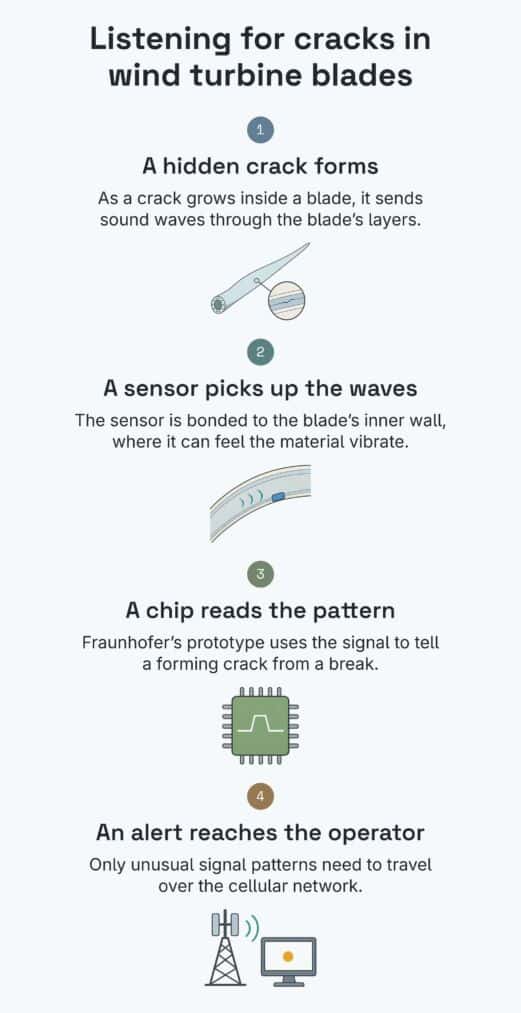
Within each rotor blade, acoustic emission sensors are used to detect waves.
A custom chip has been designed to detect surface waves due to damage to the structure.
As rotor blades have a complex composition of various materials, sound wave propagation will be different from that in a steel beam.
When a crack begins to develop in the rotor blade, distinctive patterns are seen. These patterns are detected by the chip and processed.
Remote monitoring reduces difficult offshore maintenance visits
This project was developed by combining the knowledge of Fraunhofer IIS and Fraunhofer IWES to improve remote monitoring of rotor blades.
The system is ideal for offshore wind farms, where monitoring costs are high.
Operating offshore wind farms means they are exposed to harsh weather conditions. Accessing these sites often requires extensive preparation, specialized equipment, and considerable effort.
Reducing unnecessary maintenance checks can save time and resources.
Repair decisions become more precisely targeted over time
Sometimes blades are replaced, even if damage is just suspected.
The costs can run to well over 200,000 euros per blade per incident.
Fraunhofer-Gesellschaft noted that using acoustics to detect damage allows for confirmation of damage at an earlier stage.
Maintenance decisions can therefore be more precise. The chip can identify specific acoustics.
If a crack is growing, or a breakage occurs, the chip can distinguish between the two by analyzing the acoustic signals.
This approach relies on accurate generation and detection of internal signals.
Layered blade materials make interpretation more challenging
Due to a complex composition, interpreting the signals is complicated.
Multiple composite layers alter how internal sound waves travel across the blade structure.
As a result, accurately classifying events is challenging. To ensure meaningful events are identified and separated from normal noise, careful processing must be carried out.
The sensing system must account for these complex rotor blade materials right from the start.
In this case, the challenge comes from the rotor blades themselves rather than the electronics.
Smaller data transfers improve practical system deployment
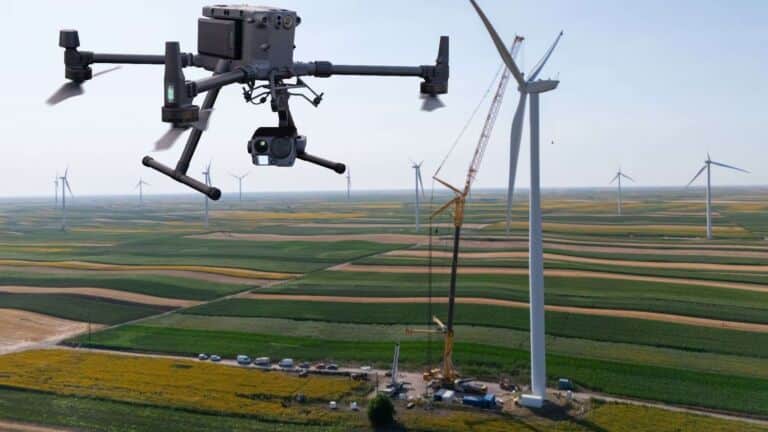
Traditional methods of monitoring rotor blades (such as drones and radar) produce large amounts of data.
This data must be transferred elsewhere. In this system, only abnormal data is transferred. That keeps things much lighter on the network.
Characteristic data has been extracted to reduce data volume. Only relevant events are transmitted to operators.
Raw measurement data does not need to be sent continuously.
This means this system can operate on mobile communication networks.
By reducing the need for high-speed broadband internet connections to send useful alerts from the turbine, engineers expanded where this system can be deployed.
Additional hazards still require future detection capabilities
There are still issues in recognizing other types of damage. Several key events cannot currently be detected by this system.
Following the launch of a successor project on June 1, the full monitoring system is being expanded.
Within this project, researchers aim to recognize lightning strikes and effects from such events. Such information would be particularly useful for offshore wind farms, where extreme weather is common.
Lightning can damage rotor blades without obvious external signs.
Whether the same acoustic method can be relied upon to detect these events will determine how this system progresses.
Read the whole thing?
Get the week's signal, not the noise
Our sharpest reporting on energy, climate and nature — free, once a week.