
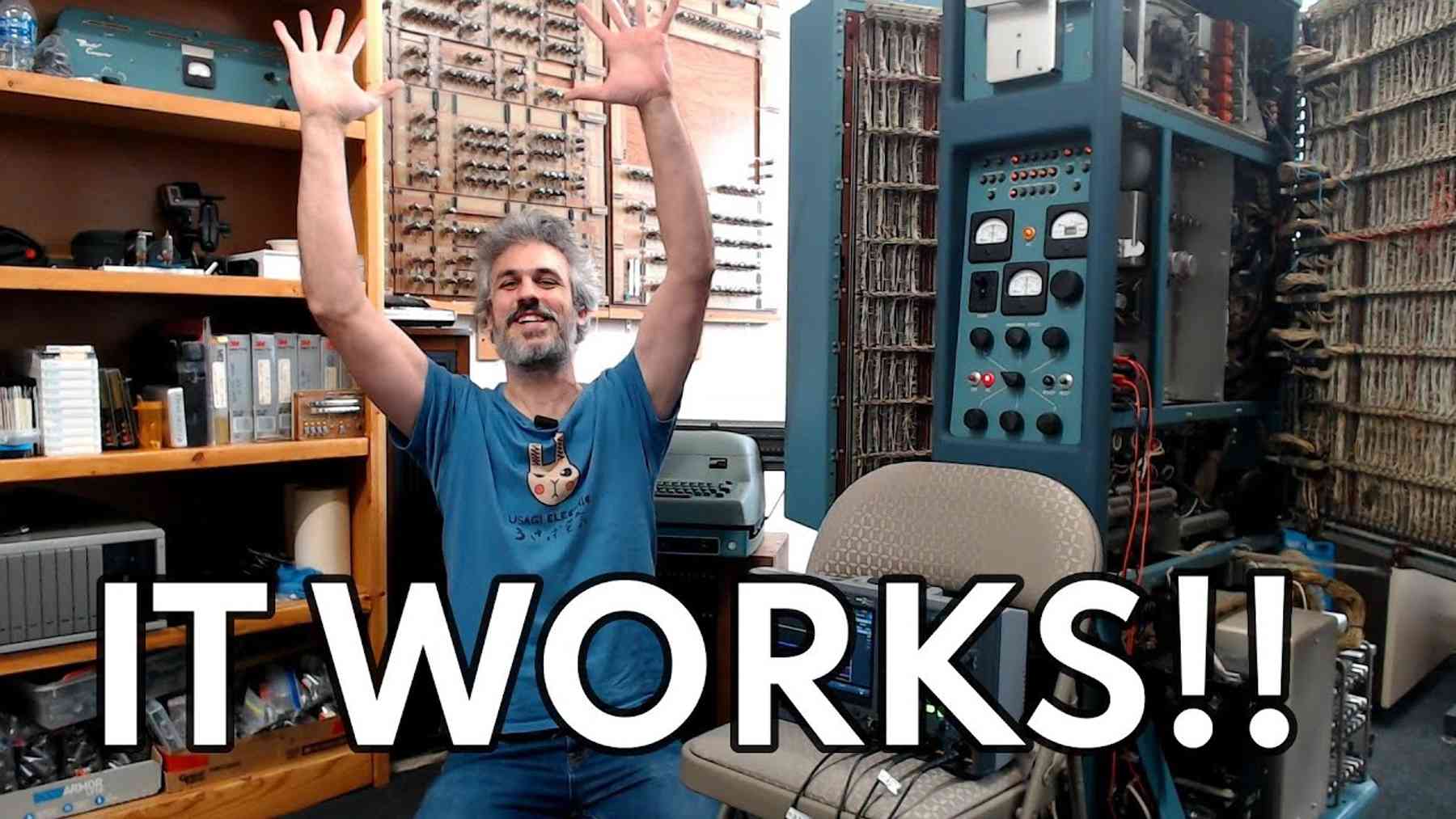
A refrigerator sized blue cabinet hums in a Texas garage, its glass tubes glowing faint orange behind a metal grille.
A paper tape clatters through a reader bolted to its side.
An electric typewriter wired into the cabinet taps out the answer, letter by letter.
The machine is about seventy years old.
It was never supposed to run again, let alone touch a modern physics problem.
So how does a machine built before the transistor era end up anywhere near particle collider data today?
A spinning drum handles all the arithmetic
The machine is a Bendix G-15, a computer sold decades ago to engineers who could not afford a room sized mainframe. Instead of silicon chips, it stores numbers as pulses on a spinning magnetic drum, timing every calculation to the drum’s rotation rather than to a modern clock chip. That drum is the whole trick.
Vacuum tubes handle the logic, flipping on and off to represent ones and zeros, while the drum turns at 1,800 revolutions per minute, carrying 2,160 words of 29 bits across twenty tracks of 108 words each, under fixed read and write heads.
There is no cache and no memory chip here. Just a rotating cylinder doing the job a hard drive and a processor would split today. That stubborn mechanical rhythm is what let a hobbyist coax modern code out of hardware from another era entirely.
One bad solder joint took months to trace
The restorer behind the project, who goes by Usagi Electric online and is known as David Lovett, took in the G-15 on loan from a computer museum in Maryland. He is largely self taught, working through the machine’s roughly 450 tubes, mostly dual triodes, one faulty component at a time in his own workshop.
Getting it running again meant chasing failures down to a single circuit card. In one documented session the system would not respond properly to the GO button on the typewriter, and the fault was traced to a flip flop, then to one particular signal on an AND gate. Swapping the suspect card changed nothing.
The real culprit turned out to be a diode card downstream, carrying a tiny solder bridge left in place since the machine was built. It loaded a buffer and caused grid leakage. Soon after, the cabinet was booting from punched paper tape and running Bendix’s own diagnostic suite, DIAPER.
75,000 lines of code ran without a stumble
By December 2024 the restored G-15 was reliably running long programs from paper tape, a milestone the electronics site Hackaday tallied at 75,000 lines of code. That endurance earned the machine a reputation as the oldest fully operational digital computer in North America, and it mattered because early tube failures tend to be intermittent, the kind of fault that hides until a program runs long enough to find it.
The following year the project moved from merely functioning to genuinely strange. Collaborators ported topoclustering, an algorithm that decides which collisions at the Large Hadron Collider are worth keeping, onto the drum machine. Hackaday reported the run finishing cleanly.
Topoclustering normally completes in under one microsecond, which is why it lives inside an FPGA as pipelined hardware rather than software. Getting it onto tubes took two translations, one from Verilog into C by a fellow restorer who serviced Bendix machines decades ago, and another from that C into Intercom, the G-15’s own interactive language.
Eight kilobytes left room for one theme song
Once the hardware proved trustworthy, the software got playful. Lovett took a break from repairs to face the question every restorer eventually faces, and the honest answer was no, the G-15 cannot render Doom. What it can do, using a modification described in the original manuals, is play the game’s theme music.
A stock G-15 has no sound output at all, and the whole drum holds only about eight kilobytes, so the music program and its note data had to be squeezed into what little room was left. Because the drum spins at a fixed, steady rate, the timing needed for musical notes is effectively built into the hardware.
That kind of patience rewards the same care it takes to pull apart a pocket coil mattress spring by spring. None of it matched the collider algorithm for usefulness, but together the stunts showed a machine built for engineering work pushed somewhere its builders never sketched.
One museum loan is still a two way trade
The G-15 is not alone. Across the retro computing hobby, enthusiasts revive machines like the Harwell Dekatron, a British valve and relay computer from the early fifties restored at The National Museum of Computing on the Bletchley Park site. Projects trade parts, scanned manuals and troubleshooting notes the way car restorers trade carburetor diagrams.
What makes the Texas project stand apart is scale and stubbornness, one person working largely alone rather than a museum staff with a budget. The same care that goes into sorting a scrap tire market into usable rubber shows up here as hours spent chasing one bad component through a wall of identical looking glass.
The G-15 is expected to eventually return to its museum, parked beside its original manuals and other oddities worth walking through. For now it still hums in a garage, running code nobody who built it could have imagined.
Read the whole thing?
Get the week's signal, not the noise
Our sharpest reporting on energy, climate and nature — free, once a week.


