
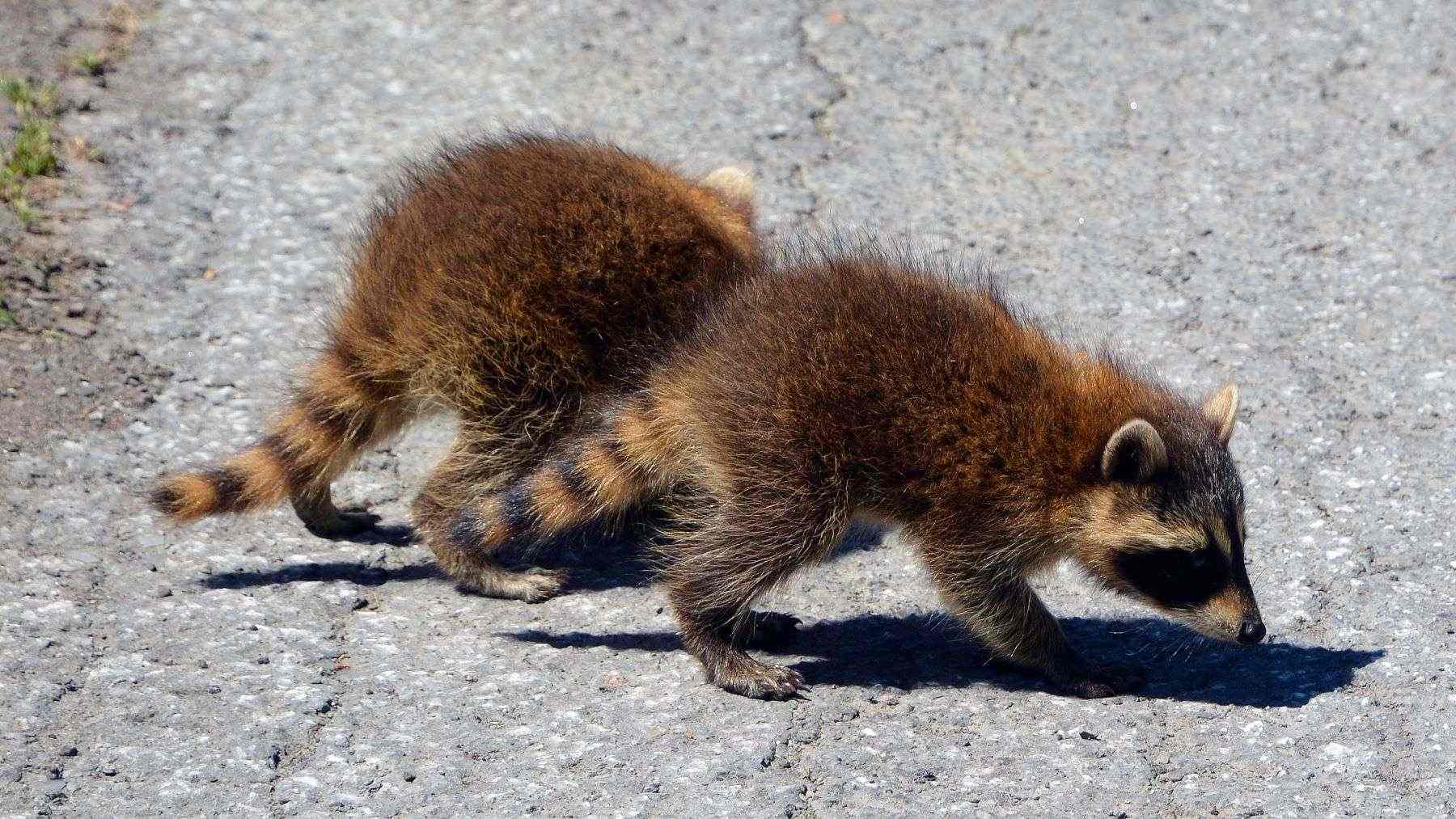
A diseased, feral raccoon roaming Westlake Village would previously have been considered a stand-alone event.
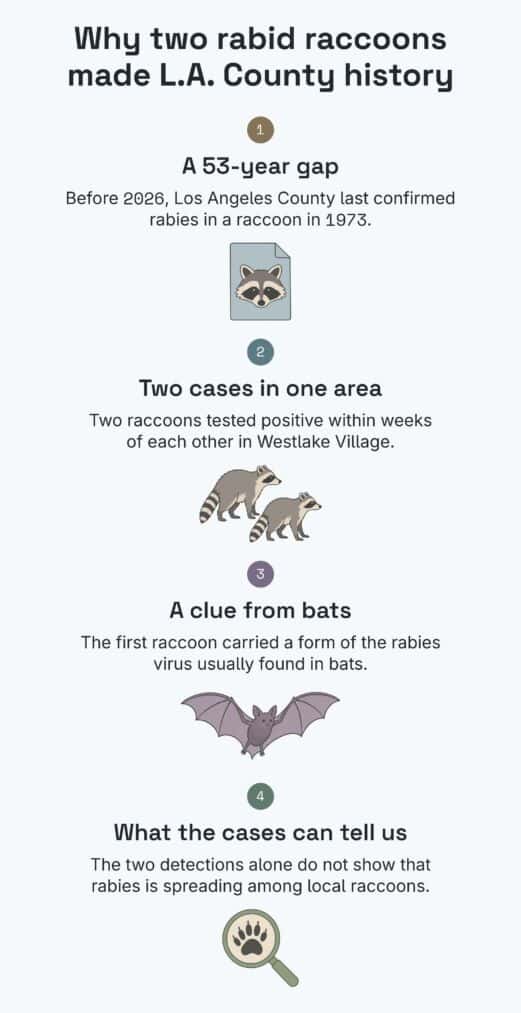
However, it proved to be only the 2nd the Los Angeles rabid raccoons identified over the past 30 days.
This followed news that the city had identified its first rabid raccoon in over 50 years. The initial raccoon tested positive for a bat-derived form of the disease.
Despite this, the identification of the second raccoon left open further areas of ambiguity regarding rabies in the region’s wildlife.
Bat-derived clues pointed toward a broader source
All forms of rabies are capable of causing disease across a range of mammalian species.
Accordingly, the identification of a bat form of the disease in the first raccoon points to a probable source of the infection being a rabid bat.
This provides the strongest indication yet of how the animal became infected.
Such cross-species transmission has been observed in LA County previously. In past cases, bat-derived strains have spilled over to other wildlife and livestock.
Strain testing for the second raccoon remains pending.
Attention centered on a single Westlake Village neighborhood
Both instances took place in the vicinity of Westlake Village, approximately 4 weeks apart.
Health Department workers conducted house-to-house visits to inform local households of the situation.
Given that no further instances of rabid raccoons have been recorded in the County since 1973, the significance of the 2 recent cases is notable.
Prior to these findings, the previous rabid raccoon detected in the County carried a skunk-derived strain. That strain has not been detected since 1979.
Ground reports offered reassurance but few answers
The second raccoon was sighted on private property and noted to be exhibiting signs of illness.
It subsequently displayed aggressive tendencies, prior to testing returning a positive result.
There was no known contact between humans or their pets and the animal.
However, two individuals working in the vicinity were advised to seek post-exposure prophylaxis.
Los Angeles County indicated that there is insufficient evidence to suggest rabid raccoons have established a self-sustaining population in the area.
The City of Westlake Village similarly attributed the cases to presumed spillover from bats.
Missing exposure records leave critical gaps behind
Once a sample is submitted for analysis, there is limited scope to determine the events leading up to its identification.
Obviously, the presence of the pathogen and, potentially, the type of strain can be determined. But the inciting incident will go unrecorded in many instances.
Detecting rabid animals in the wild is largely a passive process, often triggered when they exhibit unusual behavior or interact with humans.
As a result, it is difficult to ensure comprehensive coverage of all affected populations.
Growing bat detections complicated the emerging picture
The majority of rabies-related incidents in LA County relate to bats.
Over the last 10 years, the number of confirmed rabid bats in LA County has steadily increased.
This calendar year produced a record 77 confirmed cases.
Rabid bats are most commonly detected during the latter half of the year. However, they can be encountered at any time.
The potential for rabies to spill over into other animals remains year-round.
Public precautions remain unchanged during ongoing review
The core message to the public continues to be to avoid handling strays and report any animals showing suspicious symptoms.
Pet owners should also ensure their dogs and cats are vaccinated against rabies.
These measures will apply regardless of the form of the disease detected in the 2nd raccoon. They will remain in place until further information becomes available.
Ultimately, the presence of rabies within local wildlife is no longer in doubt.
The focus now turns to establishing if these two animals are merely two examples of cross-species transmission, or the precursor to a wider trend.
Read the whole thing?
Get the week's signal, not the noise
Our sharpest reporting on energy, climate and nature — free, once a week.


