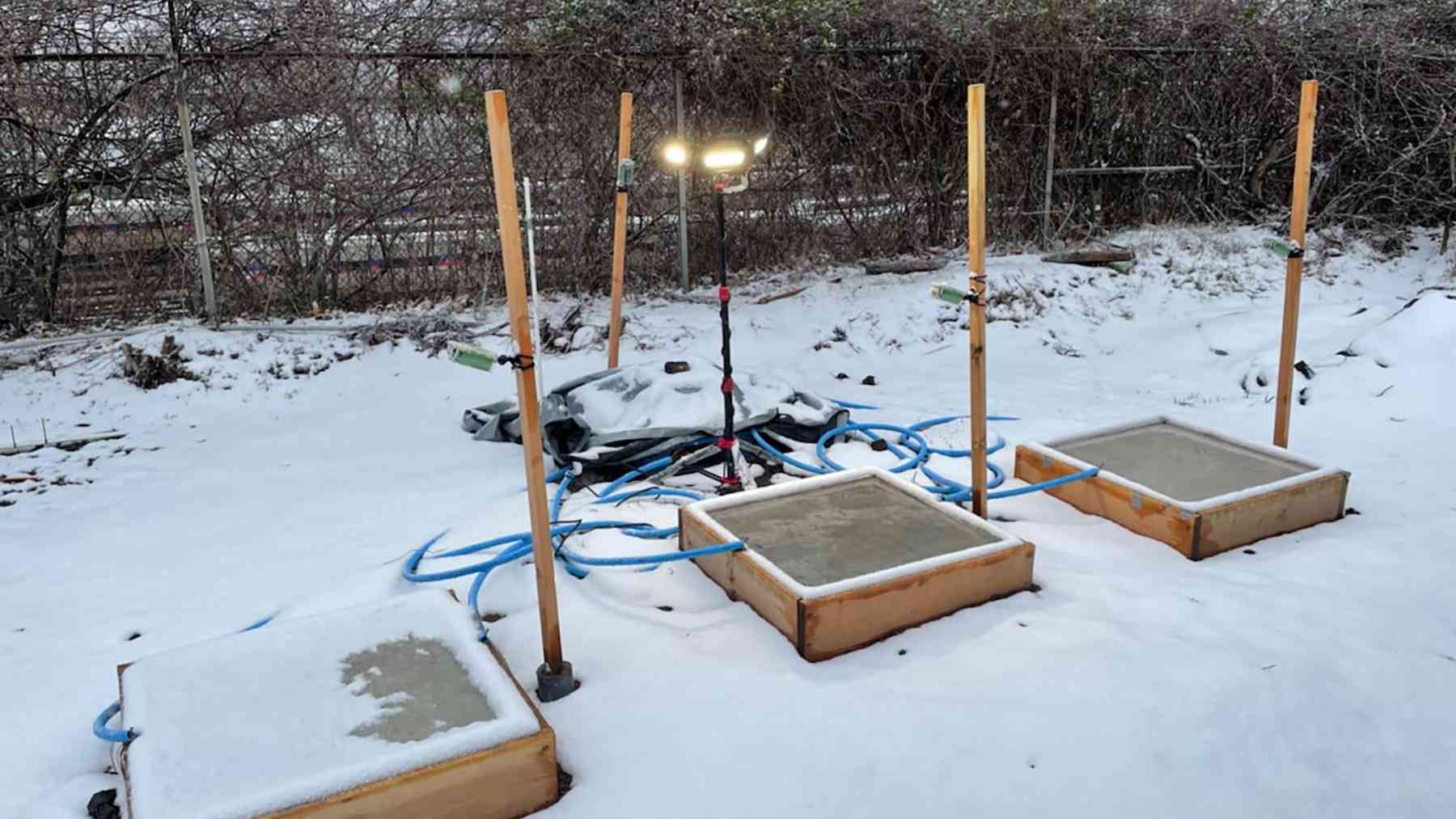
Snow falls on a quiet parking lot on a university campus, and three squares of concrete sit side by side in it.
One is buried in white.
The other two are not.
No one has come out with a shovel or a bag of salt.
The two bare slabs have been doing something on their own since before the storm started, holding a hidden store of heat that the third slab simply does not have.
The question is what is sitting inside them.
A wax hidden inside the stone gives off heat as it freezes
The trick sits inside the small stones and pebbles that normally just add bulk and strength to concrete. Engineers treated that porous lightweight aggregate with paraffin, letting the stone absorb the liquid before it was mixed into the concrete, turning ordinary gravel into tiny wax filled sponges spread through the slab.
Paraffin is a phase change material. As it turns from its room temperature liquid state into a solid when temperatures drop, it releases heat rather than cooling in a straight line the way plain rock does. The slab’s temperature stalls instead of falling, and the wax keeps feeding warmth into the surrounding concrete while everything nearby keeps dropping toward freezing.
A second version skips the stone entirely. Micro capsules of paraffin are mixed directly into the concrete, giving a faster but shorter burst of heat than the soaked aggregate manages. The team also noted that the porosity of the aggregate likely keeps the paraffin liquid below its usual freezing point of 42 degrees Fahrenheit, holding its heat release back until the material reaches 39 degrees.
The treated surface melts snow about as fast as a light storm drops it
The slabs carrying phase change material begin melting snow as soon as it starts to accumulate. That self heating lets the concrete melt snow at a rate of about a quarter inch per hour, enough to handle snowfalls up to two inches. A blizzard is well beyond it.
There is a second limit built into the physics. If the phase change material does not get time to recharge by warming enough to return to its liquid state between freeze thaw or snow events, its performance can be diminished. A run of grey, sub freezing days gives the wax nothing to reload with.
Sensors logged 10 hours above freezing across two winters of testing
The team did not stop at a lab bench, and that distinction matters. Two 30 inch by 30 inch slabs have been warding off snow, sleet and freezing rain on their own, without shoveling, salting or scraping, tucked next to a parking lot for the university’s facilities vehicles. All three have been outside in the elements since December of that first winter.
The researchers poured one slab using each method and a third without any phase change material, as a control. In the first two years they faced 32 freeze thaw events and five snowfalls of an inch or more.
Using cameras and thermal sensors, the team reported that the phase change slabs held a surface temperature between 42 and 55 degrees Fahrenheit for up to 10 hours when air temperatures dipped below freezing. The two paraffin methods did not perform identically. The treated lightweight aggregate slab was better at sustaining its heating, staying above freezing for up to 10 hours, while the microencapsulated slab heated up more quickly but maintained the warming for only half as long. That work appeared in the American Society of Civil Engineers’ Journal of Materials in Civil Engineering.
A follow up study tracked moisture levels across multiple winters
Even so, the campus patch was only a start. A newer study led by the college’s advanced infrastructure materials lab validated performance outside the lab in Philadelphia winters, monitoring outdoor test slabs across multiple winters alongside matching environmental chamber trials, much like the long run durability tests crews have run on a Texas highway repaved with shredded plastic in its asphalt.
That follow up work also tracked something beyond warmth. Specimens with phase change material in the aggregate took up water more slowly and maintained a lower overall moisture level than the reference and microcapsule mixes, which matters because trapped water is exactly what cracks pavement apart during a freeze. The lab’s lead researcher said that when paraffin is loaded into porous lightweight aggregate, “the pores act like micro reservoirs.”
Scaling beyond one parking lot slab remains the open question
None of this means plows and salt trucks are done. The technology works on a small patch near a parking lot, and scaling it to miles of highway is a very different engineering problem involving cost, reinforcement and the sheer volume of material needed.
Mechanical tests showed strengths on par with conventional concrete for the aggregate mix, an encouraging sign for anyone worried that stuffing wax into stone might weaken a sidewalk meant to bear traffic for decades. The researchers note that performance depends on local weather and on the material recharging between cold events.
Ongoing monitoring will refine design targets, including how much phase change material to use and how best to integrate it with standard paving practices, the same questions that shadow the plastic infused road surfaces other labs have tried on real streets. What started as three squares of concrete beside a maintenance lot is now a field record that grows one winter at a time.
Read the whole thing?
Get the week's signal, not the noise
Our sharpest reporting on energy, climate and nature — free, once a week.