
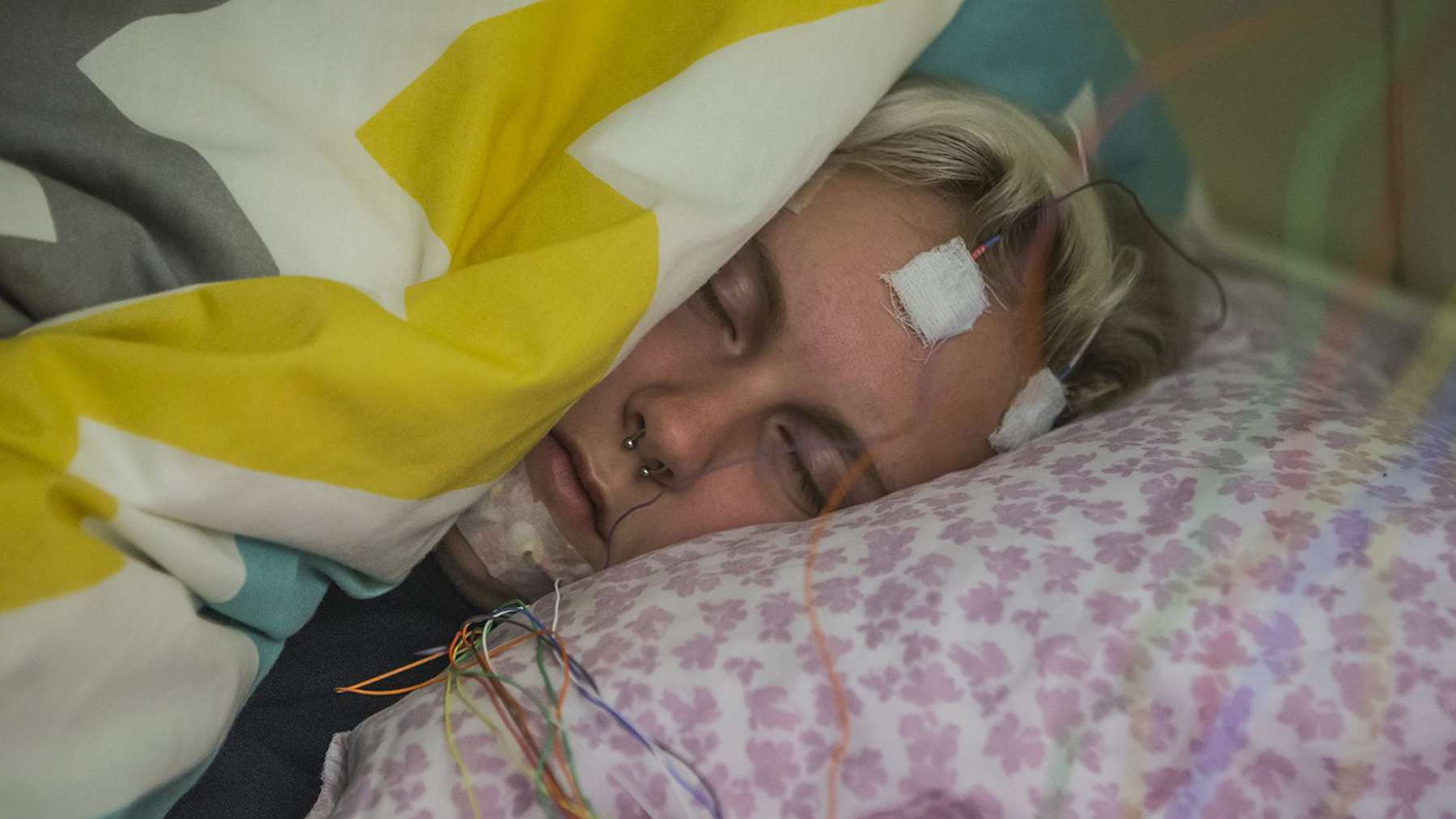
A young volunteer lies still on a narrow bed, a cap of wires running from the scalp down to a monitor nearby.
Minutes earlier, the same person had been wandering a glowing maze on a computer screen, hunting for a way out.
Now the lights are low and the task is simply to sleep.
Nobody expects the nap itself to be the interesting part.
What happens in the dream is.
So the question becomes what a sleeping brain is actually doing with a maze it only just learned to walk.
The brain keeps rehearsing the maze after the lights go out
The mechanism researchers were chasing is simple to picture even if it sounds strange. When a person learns a new layout, the brain networks that fired while walking the maze keep firing afterward, with the lights off and the task abandoned. The idea came out of rodent work, where the same patterns of neural activity appear during maze running and during the sleep that follows.
Sleep researchers call this offline reactivation, a kind of replay that runs without anyone deciding to think about anything at all. That replay does not always rise into awareness, and the step from replay to dream remains an inference rather than a demonstrated chain. The team behind this work has written that it does not propose dreaming of a learning task “causes improved memory.”
Most nappers drifted off and reported nothing related to the maze when woken. But in a handful, the maze surfaced as an actual dream about the maze itself, and even then it was rarely a faithful replay. People described seeing figures at checkpoints, being lost in a bat cave, or simply hearing the game’s background music.
Those were the volunteers whose scores jumped. The dreaming was not decoration on top of sleep, it looked like a visible sign that the underlying replay had been unusually strong that particular nap.
A glowing screen maze inside a dim lab bedroom
The setting was a hospital sleep laboratory attached to a medical school in Boston, dim, with a bedside monitor, a tangle of wires and a narrow bed. Volunteers first learned a three dimensional computer maze, hunting through its corridors and trying to fix the position of one particular landmark, a tree, in their heads.
Electrodes were already taped to their scalps, ready to catch whatever activity came next once the room settled into stillness. Those napping were prompted, plainly, to report “everything that was going through your mind.”
Most said nothing maze related at all. A small handful did, and that handful is where the real surprise in the data showed up.
Ninety minutes of sleep produced a tenfold gap in scores
Of the 99 participants, 50 had the chance to nap while the rest watched videos and stayed awake. Researchers used electroencephalography to monitor the napping volunteers and prompted them for reports three times across the 90 minute sleep opportunity, including at sleep onset and at the end.
As a group, the nappers improved more at the maze than the video watching group, which alone was not surprising given decades of sleep and memory research. What nobody had isolated so cleanly before was the dreaming subgroup.
The four students who reported thoughts of the maze while falling asleep, or actual dreams of the maze during the nap, improved on their previous performance about ten times more, on average, than other nappers did, the researchers reported in Current Biology. Those four were a tiny slice of the sleepers, and the authors said so.
The weakest performers before the nap gained the most
The four were among the weakest performers during training, and even after their poor baseline was taken into account their improvement stood out from other weak starters. The lead author’s reading is that difficult material is what a sleeping brain prioritizes, which is an interpretation offered by the researchers rather than a measured mechanism.
A second version of the nap protocol replaced open ended reports with a forced choice questionnaire about mental content. Twelve of the twenty two sleepers who answered it said maze related content had been on their minds, and they improved significantly more at retest than the ten who said it had not.
Years later the same two researchers ran the study again with an overnight sleep protocol instead of a short nap. Maze content turned up in dreams reported from every phase of the night, and unambiguous task content went with better next morning performance, leaving open why some brains let the replay surface as a dream while others process the same information without a trace.
One overnight repeat still found just four dreamers
The original study ran well over a decade ago, and its central finding has held up in that overnight repeat, which used the same basic setup: a simple maze, sleep, and a dream report instead of an expensive scanner. At least one other group has looked for the same effect and failed to find it. The approach also migrated south, where undergraduates now spend overnight sessions in electrode caps at a South Carolina liberal arts college.
The caveat is size. Four dreaming volunteers out of fifty nappers is a small group to build a tenfold claim on, and the researchers have been careful to frame the dream as a readout of memory processing rather than the thing doing the processing.
Even so, the pattern reappeared in a full night version of the experiment, which is more than many single lab findings can claim. For now the lesson is modest and strangely comforting, the maze a person walked that afternoon might still be winding through their head at midnight, and whether they remember the dream at all could matter more than whether they slept well in any ordinary sense.
Read the whole thing?
Get the week's signal, not the noise
Our sharpest reporting on energy, climate and nature — free, once a week.


