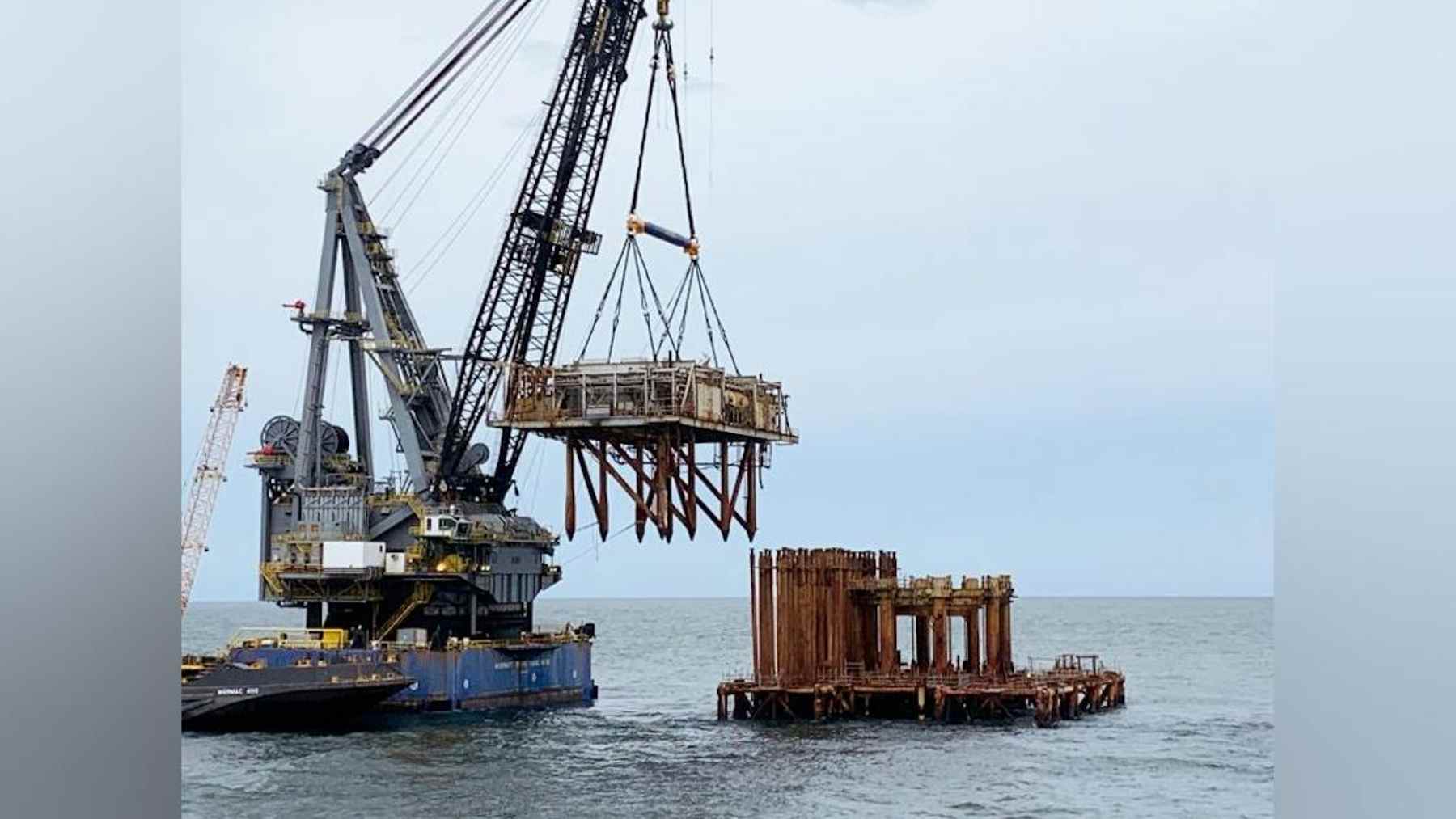
Out past the Louisiana coast, steel that once carried drilling equipment sits tipped on the seabed.
It never left the Gulf.
Most of its kind do.
Federal law says a spent platform has to come all the way out.
Some stay, on purpose, as habitat for fish.
The question is why the rule bends for so few.
A legal exception lets some platforms stay for good
The mechanism is simple once you see it. Under federal decommissioning rules, an operator must remove platforms to at least 15 feet below the mudline within one year after the lease ends, unless those facilities are approved for another use. That alternative is the opening every reefed structure slips through.
A retired platform would normally go to shore for scrap. Instead it can become a permanently submerged artificial reef under the Rigs to Reefs program, using one of three methods: cut and toppled in place, towed to a permitted reef site, or partially removed.
The exception is not automatic. Complex, stable and clean platforms are the usual candidates, and companies that donate a structure pay the state a share of the savings in exchange for taking on liability. Gulf states typically collect up to half of that projected savings.
Barnacles and bottom fish claim the standing steel
Picture the jacket after it topples. The lattice of beams that once held machinery is scoured by current and crusted with growth, rising off a seafloor that otherwise offers almost nothing like it for miles.
That height is the real advantage. In the northern Gulf, platforms supply most of the vertical relief and hard surface that red snapper and other reef dependent fish need, in a region dominated by sand, silt and mud. Younger snapper hold shallower on a platform and older fish sit deeper, so a single jacket offers far more usable habitat than the scarce flat natural reefs nearby, most barely a yard off the bottom.
Grouper and amberjack hold in the same shade. The deepest sections stay cool and dark, and that fish biomass is exactly why state agencies push to leave the steel in place.
Only 11 percent of removed platforms became reefs over three decades
Here is where the assumed number breaks down. Readers who have heard of Rigs to Reefs sometimes picture it as the default outcome for a retired platform, mostly because it is the version that gets photographed.
The federal tally tells a different story. From 1987 through 2019, 558 platforms were reefed Gulf wide while 4,736 were hauled to shore, an overall reefed share of about 11 percent. As of 2021, more than 600 platforms had been converted to permanent reefs. The share also swings hard with depth: barely 1 percent of platforms in under 100 feet of water were reefed, against roughly 63 percent of those past 200 feet. Louisiana alone had converted 350 platforms as of 2017.
So the common assumption gets the direction backward. The exception photographs well. The rule still sends most of the steel to a scrapyard.
Four years of permitting decide which jackets qualify
Not every structure is a candidate. Regulators weigh depth, the condition of the steel and conflicts with navigation or future leases, and donating a rig to a state program can take two to four years of permitting work.
Age complicates things further. A jacket coated in decades of barnacles and sponge is heavier and harder to handle than a bare one, yet that same growth is exactly what fishing and conservation groups cite when they argue for leaving it down.
The ecology is not settled. Researchers note that what happens to fish on a platform after decommissioning is uncertain, and that densities on nearby reefs likely rose as platforms disappeared, the same open question behind why reservoirs hold far more fish than their surface suggests.
An accidental afterlife built from decades of pumping
Zoom out and the oddity sharpens. An industry built to pull resources out of the seafloor has left behind some of the Gulf’s most reliable fish structure, simply by not hauling every jacket home. Nobody designed these platforms to be reefs.
That accidental afterlife now sits beside a newer habit of engineers deliberately building structures meant to double as habitat from the start, the same thinking behind redesigned barriers tested in cold water settings far from the Gulf.
Reefing stays a minority outcome, shaped by depth, distance to a permitted zone, cost and permitting time more than any grand plan for ocean recovery. For the platforms that do stay, the steel keeps standing in open water long after the wells beneath it went silent.
Read the whole thing?
Get the week's signal, not the noise
Our sharpest reporting on energy, climate and nature — free, once a week.