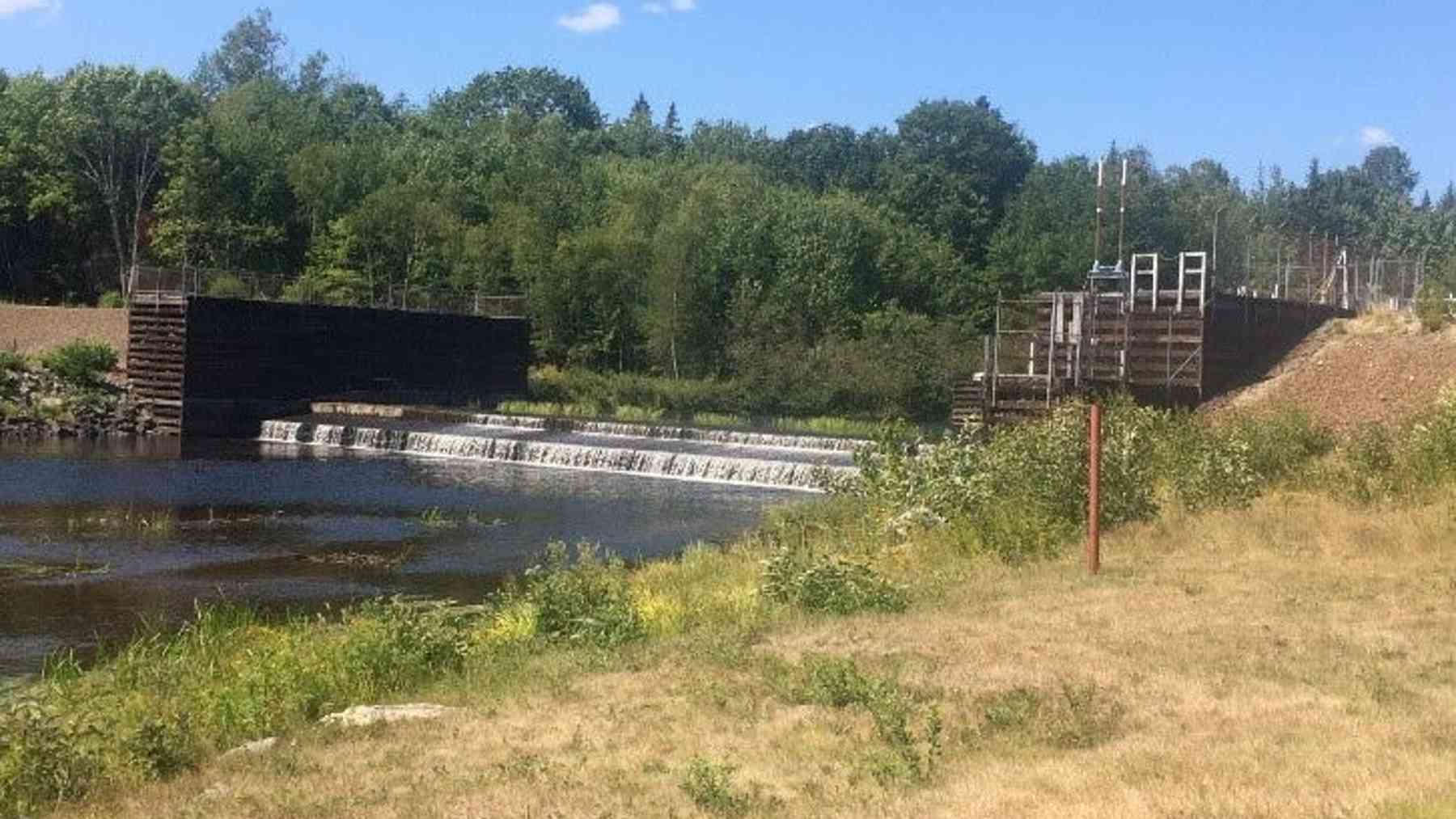
The pond behind the old dam in Cherryfield, Maine had been flat and still for six decades.
This year it dropped.
In its place sits a staircase of boulders.
Water now tumbles down in steps instead of pooling behind concrete.
The climb a migrating fish faces has changed shape entirely.
What made that climb possible is the whole story.
A dam built for ice became a wall for fish
The structure that came down was never meant to stop salmon in the first place. It was built to hold back river ice before it could jam downtown Cherryfield and flood the streets.
For decades it did exactly that job while quietly becoming the last mainstem barrier on the whole river. It stood 7 feet tall, which sounds modest until a fish has to clear it after swimming in from the Atlantic.
A fish ladder ran up one side, and alewives navigated it relatively well. Other sea run species fared worse, with American shad and salmon far more likely to be blocked or delayed at the base, so engineers designed a replacement that keeps the ice control but removes the wall, a channel spanning run of boulders and resting pools that gains the same height over a much longer, gentler distance, built to carry every species that once hit the dead end.
Stacked pools carry fish up 7 feet one step at a time
The new fishway works less like a ladder and more like a staircase cut into the riverbed itself. Instead of one sheer drop, the water falls through a series of shallow pools lined with boulders, each one giving a tired fish a place to pause before the next push. The pond above it is held at its old level, so the town keeps the flood and ice protection it has relied on for decades.
The slope through the new channel is far shallower than the old dam’s face, which matters most for species that cannot leap the way salmon can. Shad in particular struggled at the old structure.
Which is why the gentler grade was built with weaker swimmers in mind, alongside the alewives, blueback herring, sea run brook trout and American eels that share the same stretch of water, a lineup that now gets an easier passage upstream.
Construction crews raced a mid October deadline
Reconstruction began on July 15, inside a permit window that required the demolition and the new channel to be finished by October 15, a schedule set to keep heavy work clear of migrating fish. Water first trickled into the newly formed pools in late September, while crews held the river to a minimum flow through a bypass channel.
The Army Corps of Engineers built the dam in 1961, and it stood for more than 60 years before the stepped pools replaced it. The main stem of the river runs about 40 miles from its source in the Down East lakes to its head of tide in Cherryfield, right where the old wall used to sit.
Local officials had pushed for a fix for years before the design came together. Inspections showed the dam aging, and the town could not afford the repairs on its own. “Something had to be done,” said Cherryfield selectman Corey Smith.
So the project leaned on groups that rarely share a single construction site, a conservation nonprofit, a land trust, a national conservation organization and the town’s own select board, working with $9.1 million in federal restoration funding behind the same boulder plan.
515 miles of river sat behind a single 7 foot wall
Federal reviewers of the project put the gain at 515 miles of river and stream habitat in the Narraguagus, opened to Atlantic salmon and the other sea run fish that use the watershed.
That number covers the upper network of lakes and tributaries that fish could reach only by squeezing through an aging ladder on one side of a single low wall. For more than sixty years, that ladder was the whole gate.
Even so, the scale of what is coming back is modest. In recent decades, only about 25 wild adult salmon have returned to the Narraguagus each year to spawn, a run so small that returns are counted fish by fish. Biologists follow them with the same individual attention given to the Devils Hole pupfish tallied in a single desert spring in Nevada.
What the river’s first real winter will test
Nobody will know how many fish actually use the new channel until the spring runs begin, and conservationists are candid that a warming Gulf of Maine could blunt any rebound no matter how good the passage looks on paper. Warmer water and shifting ocean conditions remain outside anyone’s control.
Still, the work closes a chapter that started with flood control and ends with a main stem reopened end to end. It echoes what another Maine effort found when it tested mussel farm rope to help young eels climb past a different barrier, evidence that small design choices on old infrastructure can carry outsized consequences for the creatures swimming beneath them.
For a river that holds some of the highest quality Atlantic salmon habitat left in the eastern United States, 515 miles of open water is now simply there, waiting to see who finds it first.
Read the whole thing?
Get the week's signal, not the noise
Our sharpest reporting on energy, climate and nature — free, once a week.