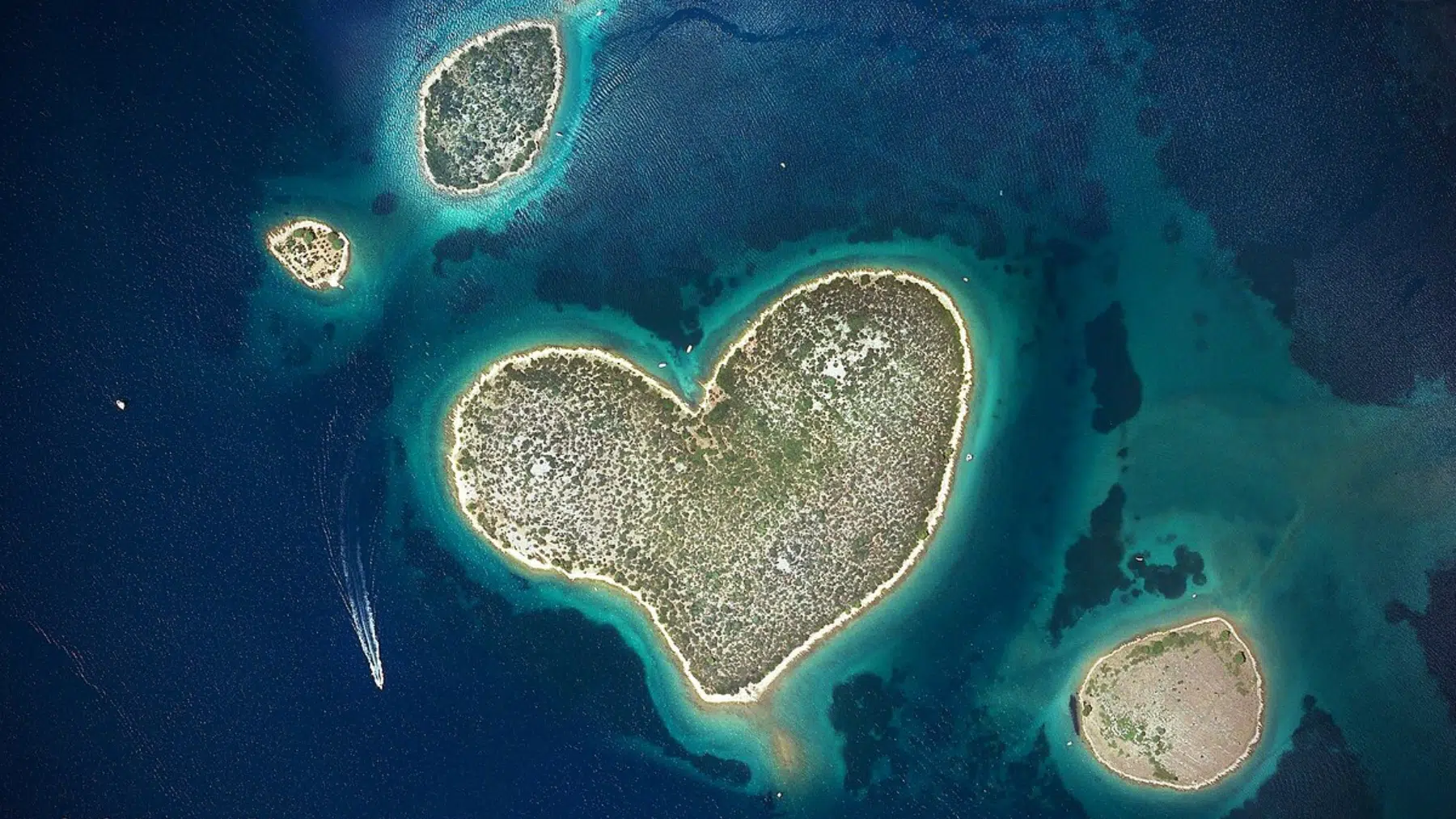
If you have seen and heard about a heart-shaped island and questioned whether or not it is true, the answer is yes, it is true, and it does exist. It is not a myth or a fairytale. It is a place where many in love go and visit, either to celebrate their honeymoon or anniversaries. It has become a place of love, fascinating to the eye and provides a soothing, calm, and peaceful feeling.
Every lover in the world gets a tingle when they see this island in Croatia. It is deserted and has a limited surface area. The island is known as Galesnjak (Galešnjak), and its distinctive appearance—it is heart-shaped—sets it apart from thousands of other islands worldwide.
Galesnjak: An Adriatic wonder with a naturally heart-shaped shape
In Croatia’s Pašman Channel sits the little, deserted island of Galesnjak. Its striking resemblance to a heart—a shape organically produced by erosion and geological processes—is what distinguishes it. Although many islands have distinctive shapes, none are as symmetrical and eye-catching as Galesnjak. It has gained global recognition and is a place to be for many lovers.
When Google Earth captured Galesnjak’s distinctive shape in 2009, it initially attracted popular attention. However, Napoleon’s cartographers produced the first map of the island at the beginning of the nineteenth century. The island was then featured in the 1806 Atlas of the Dalmatian Coast, but it’s safe to assume that Galesnjak’s brief moment in the spotlight was caused by Google.
Why Galesnjak is celebrated as a symbol of love
First of all, the island’s shape is what has given it a name and made it celebrated as a symbol of love worldwide. Young men frequently pick Galesnjak as the location for their proposal, and many visit the island for honeymoons and significant anniversaries. One may argue that the island has a certain air, a charm that is almost magical and draws lovers.
The island is now known as “the island of love” or “lovers’ island,” and it is a very well-liked vacation spot for couples. Even though there is little infrastructure, people still go there to enjoy the beauty of the area and simply to relax and enjoy their significant other. Additionally, this island maps back to the 19th century, and that is when its unique shape was first formally documented.
What to do and expect when you get to the island
What are your options at Galesnjak? The island is uninhabited, as we have already stated; neither tourist amenities nor man-made structures are present. However, the island’s wild, adventurous vibe and the fact that it’s a remote, calm, and tranquil spot where no one will bother you—in contrast to other Croatian tourist destinations that are typically crowded with visitors—are what draw people there. It’s the ideal setting for making lots of romantic memories.
There are several pebble beaches on the island; while they are not the best in Croatia, they are nevertheless nice enough for a romantic dip. The emerald-blue Pasman Channel sea encircles Galesnjak, contributing to its paradisiacal ambience. The majority of visitors wish they could stay for a few days, but since there is no lodging on the island, it is not feasible. Consequently, camping is not permitted on the island, as fires and overnight stays are prohibited on the Mediterranean scrubland that covers its grounds.
Some of the challenges related to preserving and maintaining a unique landmark
Everything, natural or unnatural, has some sort of obstacle that always comes along. An increase in tourists could endanger the island’s fragile ecology. In order to preserve Galesnjak’s allure for future generations, efforts are being made to strike a balance between tourism and conservation, setting rules that help keep the landmark natural and consistent.
Read the whole thing?
Get the week's signal, not the noise
Our sharpest reporting on energy, climate and nature — free, once a week.